
Choose a Packable Boat That Fits Your Water, Load, and Routine
Match construction, hull shape and capacity to your water, trip length, crew, load, storage and transport routine, then verify the exact model.
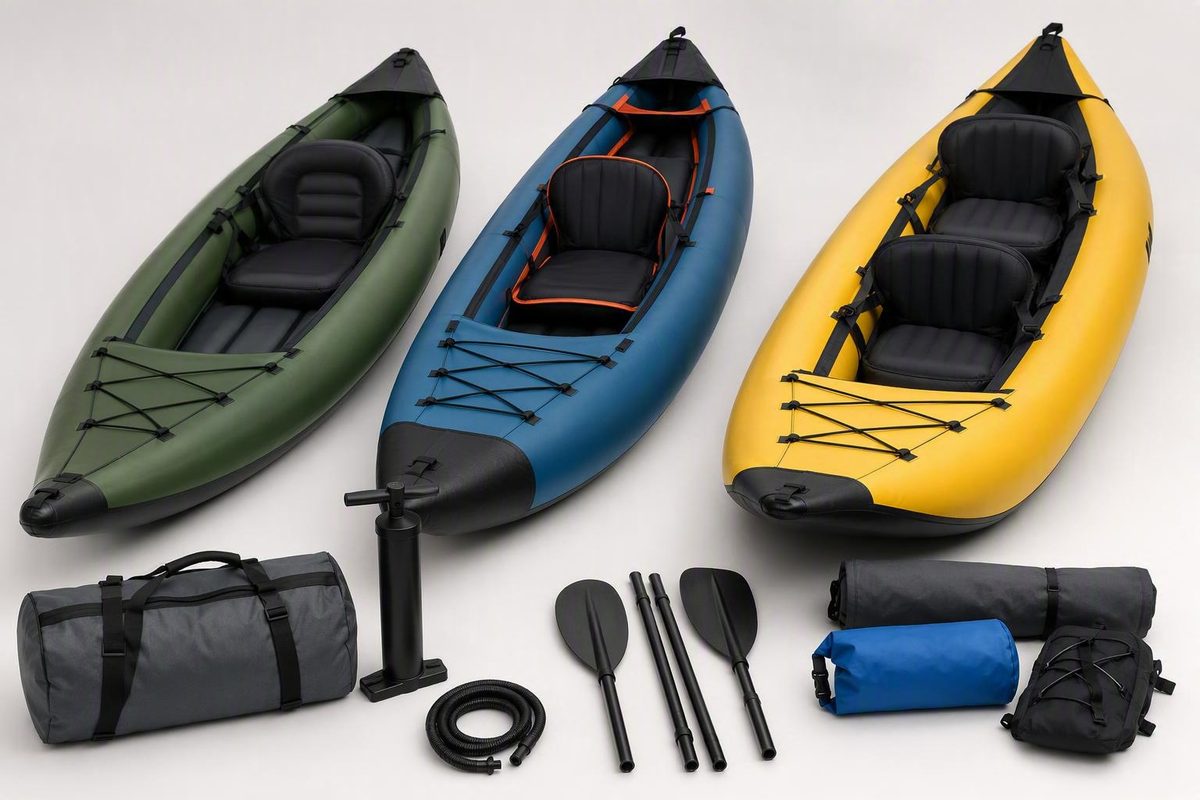
An inflatable kayak can solve a practical problem: owning a capable small boat when a rigid hull is difficult to transport or store. But “inflatable” describes a construction method, not one type of paddling. A compact recreational kayak, an efficient touring boat, a gear-heavy fishing platform, and a self-bailing river kayak make very different compromises.
The right choice therefore starts with your water, trip length, crew, load, storage, and transport routine—not a universal product ranking. Define those needs first, then compare exact models by construction, hull shape, pressure, outfitting, package contents, operating restrictions, and price.
Start With the Water: A Five-Minute Buying Decision
Answer these six questions before opening product pages:
- Water: Sheltered flatwater, slow current, ordinary river features, technical whitewater, surf, or exposed open water?
- Trip length: An hour near shore, a half day, or loaded all-day and overnight travel?
- Frequency: A few vacation outings or regular use throughout the season?
- Crew: Always solo, always tandem, or alternating between the two?
- Load: What is the combined weight of paddlers, clothing, safety equipment, food, water, and other gear?
- Logistics: How far must you carry the complete package, where will the boat dry, and how much storage space do you have?
Those answers create the first useful split.
If you expect short, occasional outings on sheltered lakes
Begin with recreational designs. A simple, wide kayak may be sufficient for unhurried paddling near shore in suitable weather, while keeping the purchase price and packed burden manageable.
“Recreational” and “beginner-friendly” are not safety ratings. Confirm the exact model’s water restrictions, pressure limits, occupancy, capacity, and operating instructions. A calm-water kayak does not become suitable for rivers, surf, or exposed coastal water simply because it has multiple chambers or comes from a familiar brand.
If you expect frequent flatwater trips or longer distances
Prioritize efficient shape and paddler connection rather than maximum width. Compare:
- A relatively long, streamlined hull
- A functional skeg, fin, keel, or shaped bow
- Enough rigidity to resist excessive flex under the intended load
- A supportive, adjustable seat
- Foot braces within your adjustment range
- Usable cargo space after everyone is seated
- A complete packed package you can carry
Wide, flat hulls generally emphasize initial stability, while longer or more defined hulls generally favor tracking and efficiency. Touring buyers should treat “hardshell-like” as a marketing comparison until the boat’s dimensions, construction, pressure, outfitting, and intended conditions support it.
If fishing is the priority
Look first for initial stability, a clear working area, secure attachment points, paddle storage, seat comfort, and realistic capacity for both the angler and equipment. Consider whether tackle is reachable without an excessive weight shift and whether exposed fabric can be protected from hooks.
Expect a compromise. Decide whether you will paddle several miles or fish mainly near the launch.
If two people will share the kayak
Capacity is only the first filter. Check:
- Whether both seats can be repositioned
- Whether the manufacturer expressly permits solo use
- Where the solo paddler sits relative to the balance point
- Whether foot braces work in each approved layout
- How much legroom remains with both paddlers aboard
- Whether cargo can be secured without blocking entry or exit
A high maximum load does not prove that a tandem will balance or steer properly with one person occupying a fixed front or rear seat. If solo use matters, require movable seating or a manufacturer-approved solo configuration.
If you want to paddle whitewater
Choose a purpose-built river inflatable rather than a recreational boat carrying an optimistic category label. Examine rocker, abrasion protection, seating and bracing, drainage or self-bailing arrangements, grab points, chamber layout, and the exact model’s rapid rating.
A rating is only a preliminary filter. Boat size, river volume, gradient, hazards, paddler ability, equipment, and rescue options still matter. Sea Eagle Explorer, STAR, AIRE, Tributary, and NRS lines include river-oriented choices, but suitability must be checked by exact model and size rather than inferred from the brand.
Treat specialist water as specialist water
Surf, exposed lakes, coastal passages, open crossings, and technical rivers increase the consequences of wind, waves, current, cold water, and equipment problems. Strong material alone does not establish suitability, nor does a broad reference to “ocean” or “whitewater” use.
If these environments are central to your plans, seek model-specific guidance and practical instruction. A kayak that works on a protected bay in settled conditions may be inappropriate beyond shelter.
When another boat type makes more sense
An inflatable kayak is not automatically the best portable craft.
- Choose a hardshell when speed, edging, immediate launch readiness, or demanding-water performance outweigh storage and transport difficulties.
- Choose a folding kayak when compact storage and a defined frame-and-skin hull appeal to you, and assembly time is acceptable.
- Choose a modular kayak when you can store rigid sections but not a full-length hull.
- Choose a packraft when carrying the boat overland is central to the trip.
- Choose an inflatable canoe when you prefer a higher seating position, single-bladed paddle, or open cargo area.
The useful question is not whether inflatables beat every alternative. It is which compromise creates the least friction in your actual routine.
Models to Compare by Use Case—Without Pretending One Is Best for Everyone
The models below are research leads, not Kayaks Hub test winners or endorsements. Editorial selections reflect each publisher’s criteria; manufacturer specifications and retailer catalogs serve different purposes. If a current first-party product page, manual, or operating rating cannot be found, treat the model as a historical example rather than an active recommendation.
| Use case | Model or line to investigate | Why it belongs on the research list | Source and evidence type |
|---|---|---|---|
| Calm-water recreation and value | Razor Kayaks R1 Ultra | The Equipment Guide selected it as its value choice and reported a weight of 18 pounds and a price of $845 when Kayaks Hub checked the publisher’s historical figures on September 5, 2026 | The Equipment Guide — third-party editorial pick |
| Calm-water recreation and budget | Advanced Elements AdvancedFrame | Selected by Paddling Magazine for shorter trips and calmer water; its capacity is conflicting in the supplied comparisons and must be verified | Paddling Magazine — specialist editorial pick |
| Touring | Advanced Elements Expedition Elite | The Equipment Guide’s touring selection; compare current seat support, foot braces, usable load, packed dimensions, and package weight | The Equipment Guide — third-party editorial pick |
| Flatwater touring | Sea Eagle 385ft FastTrack | Paddling Magazine’s flatwater pick, citing a V-shaped structure, drop-stitch floor, and removable stern fin | Paddling Magazine — specialist editorial pick; Sea Eagle — manufacturer specifications |
| Fishing | Sea Eagle 385 FTA FastTrack Angler | The Equipment Guide’s fishing selection, characterized as a stability-oriented platform rather than a fast kayak | The Equipment Guide — third-party editorial pick |
| Fishing | BOTE LONO Aero | Paddling Magazine’s named fishing pick; the supplied excerpt does not include the complete evaluation | Paddling Magazine — specialist editorial pick; BOTE — manufacturer catalog |
| Whitewater | AIRE Hot Potato | Paddling Magazine’s whitewater pick, with a short, rockered form and river-oriented construction | Paddling Magazine — specialist editorial pick |
| Tandem river or convertible use | Nyce Haul | Paddling Magazine’s tandem river pick; listed with movable backrests and a removable high-pressure floor for tandem or solo configuration | Paddling Magazine — specialist editorial pick |
| Tandem and multi-person catalog search | BOTE, Sea Eagle, Aquaglide, and NRS | Their catalogs contain tandem or multi-person choices, but the approved crew, package contents, and intended water vary by model | Manufacturer catalogs for BOTE, Sea Eagle, and Aquaglide; NRS manufacturer-retailer catalog |
| River-model catalog search | Sea Eagle Explorer, NRS, STAR, AIRE, and Tributary | Purpose-oriented options to filter by exact size, drainage, outfitting, and water rating | Sea Eagle manufacturer catalog; NRS manufacturer-retailer catalog |
The Equipment Guide also named the Razor Kayaks Edge Pro 1 its best-overall choice and reported a price of $1,249 when checked on September 5, 2026. Its quick-picks section scored the boat at 96, while its detailed entry gave 97. The score is therefore unresolved and should not be presented as a settled figure.
Keep similarly named variants separate. The standard Sea Eagle 385ft FastTrack is the Paddling Magazine flatwater selection; the 385 FTA FastTrack Angler is the heavier fishing configuration selected by The Equipment Guide. Do not transfer a weight, feature, price, or recommendation between them.
Pakayak Bluefin and Oru products sometimes appear in broad portable-kayak comparisons, but they do not belong in the core inflatable shortlist. Pakayak is modular, while Oru produces folding craft. Both can still be relevant alternatives for buyers who want portable rigid or semi-rigid structures.
Current catalogs also show that named brands cover different parts of the market. Sea Eagle organizes models into recreational, touring, fishing, and river-oriented lines, while the NRS catalog includes NRS, STAR, AIRE, and Tributary boats across solo, tandem, youth, flatwater, fishing, and whitewater categories. These catalog classifications are starting points, not independent evidence that a model suits your water.
Before ordering any named kayak, verify:
- Exact model year, size, and package
- Current dimensions and hull weight
- Maximum capacity and approved occupancy
- Packed dimensions and total package weight
- Current price, inventory, delivery status, and return rules
- Included paddle, pump, seat, bag, fin, footrest, and repair materials
- Pressure limit for every chamber
- Intended water and operating restrictions
- Current warranty
- Availability of valves, fins, seats, floors, and repair materials
This matters because the available comparisons contain malformed dimensions, conflicting capacities, and potentially duplicated specifications. Uncertain values should remain marked unresolved—verify with the current manufacturer manual, not silently corrected.
Construction Explained: What Changes as Price and Pressure Rise
Inflatable construction does not divide perfectly into fixed classes, but a broad progression helps explain why prices and ownership demands vary.
Low-pressure single-layer construction
Entry-level kayaks often use a relatively simple vinyl skin inflated at low pressure. They can be light, inexpensive, and adequate for occasional short trips in benign conditions. Their softer structure may also flex more under load and hold a less defined hull shape.
Fabric-covered bladder construction
Another method places air bladders inside a protective fabric shell. The cover can shield the bladders from routine scrapes, but it can also retain water and grit. Drying may take longer, especially when the outer layer and bladder are difficult to separate.
Reinforced PVC and higher-pressure chambers
More performance-oriented boats may use thicker or multilayer reinforced material, stronger seams and valves, and structures capable of higher pressure. Added rigidity can help the hull retain its intended shape, although it may also increase weight, folding stiffness, or pumping effort.
Razor Kayaks, a manufacturer with a commercial interest in the category, groups basic single-layer designs broadly around 1–2 psi, fabric-covered bladder designs around 2–7 psi, and reinforced high-performance designs around 7–12 psi. These are manufacturer-supplied category ranges—not inflation instructions or neutral industry standards—and hybrid boats may not fit them neatly. Razor Kayaks also describes the abrasion and drying trade-offs of these construction types.
What drop stitch means
A conventional air chamber tends to become rounded as pressure rises. A drop-stitch chamber contains many internal threads joining its opposite faces. Those threads limit separation, allowing the chamber to inflate into a flatter, more rigid panel.
Drop stitch can be used in:
- A removable floor between conventional side tubes
- An integrated floor
- Selected bow, keel, or hull structures
- Most or all of a full drop-stitch hull
These arrangements are not equivalent. A drop-stitch floor can reduce flex beneath the paddler without making the side chambers drop stitch or turning the complete boat into a hardshell.
Multiple chambers provide redundancy, not immunity
Independent chambers may preserve some flotation if one loses pressure. That redundancy does not eliminate punctures, failed valves, seam damage, swamping, flooding, or capsize. Chamber count should be considered alongside valve quality, material, repair access, and the ability to reach shore.
Pressure can also vary within one kayak. For the STAR Raven Pro demonstration, NRS specifies 2.5 psi for the side tubes and 8 psi for the drop-stitch floor. Those settings apply to that model and should not be copied to another boat.
Better materials, sound drop-stitch construction, and appropriate pressure can support rigidity, control, durability, and efficiency. Price alone does not prove that a kayak will be light, quick to assemble, comfortable, stable, or suitable for difficult water. Buy the construction that serves the intended hull and use—not the largest pressure number.
How Shape Affects Stability, Tracking, Speed, and Turning
Construction determines how well a kayak holds its form. Hull geometry determines what that form is intended to do.
Primary stability
Primary stability is the initial steadiness felt while sitting level. Wider hulls and flatter bottoms generally emphasize it by creating a broad platform. This can be useful when entering the kayak, fishing, taking photographs, or managing a passenger.
Width also brings compromises. A broad hull may have more wetted area, while wide side tubes can require a higher or less natural paddle stroke. The widest kayak is not automatically the safest because safety also depends on conditions, fit, freeboard, control, recovery options, and paddler ability.
Tracking and efficiency
Longer hulls generally resist turning more than short hulls and may hold direction more readily. A V-shaped bow, defined keel, or shaped hull line can improve directional behavior compared with a soft, flat form.
The trade-off is maneuverability. A long, directional kayak may take more effort to turn in confined water, while a narrower or V-shaped boat may feel less initially steady than a broad platform. These are design tendencies, not guaranteed outcomes; construction, loading, wind, trim, and fin configuration also matter.
Rocker and maneuverability
Rocker is the upward curve toward the bow and stern.
That shape is not optimized for straight tracking across a calm lake. A river kayak designed to change direction quickly may require more correction on flatwater.
Skegs, fins, and keels
These features may improve tracking, but they introduce practical compromises.
Removable parts can be lost or damaged. Check whether the kayak remains controllable without the fin and whether replacements are available.
Seats and foot braces are performance equipment
Foot braces allow force to transfer through the legs and torso rather than relying entirely on the arms. Together, they can improve comfort, connection, and paddle power.
Fit remains personal. Check seat height, back support, adjustment range, knee position, and whether the foot braces interfere with cargo or a tandem conversion. Premium hull material cannot compensate for a seat that does not support your body.
Maximum capacity is not a practical-load promise
A labeled capacity is a limit defined by the manufacturer; it does not establish comfort or handling near that limit. Include the weight of:
- Every paddler
- Clothing and footwear
- PFDs and other safety equipment
- Food and water
- Fishing or camping equipment
- Pump, repair kit, and dry bags
- Child or pet equipment
There is no defensible universal percentage that converts maximum capacity into a safe working load for every kayak. Seek model-specific loading guidance and test the intended load conservatively in protected conditions.
Inflatable kayak comparison worksheet
Use one row per exact variant—not one row per product family.
| Field | Model A | Model B | Model C |
|---|---|---|---|
| Exact model, year, and package | |||
| Intended or rated water conditions | |||
| Length | |||
| Width | |||
| Construction and material | |||
| Full or partial drop stitch | |||
| Pressure by chamber | |||
| Number of chambers | |||
| Kayak weight | |||
| Total package weight | |||
| Maximum capacity | |||
| Approved occupancy | |||
| Solo or tandem seating layout | |||
| Skeg, fin, keel, or V-bottom | |||
| Foot braces | |||
| Seat type and adjustment | |||
| Packed dimensions | |||
| Included paddle and pump | |||
| Repair and replacement support | |||
| Current manual checked | |||
| Unresolved specifications |
Do not quietly normalize suspicious data. The supplied listings include a malformed standard FastTrack length, malformed widths in another comparison, and an AdvancedFrame capacity reported as both 250 and 300 pounds. Record disputed fields as unresolved until the current manufacturer documentation settles them.
Budget for the Complete Boat, Not Just the Hull
The market is broad rather than divided into reliable quality tiers. When Kayaks Hub checked The Equipment Guide on September 5, 2026, that publisher’s historical prices included the Intex Challenger K1 at $156.99, Intex Excursion Pro K1 at $262.99, Aqua Marina Memba 330 at $489, and selected higher-priced boats from $845 to $1,399. The figures were labeled by the publisher as prices at its time of writing, not current offers. The Equipment Guide provides the underlying historical comparison.
Catalogs checked on September 5, 2026 showed similarly broad—and volatile—ranges:
- Sea Eagle displayed starting prices from $449; these varied by model and package. Sea Eagle’s catalog identifies the figures as starting prices.
- NRS displayed regular prices from $600 to $2,680 across NRS, STAR, AIRE, and Tributary products. The NRS category page supplied that dated range.
- Aquaglide displayed 18 products from $449.99 to $1,699.99, with all 18 marked out of stock. Aquaglide’s collection showed both the prices and availability status.
- BOTE displayed sale, regular, and package prices from $799 to $2,106. BOTE’s catalog showed the dated range and changing sale status.
These figures establish market breadth, not comparative value. Sales, inventory, packages, and starting prices can change quickly, and an unavailable product is not a stable price benchmark.
How much should you spend?
For occasional, short, near-shore paddling on calm water, a basic kayak may meet the need if its manual, load rating, construction, and operating limits fit that use. A low price becomes poor value if the kayak is frustrating to control, cannot carry the intended load, or cannot be dried in your available space.
Regular use, longer trips, current, or a demand for better control justifies closer examination of reinforced materials, shaped hulls, pressure-capable floors, supportive outfitting, and repair support. That does not mean buying the most expensive model. It means paying for features tied to the water and frequency identified at the beginning.
Ready-to-paddle checklist
Confirm whether the quoted package contains each item and whether it is suitable—not merely present:
- [ ] Correct-length paddle
- [ ] Pump capable of reaching every specified pressure
- [ ] Correct valve adapter
- [ ] Supportive seat
- [ ] Footrests or foot braces, if needed
- [ ] Correct skeg or fin
- [ ] Properly fitted paddling PFD for each person
- [ ] Carry bag or backpack
- [ ] Repair kit compatible with the material
- [ ] Dry bag for communication equipment, clothing, and essentials
- [ ] Any required thigh straps, drain plugs, deck parts, or model-specific fittings
Package names can conceal major differences. Marketplace listings may combine seats, paddles, pumps, bags, backpacks, and skegs in different bundles even when the hull name appears identical. Two hull prices are not comparable until missing equipment is added.
Calculate a dated ready-to-paddle subtotal, not a supposedly complete ownership cost. The available evidence does not consistently establish shipping, taxes, maintenance supplies, replacement parts, or long-term accessory expenses.
Inflatable or Hardshell? Choose the Compromise You Prefer
Neither format is universally better. The decision depends on storage, transport, water conditions, performance expectations, setup tolerance, and maintenance.
Where an inflatable has the advantage
Compact storage is the clearest benefit. A deflated kayak can fit where a full rigid hull cannot, and many owners can avoid buying and installing a roof rack.
Compare the complete package rather than hull weight alone. The pump, paddle, seat, fin, repair kit, PFD, bag, and other equipment all have to be carried.
Where a hardshell often has the advantage
A well-matched rigid kayak is often the stronger candidate when speed, crisp handling, edging, long-distance efficiency, or demanding-water performance takes priority. It also removes inflation and drying from the launch routine, although roof loading and full-length storage create different work.
Modern high-pressure inflatables can narrow the gap through firmer floors, defined hull structures, foot braces, and effective fins. They still vary widely in wind response, tracking, comfort, puncture exposure, and durability, so “hardshell-like” should always be examined at model level.
One In4Adventure comparison considered a Sea Eagle RazorLite 393rl and a Jackson Tupelo 12.5. The listed inflatable weighed 35 pounds, compared with 55 pounds for the hardshell, and packed for transport; the author nevertheless preferred the hardshell overall for performance, comfort, durability, and features. That conclusion applies to the two compared models, not both categories as a whole.
Other portable compromises
An inflatable canoe can offer higher seating, single-blade paddling, and open cargo room. A packraft prioritizes overland carrying and compact packing. A folding kayak trades assembly time for a structured portable hull. A modular kayak uses rigid sections that are easier to store than a full-length boat but bulkier than a rolled inflatable.
Choose an inflatable when storage and transport are decisive and an exact model fits your conditions. Favor a hardshell or specialist portable alternative when performance, precise handling, or demanding water outweighs packing convenience.
Setup, Pack-Down, and Care: The Work Between Trips
Portability does not eliminate work; it moves that work to the launch and the end of the trip. A realistic comparison includes carrying, unpacking, inspection, inflation, rigging, pressure checks, drying, deflation, folding, and storage.
A model-safe setup workflow
- Find a clean, flat area away from sharp debris.
- Unpack the kayak and inspect the skin, seams, valves, and removable components.
- Read the current manual for the exact variant.
- Install anything that must be fitted before inflation.
- Set each valve stem as directed.
- Inflate chambers in the specified order and to their individual limits.
- Install and adjust the seat, foot braces, and other outfitting.
- Fit the skeg or fin at the stage required by the manual.
- Confirm pressure and close every valve cap.
- Inspect the complete kayak before carrying it to the water.
Do not copy another brand’s inflation order, pressure, or fin sequence. These procedures vary by model.
Choosing a pump
A foot pump is portable but may not reach high drop-stitch pressures unless designed for them. A hand pump may provide separate high-volume and high-pressure modes. A compatible electric pump can reduce effort and may shut off at a selected pressure.
The valve adapter and achievable pressure must match the kayak.
Inflatable Kayak World estimates approximately 5–8 minutes with a manual pump and about two minutes with an electric pump, while expressly noting that boat size and pump performance affect the result. Treat those figures as planning estimates rather than promised setup times.
What model-specific instructions look like
For the STAR Raven Pro demonstration, NRS instructs users to close the valve by pressing and turning the stem clockwise before attaching the pump hose. The seat connects to floor straps and D-rings; footpegs are adjusted with some bend remaining in the legs; optional thigh straps must remain loose enough for the paddler to release their legs.
For pack-down, NRS directs the user to turn the valve stem counterclockwise so it stays open, remove accessories and the seat, and fold from the bow toward the stern-mounted valves. The complete Raven Pro sequence illustrates why the exact manual controls.
After every trip
Remove grit from valves, fin boxes, seams, and folds. Rinse away salt, mud, algae, and other residue. Open or separate fabric-covered areas where the manual permits and allow every surface to dry before long-term packing.
Inspect the kayak while it is clean. Look for abrasion, lifting seam edges, damaged hardware, slow leaks, and loose fittings.
Store it in a cool, dry place away from direct sunlight. Whether it should be folded, loosely rolled, partially inflated, or stored inflated depends on the manufacturer, storage duration, temperature, and available space. Do not apply one storage pressure or fold pattern to every brand.
Before buying, investigate:
- Verified packed dimensions
- Likely wet carry burden
- Drying time for fabric layers
- Whether one person can refold it into the supplied bag
- Whether valves are field-replaceable
- Availability of spare fins and mounts
- Patch access around likely damage points
- Warranty procedure
- Long-term availability of floors, seats, and fittings
A boat that paddles well but cannot dry in your home or fit back into its bag may be the wrong portable kayak for your routine.
Safety and Final Checks Before You Buy or Launch
Wear a properly fitted, approved paddling PFD while paddling. It should permit an unrestricted stroke and remain secured to the wearer. Paddling Magazine’s buyer’s guide specifically advises using an approved Level 70 or Type III paddling life jacket at all times. Its PFD guidance appears in the inflatable-kayak buyer’s guide.
Before purchase, verify the exact variant’s:
- Current owner’s manual
- Pressure limit for every chamber
- Maximum load and approved occupancy
- Intended or rated water conditions
- Required fittings and safety accessories
- Drain configuration and operating restrictions
- Inspection and repair procedure
Never assume that a recreational flatwater kayak is suitable for rapids, surf, exposed lakes, or coastal passages. Boats made with similar materials can have very different hulls, drainage, outfitting, and operating limits.
Before launch, check the forecast, wind, water temperature, current or river flow, access points, local rules, closures, traffic, and known hazards. Plan within your skills and account for cold water, conditions, and load limits; Kayaks Hub’s general water-safety notice also directs readers to wear a life jacket. Kayaks Hub states that guidance in its safety notice.
A commercial rapid rating does not provide judgment, boat control, local knowledge, protective equipment, or rescue capability. Elk Mountain Expeditions explicitly pairs river-ready inflatables with condition and flow checks and identifies strainers and swiftwater drops among river hazards. Its discussion is conditional on proper equipment, suitable conditions, and local awareness.
Advertised occupancy and maximum capacity do not establish comfort or control in wind, waves, current, or cold water. Treat them as limits to verify, not promises about practical performance.
Never substitute a generic PSI range for the current manual and chamber labels.
Final pre-purchase verification
- [ ] Exact model, year, size, and package variant
- [ ] Current manual downloaded and read
- [ ] Price recorded with the source and check date
- [ ] Inventory and delivery status confirmed
- [ ] Package contents listed item by item
- [ ] Capacity and occupancy confirmed
- [ ] Pressure confirmed by chamber
- [ ] Intended water and rapid rating confirmed
- [ ] Warranty terms obtained
- [ ] Replacement valves, fins, floors, and seats investigated
- [ ] Return policy checked, including restrictions on inflated or water-used products
Frequently Asked Questions
Are inflatable kayaks good for beginners?
They can be. A broad recreational inflatable may make transport and introductory paddling approachable on sheltered water. A purpose-built river inflatable may also be suitable in a properly instructed or guided setting.
“Good for beginners” is not a universal safety classification. The exact boat still needs to fit the paddler, load, and water. Beginners should start in conservative conditions, wear a properly fitted PFD, and avoid treating a calm-water model as suitable for current, surf, or exposed open water.
How much should a reliable inflatable kayak cost?
There is no single price threshold for reliability. Catalogs and comparisons checked on September 5, 2026 ranged from examples below $500 to specialist products above $2,000, with many recreational and touring listings between roughly $600 and $1,400. Those figures describe the reviewed market on that date; they do not guarantee quality, availability, or current pricing.
Compare construction, seams, valves, outfitting, repair support, and intended use. A cheaper hull that still needs a suitable paddle, pressure-capable pump, seat, foot braces, fin, bag, and repair materials may cost more to launch than a better-equipped package.
Is a drop-stitch inflatable kayak better than a conventional inflatable?
Drop stitch is generally more rigid where it is used. That can help a floor or hull retain a flatter form and support the paddler. It can also mean higher required pressure, greater cost, more pumping effort, or a stiffer folded package.
A drop-stitch floor does not make the side chambers drop stitch or guarantee hardshell-like behavior. Compare the complete hull shape, width, seat, foot braces, fin or keel, weight, repairability, and operating rating.
Can one inflatable kayak work for both solo and tandem paddling?
Yes, when the manufacturer approves both arrangements and the seats, foot braces, and load can be positioned correctly. The Nyce Haul, for example, was presented by Paddling Magazine as configurable for tandem or solo use with movable backrests and a removable drop-stitch floor.
Do not infer convertibility from capacity alone. Check the current manual’s seating diagrams, solo position, remaining cargo room, and whether one person can carry and rig the complete package.
Can an inflatable kayak be left inflated between trips?
Sometimes, but the exact manufacturer’s storage instructions control. Guidance varies: some boats may be stored inflated or partially inflated, while others should be fully dried and folded or loosely rolled.
If inflated storage is permitted, keep the kayak dry and away from direct sunlight, and check its condition and pressure before use. Do not assume that one storage pressure, temperature range, or method applies to every material and seam system.
The final decision should return to the original six inputs: water, distance, frequency, crew, load, and logistics. Build a shortlist of exact variants, calculate what each package still needs, and read the current manuals. Choose the kayak whose construction and operating rating fit the most demanding conditions you can reasonably expect—not the model making the broadest claim.