
One Shared Boat or Two Independent Kayaks? A Practical Guide for Two Paddlers
A disabled tandem takes both seats out of use. A disabled single leaves the other boat usable. Solo plans, control, heaviest lift and rack fit may matter more.
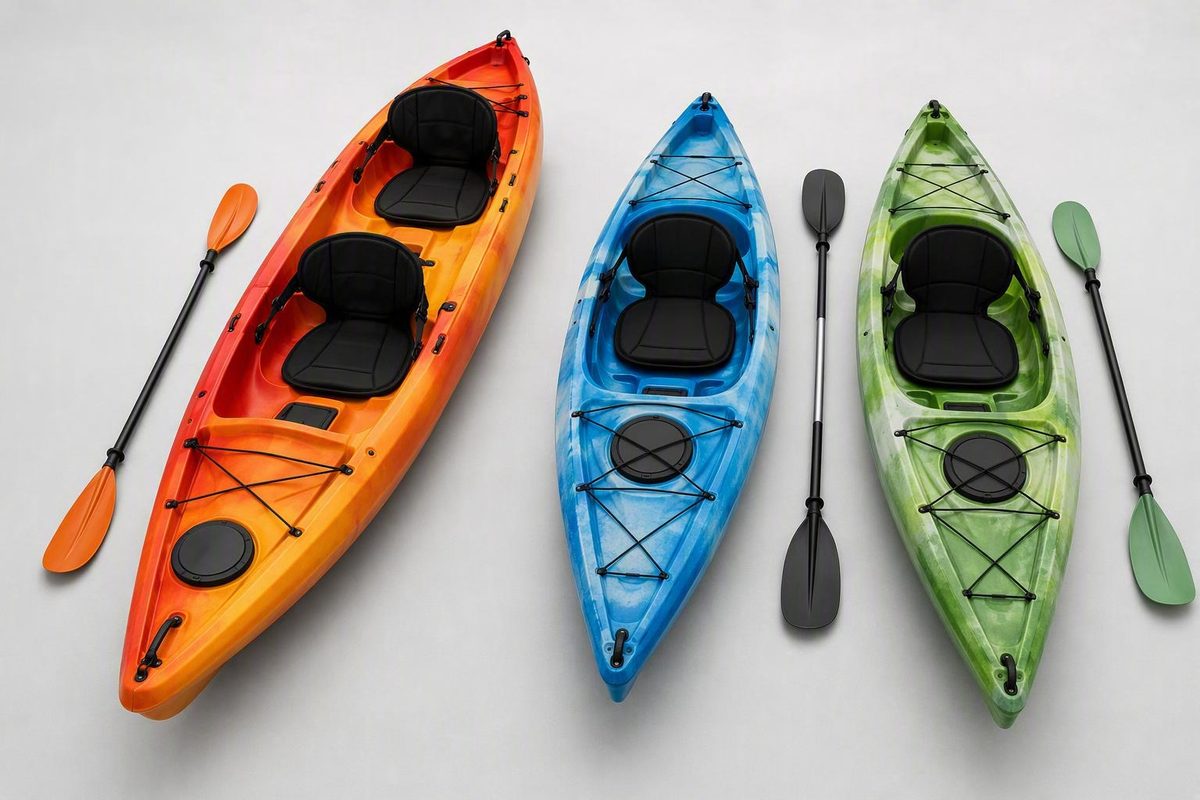
The useful comparison is one two-seat tandem kayak versus two one-person kayaks. Comparing one tandem with one single distorts the decision because only the tandem can carry both paddlers at once.
The choice is not as simple as “tandems are cheaper” or “singles are easier.” One tandem concentrates two paddlers, their effort, and their gear in one vessel. Two singles divide control, load, lifting, and future use between two boats. The better setup depends on the actual models, paddlers, water, vehicle, storage space, and whether either person expects to paddle alone.
Editorial method: This guide synthesizes commercial buyer guides, rental-operator experience, paddling editorial guidance, and model-dependent caveats. The available sources do not provide controlled testing of matched tandem and single kayaks, so performance and ownership conclusions are treated as tendencies to verify—not universal rules.
Tandem Kayak vs Two Singles: The At-a-Glance Comparison Chart
This tandem kayak vs two single comparison chart covers the differences that matter most when both configurations must carry two paddlers.
| Comparison factor | One tandem | Two singles | Likely advantage or caveat |
|---|---|---|---|
| Number of boats | One boat with two seating positions | Two independently controlled one-person boats | Both configurations serve two paddlers |
| Independent control | Both paddlers’ inputs affect the same boat | Each paddler controls steering, pace, corrections, and stops | Two singles |
| Coordination | Communication and compatible stroke timing matter | No need to synchronize strokes between boats | Two singles require less stroke coordination |
| Shared effort | Both paddlers propel the same hull | Each paddler propels a separate hull | Tandem for pooling propulsion |
| Solo-use flexibility | Depends on hull design, seating positions, and weight distribution | Either boat can be used independently | Two singles |
| Heaviest individual lift | Commonly the tandem—the larger single object | Commonly one single at a time | Often two singles, subject to model weights |
| Total boats handled | One boat | Two boats | Tandem for fewer separate units |
| Rack or storage positions | Commonly one boat position | Commonly two boat positions | Tandem, subject to dimensions and rack arrangement |
| Launching | One larger boat to position; both paddlers board it | Two smaller launch sequences | No universal winner |
| Stopping together | Both occupants travel and stop in the same vessel | Each paddler controls their own stop | Tandem for cohesion; singles for autonomy |
| Independent pace and route | The pair must agree | Each paddler can choose pace, line, position, and course corrections | Two singles |
| Repair downtime | An unavailable boat removes both seats | One undamaged single remains available for one paddler | Two singles |
| Purchase-cost tendency | May cost less than two comparable singles | Requires buying two hulls | Model-dependent; commercial guides report the tendency but do not establish a universal market result (Verda’s buyer guide) |
| Payload | One capacity rating shared by both people and their gear | Two separate capacity ratings | Model-dependent; compare remaining payload and usable layout |
| Stability | Depends on hull, width, load, fit, and occupants | Depends on both hulls, loads, and paddlers | Model-dependent |
| Speed | A coordinated pair in a suitable hull may cover distance efficiently | Each paddler’s speed depends on boat and technique | Model-dependent |
| Tracking | A longer, suitable hull may hold a course efficiently | Varies among recreational, touring, fishing, and inflatable singles | Model-dependent |
| Maneuverability | A longer boat may require more turning room | Smaller individual boats may permit easier independent positioning | Model-dependent |
| Actual storage footprint | One hull or packed unit, potentially long or bulky | Two hulls or packed units, potentially stackable or separately stored | Model-dependent |
| Best-fit users | Compatible pairs who consistently paddle together and want teamwork or one boat position | Friends with different goals, regular solo paddlers, or owners prioritizing flexibility | Depends on the intended experience |
A tandem is commonly the heavier individual object, but two singles create two separate lifts and more total loading, rinsing, securing, and unloading. One tandem may use one rack position, yet its length or weight can make roof-loading awkward. Two singles may be easier to lift individually but may not fit side by side on the available rack.
Repair consequences are clearer. A tandem taken out of service removes two seating positions, whereas one remaining single can still serve one paddler if its companion boat is unavailable (Huale’s inflatable-fleet comparison).
Comparison note: Category tendencies cannot replace a direct comparison of the intended boats. Check current equipped price, hull or packed dimensions, individual and total weight, rated capacity, construction, seating layout, rack compatibility, and intended water. Match like with like: do not judge a rigid recreational tandem against two ultralight inflatables or specialized touring singles.
The Core Choice: Shared Experience or Independent Control
The central decision is shared coordination versus individual autonomy, not beginner versus expert.
In two singles, each person controls their own pace, steering, route, course corrections, and stops. One paddler can investigate a shoreline while the other holds a different position. Anglers can work separate areas, and paddlers with different preferred rhythms do not have to negotiate every stroke.
That independence does not make the boats equivalent to two unrelated outings. Conditions, visibility, trip plans, and the abilities of both paddlers still affect how the pair should plan and travel. The advantage is independent boat control—not the disappearance of shared trip considerations.
A tandem produces a different experience. Both paddlers occupy the same vessel, so they travel, turn, stop, land, and launch together. Conversation is easy, both people contribute propulsion to one hull, and the outing can feel collaborative rather than merely simultaneous.
The tradeoff is coordination. An unexpected change in cadence, a hard correction, or one paddler stopping can affect the other person’s work. A tandem may feel smooth when expectations align and frustrating when each occupant tries to control the boat independently.
A common working arrangement has the front paddler establish the rhythm while the rear paddler performs much of the steering. This is a convention, not an absolute rule: seating geometry, rudders, wind, current, experience, and the maneuver itself can change the division of work (Retrospec’s tandem guide).
Two friends may prefer singles when they differ in:
- cruising speed;
- interest in fishing, photography, or shoreline exploration;
- frequency or length of stops;
- preferred route or distance;
- tolerance for giving or receiving instructions;
- interest in developing skills independently.
A couple or close pair may prefer a tandem when they consistently want:
- one shared conversation;
- teamwork rather than separate control;
- both paddlers in the same vessel;
- pooled propulsion;
- one boat to manage at launches and landings.
Neither format is automatically more enjoyable. A synchronized pair may find singles disconnected, while two independent friends may find a tandem restrictive. Choose the control structure and social experience you actually want.
Different Strength, Skill, Confidence, or Stamina
Unequal paddlers do not create an automatic winner. They change which compromise matters most.
A tandem lets the stronger or more experienced person contribute more propulsion while both occupants remain in one vessel. That can appeal to an experienced paddler accompanying a nervous beginner or an adult paddling with a child. The less experienced occupant does not have sole control of another boat, and the stronger paddler can continue propelling the shared hull when the other reduces effort.
That does not make every tandem easier for beginners. Two first-timers may make conflicting corrections, strike paddles, or struggle to establish a cadence. A boat that does not fit its occupants, load, or intended conditions does not become suitable merely because it has two seats.
Singles provide clearer individual feedback. If a boat turns unexpectedly, the paddler can connect the result to their own stroke, trim, or body position. One person’s stroke cannot directly alter the other’s steering, although each paddler must control and propel a separate hull.
Fatigue exposes the practical difference:
- In a tandem, both paddlers remain in the same hull, and one can contribute more when the other reduces effort.
- In two singles, the tired paddler still occupies a separate boat. The pair must adjust expectations because the stronger paddler cannot transfer propulsion directly to the other hull.
Conditional verdicts by pairing:
| Paddler pairing | Initial lean | Why—and what to verify |
|---|---|---|
| Equal-skill partners | Either | Choose a tandem for shared rhythm or singles for autonomy |
| Unequal-skill partners | Slight tandem lean if both want a shared boat | The stronger paddler can contribute more, but coordination and seating fit still matter |
| Two first-timers | Try both | Singles may provide clearer feedback; tandem coordination may or may not feel intuitive |
| Confident adult and anxious adult | Consider a tandem | Sharing a vessel may feel reassuring, but test whether shared control actually reduces anxiety |
| Parent and child | Consider a suitable tandem | Both remain in one vessel, subject to seating fit, load, conditions, supervision, and adult competence |
| Different stamina, similar goals | Tandem may help pool propulsion | Confirm that the selected boat remains manageable when one paddler contributes less |
| Different stamina and different goals | Two singles may reduce coordination conflict | Plan pace and distance around both paddlers’ actual abilities |
These are starting points rather than guarantees. Boat fit, combined load, seating arrangement, intended water, conditions, and adult competence remain decisive. Paddling Magazine similarly presents tandems as useful for pairs with different abilities while emphasizing communication and practice rather than treating the format as self-managing (Paddling Magazine’s tandem buyer guide).
Transport, Carrying, Launching, and Home Storage
“Which is easier to transport?” combines four separate questions:
- Can the setup be loaded onto or into the vehicle?
- Can it be carried from the vehicle to the water?
- Can it be launched and landed conveniently?
- Can it be stored at home?
A tandem and two singles can produce different answers to each.
Vehicle loading: One tandem requires securing one hull, but that hull may be the longest and heaviest object under consideration. Two singles require two mounting positions, enough rack width and capacity, and attachment hardware suitable for both boats. If one person normally loads alone, the heaviest individual lift may decide the issue. If two people always load together but rack space is limited, the tandem may be more practical.
Carrying: Two singles can be moved separately, potentially with each paddler responsible for one. A tandem is one larger object that may suit a two-person carry but prove awkward for one person. Conversely, one person handling two singles may need two trips.
Launching and landing: A tandem creates one launch and landing sequence. Two singles create two. Yet a long or bulky tandem may be harder to position around a steep bank, tight ramp, crowded dock, or narrow access lane. The site layout matters as much as the boat count.
Home storage: A tandem commonly occupies one boat position, while two singles commonly occupy two. That does not mean the tandem requires exactly half the space. A long rigid hull may not fit the available wall, garage bay, shed, or ceiling system. Two shorter boats may stack or fit into separate spaces.
Inflatable and folding kayaks introduce different constraints. An inflatable tandem may pack into one large bag, while two inflatable singles become two smaller bags. Folding designs add assembly and packed-form considerations. Rigid kayaks remain full-length objects after removable accessories are taken off.
Before buying, record:
- hull length or packed length;
- width and height;
- weight of each unit;
- total setup weight;
- heaviest single lift;
- longest item;
- rack’s stated load limit;
- crossbar width and spacing;
- cradle, saddle, stacker, or attachment compatibility;
- garage-door, hatchback, and ceiling clearance;
- carry distance and terrain;
- stored dimensions with removable accessories detached.
Then perform a real pre-purchase test:
- For a tandem: Lift or test-load the intended model on the actual vehicle using the rack, mounts, straps, clearances, and people that will normally be involved.
- For two singles: Confirm that both boats fit the rack’s width, spacing, attachment system, and load limits simultaneously. Check access to the inner as well as the outer boat.
The logistics verdict remains conditional:
- Solo loading: Lean toward singles if each falls within the loader’s ability; consider a lightweight or packable tandem only after testing the lift.
- Two-person loading: A tandem may be straightforward if both paddlers are consistently present and can manage it together.
- Long carries: Compare the weight of each single with the tandem’s carry arrangement and the number of required trips.
- Compact storage: Compare measured stored dimensions, not category names.
- Limited rack space: A tandem has a one-position advantage only if its dimensions and weight suit the vehicle and rack.
Cost, Capacity, and Ownership Flexibility
One tandem may cost less than two comparable singles, but this is a commercial-guide tendency rather than a universal or current market finding (Retrospec’s comparison guidance). A premium or specialized tandem may cost more than two basic singles, while a recreational tandem may undercut two directly comparable recreational boats.
Compare genuinely matched setups: recreational inflatable against recreational inflatable, rigid sit-on-top against rigid sit-on-top, fishing kayak against fishing kayak, or touring design against touring design.
Use this worksheet rather than comparing hull prices alone:
| Cost item | One tandem | Two singles |
|---|---|---|
| Boat price | $_____ | $_ + $___ |
| Paddles required for two people | $_____ | $_____ |
| Life jackets for two people | $_____ | $_____ |
| Seats or backrests, if not included | $_____ | $_____ |
| Roof-rack bars or platform | $_____ | $_____ |
| Cradles, saddles, stackers, or mounts | $_____ | $_____ |
| Straps and tie-down hardware | $_____ | $_____ |
| Cart or carrying aid | $_____ | $_____ |
| Home-storage hardware | $_____ | $_____ |
| Pump or assembly equipment, if applicable | $_____ | $_____ |
| Initial repair parts | $_____ | $_____ |
| Expected maintenance items | $_____ | $_____ |
| Delivery charges | $_____ | $_____ |
| Total equipped cost | $_____ | $_____ |
Both configurations still serve two people, so both require equipment for two paddlers. A tandem does not eliminate the second paddle or second life jacket merely because the occupants share a hull. Verda’s two-person cost comparison likewise lists two paddles and two life jackets for either configuration.
Keep three measurements separate:
- Total setup weight: everything that must be transported.
- Heaviest single lift: the largest object one person must raise or control.
- Rated capacity: the manufacturer’s stated load limit for a particular boat.
For usable payload, subtract both paddlers and all carried equipment from the applicable rating. With singles, calculate this separately for each hull. Spare capacity in one boat does not automatically solve poor fit or load distribution in the other. With a tandem, confirm that the remaining rating corresponds to usable cockpit or deck space.
Do not assume one tandem carries more than two singles combined. A tandem may exceed either single individually while still offering less combined rated capacity or practical cargo room than both singles together. A capacity rating also does not establish that two occupants, a child, a dog, a cooler, or camping equipment will fit comfortably.
Ownership flexibility generally favors singles. Either person can take one boat while the other stays home. Solo use of a tandem depends on the hull design, available seating positions, and weight distribution. Paddling from the rear seat of an arbitrary tandem is not necessarily equivalent to using a purpose-built single.
A convertible tandem is a legitimate third option. Some models permit seats to be moved or removed for solo use. Convertibility does not prove that the boat will accelerate, turn, carry, or load like a dedicated single, so evaluate the solo configuration as a separate use case.
Before purchase, verify:
- current price and delivery charges;
- included paddles, seats, pumps, fins, hatches, or mounts;
- warranty terms and exclusions;
- replacement-seat, valve, fin, rudder, hardware, and repair-part availability;
- rated capacity and how the manufacturer defines it;
- assembled, hull, and packed dimensions;
- bare and equipped weight;
- manufacturer instructions for solo seating;
- construction and intended water category.
For any shortlisted products, create a dated matched-model sheet showing equipped price, individual and total weight, heaviest lift, dimensions, rack requirements, rated capacity, remaining payload, and included equipment. The evidence available here does not support presenting one product pairing as representative of the whole market.
Speed, Stability, Tracking, and Maneuverability: Why the Boat Matters More Than the Label
Commercial guides frequently characterize tandems as faster, more stable, or better tracking and singles as more maneuverable. The available material does not include controlled tests of matched models, so those descriptions should be treated as hypotheses to examine.
Performance depends on:
- hull shape and waterline length;
- width and cross-sectional form;
- rocker and keel profile;
- construction and stiffness;
- windage;
- rudder, skeg, or fin configuration;
- total load and its distribution;
- paddler fit and technique;
- tandem coordination;
- wind, waves, current, and water depth.
A longer tandem hull with two coordinated paddlers may hold a course efficiently and cover distance well. That outcome assumes the design suits the task and both paddlers apply compatible power. Conflicting corrections, poor timing, or a large mismatch in effort can erase the theoretical benefit.
Singles provide direct control and are often smaller than tandems in the same product family. That may help with independent turns, shoreline positioning, or narrow passages. It does not follow that every single is more maneuverable than every tandem. A long touring single and a short recreational tandem could reverse the expectation.
Stability is especially easy to oversimplify. Width, hull form, seat height, load placement, paddler movement, and conditions all matter. Kayak Starved Rock’s operator guidance explicitly rejects a universal format winner and says stability depends on the specific boat and its occupants (the operator’s single-versus-tandem guidance).
A wide-looking hull or large capacity number is not a substitute for suitable fit and loading. Rated capacity addresses a manufacturer-defined load limit; it does not by itself establish comfortable seating or predictable handling near that limit.
For a useful performance comparison:
- Match construction and intended-use category.
- Compare boats designed for the same type of water.
- Review measured length, width, weight, and capacity.
- Examine the actual hull and seating layout.
- Use independent measurements where available.
- Test both configurations with the intended paddlers and typical load.
A test paddle should include starting, accelerating, turning both ways, correcting course, stopping, holding position, approaching shore, landing, and maintaining a comfortable cruising rhythm. If considering a tandem for unequal paddlers, test how it responds when either person reduces effort. If considering singles, confirm that both paddlers can sustain a mutually workable pace.
Scenario Verdicts: Couples, Families, Friends, Dogs, and Solo Plans
Different households can reasonably reach opposite conclusions.
Coordinated couple who always paddles together: Lean tandem if both people want a shared experience, enjoy teamwork, and can lift, transport, and store the selected model. Choose singles instead if either partner values personal control even on joint trips.
Two independent friends: Lean two singles when preferred speeds, routes, fishing positions, photography stops, or rest habits differ.
Parent and child: A suitable tandem may simplify keeping both occupants in one vessel. That remains conditional on seating fit, rated capacity, intended water, conditions, supervision, and adult competence. A commercial rental operator identifies parent-child paddling as a common tandem use case but does not treat two seats alone as proof of suitability (Kayak Starved Rock’s guidance).
Nervous beginner with an experienced partner: A tandem may feel reassuring because the beginner is not solely responsible for another boat. Test that assumption: some paddlers dislike shared control, and the experienced partner still needs to communicate effectively.
Two beginners: Try both. A tandem allows shared propulsion but demands coordination; singles give clearer individual feedback but require each person to manage a complete boat.
Occasional or regular solo use: Lean two singles. Otherwise, consider a tandem only if its manufacturer provides an appropriate solo seating arrangement and weight-distribution guidance.
Dog or substantial gear: Calculate remaining rated payload after both people and all equipment are counted, then inspect where the dog or cargo would actually sit. Do not assume a tandem offers more usable room than two singles combined.
Anglers or paddlers pursuing different activities: Two singles generally provide greater positioning and route flexibility. A tandem can still work for paddlers who intentionally operate as a team and choose a suitable layout.
Use this compact decision tree:
-
Will either person paddle alone? - Yes: Lean two singles, or assess a convertible tandem in its solo configuration. - No: Continue.
-
Do both people want the same pace, route, stops, and style of outing? - No: Lean two singles. - Yes: Continue.
-
Can the intended tandem be lifted and loaded by the people who will normally use it? - No: Compare lighter singles or another construction. - Yes: Continue.
-
Does the complete setup fit the vehicle and storage area? - If only one boat position is available, a suitable tandem may have the edge. - If tandem length or weight is the obstacle, shorter or lighter singles may work better.
-
Do matched specifications support the required people, gear, dog, or child and the intended water? - No: Reject that model regardless of category. - Yes: Rent or test both configurations before committing.
Rental Fleets and the Final Pre-Purchase Checklist
A rental operator is solving a different problem from a private buyer. A household may care most about partner dynamics and whether one person can load the boat. An operator must also consider booking patterns, staff handling, maintenance, seat availability, turnaround time, and the effect of a disabled unit.
Two singles can be rented independently or together. A tandem primarily serves a paired booking, although it may also suit family, parent-child, or guided demand. Singles therefore allow more booking combinations; a tandem condenses a two-person booking into one vessel and one boat position.
Repair resilience differs as well. A disabled tandem removes two seats. If one of two singles is unavailable, the other can still serve one customer. That describes how capacity is distributed; it does not prove that singles generate more revenue or utilization.
A mixed fleet may accommodate a broader combination of solo customers, couples, families, and guided groups than an all-single or all-tandem inventory. The supplied evidence does not establish an optimal ratio. Any ratios published by manufacturers should be treated as hypothetical planning examples, not industry benchmarks.
Operators should evaluate:
- the share of solo, paired, family, and guided bookings;
- customer preference for shared or independent control;
- staff lifting and loading ability;
- launch width, congestion, and carry distance;
- assembled and stored dimensions;
- session length and likely variation in paddler stamina;
- repair exposure per unit and per seat;
- availability of replacement parts;
- cleaning, drying, inspection, and turnaround workflow;
- seasonal changes in customer mix;
- the operational effect of losing one hull during peak demand.
Much of the available fleet material concerns inflatable rental kayaks. Packed storage, seams, valves, pressure testing, and inflatable repair workflows should not be generalized automatically to rigid touring, sea, fishing, surf, or whitewater fleets.
Private and commercial buyers can finish with the same core checklist:
- [ ] Intended water and conditions are defined.
- [ ] Boats are matched by construction and use category.
- [ ] Fully equipped cost is calculated for two paddlers.
- [ ] Total setup weight and heaviest individual lift are recorded separately.
- [ ] The number of units and loading steps is acceptable.
- [ ] The complete setup fits the vehicle and rack.
- [ ] Measured stored dimensions fit the available space.
- [ ] Remaining payload is calculated after people and gear.
- [ ] Seating and cargo layout work in practice.
- [ ] Solo-use plans are addressed.
- [ ] Pace, route, communication, and stopping preferences are compatible.
- [ ] Repair consequences are acceptable.
- [ ] Replacement parts and warranty terms have been checked.
- [ ] Loading and paddling have been tested where possible.
The final verdict is conditional. Choose one tandem when two compatible paddlers expect to travel together, value shared propulsion, need one boat position, and can manage the selected boat’s weight and dimensions. Choose two singles when independence, different pacing, regular solo use, lighter individual lifts, and retaining one usable boat during repairs matter more.
Before committing, compare matched models on equipped cost, heaviest lift, stored dimensions, rack fit, remaining payload, and intended water. Then test-load the actual setup and paddle or rent both arrangements with the intended partner.
Check conditions and the boat’s load limit before launching; Kayaks Hub’s general notice identifies conditions, cold water, and load limits as serious hazards (Kayaks Hub’s water-safety notice).
Wear a life jacket when paddling; Paddling Magazine’s tandem guide advises every paddler to wear one.
Is one tandem kayak cheaper than two single kayaks?
It can be, but not universally. Commercial retailer guidance identifies lower cost as a possible tandem advantage, while providing no matched market-wide price testing (Brooklyn Kayak Company’s single-versus-tandem guide).
Compare the complete setup: boat prices, two paddles, two life jackets, seats where needed, rack hardware, mounts, straps, carts, storage equipment, repair parts, maintenance items, and delivery charges. A premium tandem may cost more than two basic singles.
Can one person paddle a tandem kayak?
Sometimes. Practical solo use depends on hull design, seat adjustment, paddler position, and weight distribution. Some convertible tandems provide a designated center or repositioned solo seat. Others can be moved by one person but may trim poorly or feel cumbersome.
Check the manufacturer’s solo-seating instructions for the exact model. Do not assume that occupying the rear seat of any tandem creates a suitable solo configuration.
Are tandem kayaks more stable and better for beginners?
Not inherently. Stability depends on the specific hull, dimensions, seating, load distribution, occupants, and conditions. Some recreational tandems are designed to feel reassuring; other tandem designs demand substantial skill.
A tandem can let a beginner share propulsion with an experienced partner, but it also requires coordination. Two beginners may find conflicting strokes and corrections frustrating. The better beginner setup is the suitable boat that fits the paddlers, load, intended water, and preferred learning style.
Which is easier to transport: one tandem or two singles?
Neither wins universally. A tandem is one boat and commonly uses one rack position, but it may be the heavier and longer individual object. Two singles can be moved one at a time but require two lifts, two boat positions, and more total handling.
Compare actual weights, lengths, rack fit, attachment points, stored dimensions, and carry distance. Test-loading the intended setup on the real vehicle is more useful than deciding by boat count.
What happens if one paddler gets tired or one kayak needs repair?
In a tandem, the other paddler can continue contributing propulsion to the same vessel while the tired paddler reduces effort. In two singles, the tired paddler remains in a separate hull, so the pair must adjust its pace and plan rather than assuming propulsion can be shared directly.
A disabled tandem removes both seating positions. With two singles, one undamaged boat remains available for one paddler. That redundancy favors singles for owners and fleets that value retaining partial use.