
A Folding Kayak Must Fit the Water and the Trip
Compare origami, skin-on-frame and nesting kayaks by water, packed size, weight, flotation, setup and maintenance before buying.
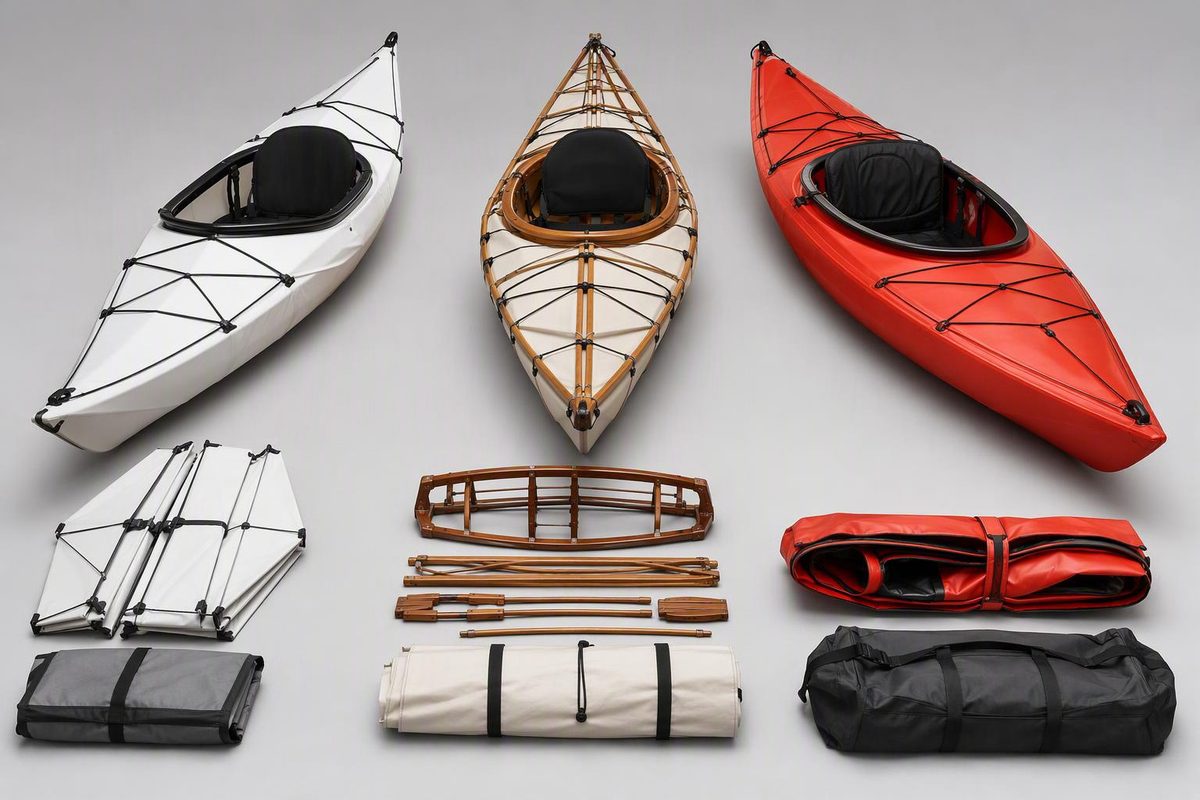
A folding kayak solves a transport or storage problem—not every paddling problem. The right boat must fit your water, load, skills and rescue plan after it fits the trunk, elevator or closet.
For calm ponds and short outings, a wide recreational folder may be enough. Exposed coasts and loaded touring require a properly equipped touring design and the skills to use it. A compact package alone does not make a kayak suitable for rough water.
First, decide what “folding” means
Portable kayaks use several substantially different structures:
| Type | How it packs | Main advantage | Main compromise |
|---|---|---|---|
| Folding-sheet or “origami” | The hull sheet becomes the boat and carrying case | Low weight and few loose components | Capability varies from calm-water recreation to touring |
| Skin-on-frame | A fabric skin stretches over a sectional frame | Efficient touring shapes and replaceable components | More parts, assembly steps and drying surfaces |
| Nesting hardshell | Rigid hull sections stack inside one another | Rigid construction and conventional fittings | Heavier and bulkier than many true folders |
An inflatable relies on air chambers rather than folds or a sectional frame. If easy storage matters more than a narrow touring hull, compare construction and intended water in our inflatable kayak guide.
Match the boat to the water
Do not shop by packed dimensions first. Start with where the boat will actually be used. The examples below use manufacturer specifications available in September 2026; they are useful comparisons, not independent performance tests.
Sheltered, calm water
A short, wide, open-cockpit folder prioritizes easy entry and initial stability. It can suit small lakes and protected shoreline paddling when wind, current and boat traffic are limited.
The Oru Lake Sport illustrates this class. Oru lists it at 9 feet by 32 inches, 18 pounds and a one-minute assembly time, and categorizes its conditions as “calm.” Those figures should not be transferred to Oru’s other models—or interpreted as approval for exposed crossings (Oru Lake Sport specifications).
Choppy water and day touring
Look for a longer waterline, deck, secure cockpit rim, deck lines, foot support and effective flotation. The kayak should also support the re-entry method you know how to perform.
The closed-cockpit Oru Bay is 12 feet 3 inches by 25 inches and has deck lines plus a coaming that accepts a spray skirt. Oru lists a 26-pound weight and 15-minute setup, substantially different from its calm-water Lake Sport (Oru Bay specifications). “Folding kayak” is too broad a category to establish where a boat belongs.
Touring and exposed water
Length alone is not enough. Check flotation, perimeter lines, cockpit fit, load security, repair provisions and the manufacturer’s stated use. Then determine whether you can empty and re-enter that exact boat in the expected conditions.
Skin-on-frame examples show the range. Pakboats lists its Quest 150 at 14 feet 11 inches by 24 inches, 31 pounds, with a 28-by-16-by-12-inch packed bag; side tubes provide flotation (Pakboats folding-kayak specifications). The narrower TRAK 2.0 is 16 feet by 22.5 inches, with a 49-pound assembled weight, 350-pound payload limit and 56-pound transport weight (TRAK 2.0 specifications). These are touring designs, but dimensions and price do not replace training or a conservative route plan.
Compare the complete package
Record these figures for every candidate:
- Assembled weight: what you lift at the launch.
- Transport weight: boat, bag, frame and included hardware.
- Packed dimensions: in the configuration you will actually carry.
- Paddler-and-gear load: your dressed weight plus water, safety equipment and trip gear.
- Cockpit and legroom: especially with a closed cockpit.
- Number of packages: the paddle, PFD and accessories may not fit in the boat bag.
Hull and travel weight can differ materially. TRAK lists 49 pounds assembled and 56 pounds packed. Its air-travel guidance recommends checking the airline’s current limits and splitting components between two checked bags when necessary (TRAK air-travel guidance). “Airline portable” does not necessarily mean one standard checked bag with no fee.
A nesting kayak makes a different trade. The Pakayak Bluefin is a rigid 14-foot-2-inch kayak that nests into a 42-inch stack; its bag is 44.5 by 24 by 16 inches. It weighs 52 pounds and has a 300-pound maximum capacity (Pakayak Bluefin specifications). It may fit a closet and avoid a roof rack, but the lift is comparable to many conventional touring kayaks.
Before ordering, mock up the packed dimensions with cardboard and carry an equivalent weight from storage to the vehicle and launch. Check stair turns, elevator depth, trunk opening and the distance from parking to water. A package that technically fits can still be impractical to move.
Treat setup as part of the outing
Manufacturer setup times help compare designs, but they do not predict a first attempt at a windy or muddy launch. Oru lists one minute for the Lake Sport and 15 minutes for the Bay. Pakayak says the Bluefin’s rigid sections join in under three minutes (Pakayak Bluefin product page). Frame-and-skin boats generally have more separate components to manage.
Ask:
- Can I assemble it alone in wind without losing a part?
- Is there a clean area at the launch, or will the skin and frame lie in sand or mud?
- Can I identify an incomplete latch, loose frame joint or poorly seated closure?
- Will I still set it up for a short paddle?
Practice at home until the sequence is repeatable. Before launching, inspect closures, joints, seams or creases, seat attachment, foot braces, drain fittings and flotation. Carry the model-specific repair supplies and learn what can—and cannot—be fixed in the field.
Verify flotation and rescue compatibility
Do not assume a portable hull will be manageable when flooded. Pakayak specifies sealed bulkheads fore and aft of the cockpit, while Pakboats uses side air tubes for flotation. Other models may need separate float bags.
Confirm what is included, where the flotation sits and whether loaded gear interferes with it. For moving water, the American Canoe Association says boats should have secured flotation or sealed bulkheads (ACA course curriculum). Flotation is also valuable on flat water because it reduces the volume of water a swamped kayak can take on.
A spray skirt keeps splash out but changes capsize procedures. Learn a wet exit before relying on one, then practice assisted and solo recovery with the assembled boat and normal load. A folding mechanism does not remove the rescue questions that apply to a one-piece kayak.
Check fit, capacity and the real system cost
Maximum capacity is not a target load. Add the paddler, clothing, PFD, water, safety equipment and baggage. Leave a useful reserve rather than planning to reach the published ceiling, especially because manufacturers may define capacity differently.
Cockpit fit can rule out a boat even when its capacity is sufficient. Pakayak publishes an 18-by-35.5-inch cockpit and 48.5 inches from seatback to front bulkhead; TRAK lists a 16.5-by-30.5-inch cockpit. Sit in or demo the exact model when possible.
Also price and pack the whole system:
- appropriately sized breakdown paddle
- worn, properly fitted life jacket
- required flotation bags or sea sock
- pump, paddle float and communication equipment suited to the venue
- spray skirt only if compatible and you have practiced releasing it
- repair materials and spare proprietary fasteners
- carrying straps, cart or backpack harness
Paddle length depends partly on the assembled beam and your stroke style. Use the boat’s on-water width with our kayak paddle sizing guide, not its folded width.
Plan for drying, storage and parts
Portable does not mean maintenance-free. Salt, sand and grit can affect skins, frames, latches and closure channels. Follow the model’s instructions for rinsing, drying, inspection and lubrication, and do not put a damp boat and bag into long-term storage.
Before buying, check whether the maker sells replacement skins, frame sections, buckles, gaskets and seats for the exact model and generation. Oru, for example, maintains a catalog of model-specific replacement hardware and parts. Read the warranty to see which damage is treated as a defect and which is considered wear or misuse.
The practical choice
Choose a folding kayak when storage or roof transport is the constraint and a suitable model exists for your intended water, load and rescue method:
- a simple recreational folder for sheltered, short outings;
- a decked origami or light skin-on-frame boat when carry weight matters but conditions demand more capability;
- a touring skin-on-frame design when paddling performance and expedition packing justify longer setup;
- a nesting hardshell when compact storage matters more than low carrying weight.
Rent or arrange a demo first if you cannot verify cockpit fit, manage the packed weight, assemble the boat reliably, provide adequate flotation or dry and inspect it after use.
For U.S. paddlers, the Coast Guard recommends wearing a properly fitted, Coast Guard-approved life jacket, dressing for the water, checking the forecast and currents, filing a float plan and carrying two waterproof ways to call for help (U.S. Coast Guard paddling-safety checklist).