
Find the Right Paddle Length for Your Boat, Body, and Stroke
For most recreational and touring kayaks, suitable lengths run 200-250 cm. A wider stroke or zigzagging can signal excess length, though technique can cause both.
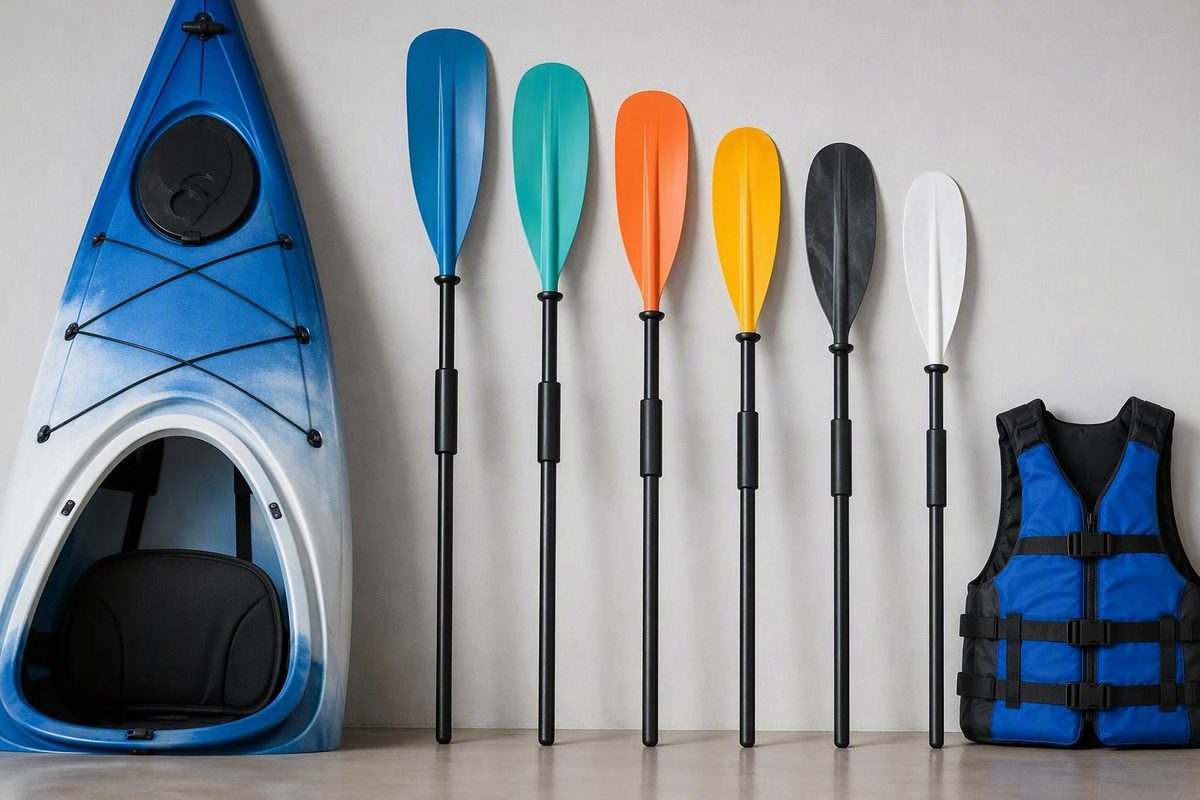
Methodology: This guide synthesizes manufacturer sizing guidance, retailer charts, and specialist paddling publications. The recommendations are starting points, not results of first-party product testing or universal fitting standards.
The quick answer: start with height and kayak width
For most recreational and touring kayaks, the answer to “what length kayak paddle do I need?” falls between approximately 200 and 250 cm. Your best starting point within that range depends primarily on:
- Your standing height
- Your kayak’s width at its widest point
The central rule is simple: wider kayaks generally require longer paddles to reach beyond the hull, while narrower kayaks generally suit shorter paddles. Commercial kayak paddles are commonly labeled in centimeters even when kayak width is listed in inches.
For a quick recommendation:
- Identify the kayak type: recreational, touring, fishing, inflatable, or hard-shell whitewater.
- Measure its maximum width: measure horizontally across the widest part of the hull.
- Record your standing height.
- Identify your normal stroke: relaxed low angle or upright high angle.
- Check the seat height: low, elevated, fixed, or adjustable.
- Find the chart value and one adjacent size to compare.
As a bounded example, a paddler between 5 feet and 6 feet tall using a recreational or touring kayak approximately 23–28 inches wide commonly starts around 220 cm. Across broader height-and-width combinations, one recreational and touring chart spans 200–250 cm and presents those values as starting points.
That does not make 220 cm—or any other length—a universal default. A narrow touring kayak and upright stroke may point shorter. A wide sit-on-top, elevated seat, or relaxed low-angle stroke may point longer.
Fishing kayaks, recreational inflatables, hard-shell whitewater boats, and inflatable whitewater kayaks also need separate treatment. Their widths, seating positions, and intended strokes differ too much to force them into one generic table.
Treat every chart value as a baseline to verify. Brand charts can differ, and two paddles with the same overall length can feel different because their blade dimensions and usable shaft lengths are not identical.
Measure the inputs that actually determine paddle length
A chart is useful only when its inputs accurately describe the boat and paddling position. Do not estimate paddle length from kayak length, a product category alone, or a standing reach test in a store.
Measure the kayak at its widest point
Find the maximum beam—the greatest side-to-side width of the kayak. Measure horizontally from the outside edge of the hull on one side to the outside edge on the other.
Do not assume a longer kayak is wider. A long touring kayak may be narrower than a short recreational model. Two boats marketed as sit-on-tops can also have substantially different widths.
If you cannot measure the boat directly, look for “width,” “beam,” or “maximum beam” in the manufacturer’s specifications. Confirm that the number describes the overall hull rather than the cockpit opening or interior seat area. Aqua-Bound likewise instructs paddlers to measure an unknown boat at its widest point before consulting its chart.
Record your standing height
Standing height is the conventional body measurement in most recreational and touring charts. It provides a practical baseline for reach and determines the chart row to use.
It is not a complete description of body geometry. Two equally tall paddlers can have different torso and arm proportions, which may help explain why they prefer different adjacent lengths. Use those proportions to resolve a borderline choice—not as a universal replacement for boat width, seat position, and actual technique.
Some retailers publish torso-based methods, but the supplied guidance is not consistent enough to establish one authoritative torso formula. Start with standing height and boat width, then refine the result through seated or on-water comparison.
Identify the kayak category
Choose the table that best matches the boat:
-
Recreational: often wider and commonly used for relaxed paddling.
-
Fishing: often broad, sometimes with pronounced hull flare and an elevated seat.
-
Hard-shell whitewater: normally sized through a separate height-and-use chart.
- Inflatable whitewater: much wider than a hard-shell whitewater boat and therefore sized separately.
“Sit-on-top” is not a complete sizing category. It can describe anything from a compact recreational kayak with a molded seat to a wide fishing platform with an elevated frame. Measure the actual boat and evaluate the seat.
Decide whether you use a low-angle or high-angle stroke
A low-angle stroke is relatively relaxed and horizontal. The shaft is only slightly tilted, the hands stay lower, and the blade follows a path farther from the kayak. This technique generally favors a longer paddle.
A high-angle stroke uses a more upright shaft. The upper hand rises, and the blade enters and travels closer to the kayak. This technique generally favors a shorter paddle and may accompany a quicker cadence.
Base the decision on how you normally paddle, not the style you hope to adopt later. If your technique is still developing, begin with the height-and-width value and compare adjacent lengths once your stroke becomes more consistent.
Check the seat height
Consider the distance between your seated position and the water—not merely the amount of seat padding.
A low seat puts you closer to the water. An elevated fishing seat increases the reach required to clear the hull and immerse the blade. An adjustable seat can create two materially different paddling positions, which may make an adjustable-length paddle useful.
Test from the position you actually use while paddling. A paddle sized exclusively for one position may feel compromised in the other.
Note deck height, hull flare, and seated reach
An inward-tapered hull may permit a closer stroke.
These are secondary refinements rather than substitutes for height and width. Before using a chart, record:
- Kayak category
- Maximum width
- Standing height
- Normal seat position
- Usual stroke angle
- Pronounced deck height, side tubes, or hull flare
That turns the chart into a reasoned starting point rather than a guess.
Recreational and touring kayak paddle size chart
The following is a general starting chart, not an industry-wide standard. It reproduces one recreational, touring, and performance guide’s height-and-width recommendations; specialty paddles and individual brands may use different fitting conventions in their own charts.
| Paddler height | Boat under 23 in | Boat 23–27.75 in | Boat 28–32 in | Boat over 32 in |
|---|---|---|---|---|
| Under 5 ft | 200 cm | 210 cm | 220 cm | 230 cm |
| 5 ft–5 ft 6 in | 210 cm | 220 cm | 230 cm | 240 cm |
| 5 ft 7 in–6 ft | 220 cm | 220 cm | 230 cm | 240 cm |
| Over 6 ft | 220 cm | 230 cm | 240 cm | 250 cm |
How to read the chart
Find the column containing your kayak’s maximum width, then choose the row containing your standing height. The cell where they meet is your baseline length.
For example:
- A paddler under 5 feet in a sub-23-inch boat starts at 200 cm.
- A paddler from 5 feet to 5 feet 6 inches in a 23–27.75-inch boat starts at 220 cm.
- A paddler from 5 feet 7 inches to 6 feet in a 28–32-inch boat starts at 230 cm.
- A paddler over 6 feet in a boat wider than 32 inches starts at 250 cm.
Record that result rather than treating it as an automatic purchase decision. Then note the nearest available size and evaluate stroke angle, seat height, and hull shape.
Why charts do not always agree
REI’s Werner-attributed low-angle chart differs from the table above by 5–10 cm in several cells. It lists 210 cm rather than 200 cm for a paddler under 5 feet in a boat under 23 inches, and 215 cm rather than 210 cm for a 5-foot-to-5-foot-6-inch paddler in that narrowest category. It also gives 250 cm in one tall, wide-boat combination where the general table above gives 240 cm in its brand-specific comparison.
Those differences do not necessarily make either chart wrong. They may reflect assumptions about blade design, shaft configuration, stroke style, or the paddle line itself. Once you choose a model, consult that manufacturer’s current chart.
What common paddle sizes generally indicate
Across the supplied recreational and touring guidance, common lengths tend to appear in these settings:
- 210 cm: narrow touring or performance boats, shorter paddlers, or high-angle technique.
- 220 cm: many narrow-to-mid-width touring and recreational combinations.
- 230 cm: many mid-width recreational setups and some wider boats used by shorter paddlers.
- 240 cm: wide recreational, sit-on-top, inflatable, or some fishing arrangements.
- 250 cm: very wide boats, taller paddlers, or fishing setups requiring substantial reach.
- 260 cm: specialized wide fishing or elevated-seat arrangements rather than ordinary touring use.
The 220–230 cm range covers many recreational and touring combinations, while 240–260 cm appears more often in broad recreational or fishing boats. These are cross-source tendencies, not universal assignments for every paddler or kayak.
Although NRS describes 230 cm as a popular length for average-height paddlers using a relaxed low-angle stroke, that is a publisher-specific observation rather than evidence that 230 cm is the best default for everyone.
Adjust the baseline for stroke angle, seat height, and hull shape
Once you have a chart value, ask whether several secondary factors consistently point longer or shorter:
- A relaxed low-angle stroke generally favors a longer paddle.
- An upright high-angle stroke generally favors a shorter paddle.
This is a refinement of the baseline, not an instruction to change length for every isolated feature.
Factors that can support the longer adjacent size
Consider the longer option when several of these conditions apply:
- The kayak is unusually wide for its category.
- The seat is elevated.
- The hull flares outward between the seat and the water.
- A high deck or large side tubes interfere with a close stroke.
- You paddle at a relaxed pace.
- You use a genuine low-angle stroke.
- You fall near the next height or width category.
- The shorter paddle makes full blade immersion difficult without leaning.
Together, these factors indicate a practical need for more reach.
Factors that can support the shorter adjacent size
Consider the shorter option when several of these conditions apply:
- The kayak is unusually narrow.
- The seat is low.
- The hull tapers inward near the paddler.
- You use an upright high-angle stroke.
- You prefer a more aggressive pace or faster cadence.
- You want the blade path close to the kayak.
- The longer option produces a broad sweep rather than a clean forward stroke.
Aqua-Bound recommends considering a change of at least 5 cm only when two or more relevant factors point in the same direction—such as a wide hull plus a high seat for more length, or a narrow hull plus a high-angle stroke for less length in its manufacturer-specific guidance.
That is more defensible than reacting to one feature. A slightly elevated seat does not automatically justify a longer paddle if the kayak is narrow and your stroke is upright.
Choosing between 220 and 230 cm
This is a common adjacent-size decision.
Lean toward 230 cm when:
- The hull is near the wider end of its chart category.
- The seat is elevated.
- The hull, deck, or side tubes push the stroke outward.
- You use a relaxed low-angle stroke.
- A 220 cm paddle makes you lean or struggle to immerse the blade.
Lean toward 220 cm when:
- The kayak is narrow or has a low deck.
- You sit close to the water.
- You use an upright high-angle stroke.
- You prefer a faster cadence.
- A 230 cm paddle produces a broad stroke path or feels cumbersome near the hull.
Some general guidance favors the shorter option when a paddler falls between sizes. Treat that as a tiebreaker, not an absolute rule. If hull width, seat height, and stroke style all create a clear need for reach, the longer adjacent option is reasonable.
Keep fishing adjustments separate
Bending Branches uses a larger conditional adjustment for fishing setups: it suggests considering a 10 cm change only when at least two fishing-specific factors point in the same direction. That manufacturer’s rule reflects the combined effects of wide fishing hulls, elevated seats, pace, stroke angle, and hull shape; it should not be transferred automatically to an ordinary touring kayak.
No adjustment guarantees greater speed, lower effort, better comfort, or injury prevention. It identifies a better-supported option to test.
Special cases: fishing, inflatable, and whitewater kayaks
A standard recreational chart does not work equally well for every kayak. Fishing platforms, inflatables, and whitewater boats create different reach and stroke requirements.
Fishing kayaks
Fishing kayaks are often wide and may place the paddler higher above the water. Those two features commonly move suitable lengths toward approximately 240–260 cm, depending on the hull, seat, paddler, and stroke.
Bending Branches provides a specific example: 250 cm for a 5-foot-8-inch paddler in a 32-inch-wide fishing kayak. If the seat changes height, it recommends a 250–260 cm adjustable paddle; for exclusive paddling from the high position, it points to 260 cm for that documented setup.
That is manufacturer guidance, not a universal equation. A 32-inch boat with a low fixed seat and close stroke may not require the same adjustment as a flared hull with a high framed seat.
Check:
- Maximum hull width
- Width near the normal blade-entry point
- Low and high seat positions
- Clearance around rod holders and deck fittings
- Whether the seat position changes during an outing
- The chosen brand’s fishing-specific chart
Inflatable recreational kayaks
Many inflatable kayaks have broad side tubes and a wide overall beam. Even if the seat is not especially high, the paddler may have to clear more hull before the blade reaches open water.
Inflatable-specific guidance places many recreational options around 220–240 cm. It describes inflatable widths ranging broadly from 28 to 40 inches, suggests 220 or 230 cm for models up to 32 inches, and commonly points toward 230 or 240 cm for wider boats. The source presents these as general, experience-based ranges with substantial overlap rather than a precise universal chart.
Start with the measured width rather than assuming every inflatable requires 240 cm. A narrower model with a low seat may suit 220 or 230 cm; a broad inflatable used with a relaxed stroke may make 230 or 240 cm more practical.
Hard-shell whitewater kayaks
Hard-shell whitewater paddles are substantially shorter than ordinary recreational paddles. Paddler height and intended whitewater use matter more than a recreational boat-width table.
NRS lists the following starting ranges:
| Paddler height | Hard-shell whitewater paddle |
|---|---|
| Under 5 ft 2 in | 188–194 cm |
| 5 ft–5 ft 8 in | 191–197 cm |
| Over 5 ft 6 in | 194–203 cm |
The height bands overlap, so some paddlers fit more than one row. NRS associates the shorter end of each range with playboating or freestyle and the longer end with river running or creeking.
These values come from an NRS guide last updated in 2013, so treat them as bounded starting ranges and compare them with current guidance for the paddle model and whitewater use you are considering.
Inflatable whitewater kayaks
Do not apply the hard-shell table to an inflatable whitewater kayak. Inflatable boats are much wider, so the corresponding paddles are longer:
| Paddler height | Inflatable whitewater paddle |
|---|---|
| Under 5 ft 2 in | 220 cm |
| 5 ft–5 ft 8 in | 230 cm |
| Over 5 ft 6 in | 240 cm |
Both sets of whitewater values—and their overlapping height categories—appear in the NRS category-specific sizing guide.
The overlap does not provide one exact answer for every paddler. It makes comparison within the relevant range more responsible than extracting false precision from a single row.
Worked examples for common paddler-and-kayak combinations
Each example follows the same process:
- Find the baseline chart value.
- Identify secondary factors.
- Compare an adjacent option.
- Test rather than assuming the chart is final.
These are conditional examples, not individualized prescriptions.
Example 1: Narrow touring boat
Setup: A 5-foot-8-inch paddler in a kayak under 23 inches wide.
Baseline: The general recreational and touring chart gives 220 cm.
Secondary factors: The boat is narrow, and the paddler uses an upright high-angle stroke with a relatively quick cadence.
Adjacent option: Compare 220 cm with a shorter, brand-specific high-angle option. Depending on the manufacturer and blade design, that may be 210 or 215 cm rather than the result of subtracting an arbitrary amount.
Why test: A combined recreational and touring chart may not fully account for a committed high-angle technique. Compare blade immersion, distance from the hull, cadence, and tracking from the actual seat.
If the same paddler instead uses a relaxed low-angle touring stroke, the 220 cm baseline becomes more persuasive.
Example 2: Mid-width recreational kayak
Setup: A paddler between 5 feet and 6 feet tall in a 23–27.75-inch recreational kayak.
Baseline: The chart starts this combination at 220 cm.
Secondary factors: The kayak has an ordinary low seat, and the stroke is neither strongly high angle nor strongly low angle.
Adjacent option: Compare 220 with 230 cm if the paddler uses a more relaxed stroke, sits higher than expected, or finds that 220 requires leaning to immerse the blade.
Why test: A low seat and upright stroke may favor 220; a higher seat and relaxed stroke may make 230 feel more natural. Height alone cannot settle the choice.
Example 3: Wide recreational or sit-on-top kayak
Setup: A 5-foot-4-inch paddler in a 28–32-inch boat.
Baseline: The general chart gives 230 cm.
Secondary factors: Determine whether the sit-on-top has a low molded seat or an elevated framed seat, then check for outward hull flare.
Adjacent option: A low seat and upright stroke may keep 230 appropriate or justify comparing a shorter model-specific option. A high seat, pronounced flare, and relaxed stroke may justify comparing 230 with 240 cm.
Why test: “Sit-on-top” does not describe the paddling position precisely enough. Two boats with similar listed widths may require different reach because of their seats and hull shapes.
Example 4: Fishing kayak
Setup: A 5-foot-8-inch paddler in a 32-inch-wide fishing kayak.
Baseline: The documented manufacturer recommendation is 250 cm.
Secondary factors: The seat adjusts between low and high positions.
Adjacent option: Rather than selecting one longer fixed length, the manufacturer recommends an adjustable 250–260 cm range. Its guidance points to 260 cm if the paddler always uses the high position in this specific fishing example.
Why test: Confirm that the shorter setting clears the hull from the low seat and that the longer setting supplies enough reach from the high seat without creating an unnecessarily broad sweep.
Example 5: Hard-shell whitewater kayak
Setup: A paddler around 5 feet 6 inches tall.
Baseline: This paddler falls within overlapping ranges of 191–197 cm and 194–203 cm.
Secondary factors: Intended use becomes particularly important. Freestyle-oriented use may suggest the shorter portion, while river running or creeking may support the longer portion.
Adjacent option: Compare available lengths within the overlap rather than selecting one number such as 197 cm and treating it as exact.
Why test: Whitewater blade shape, cadence, technique, and intended use can all affect fit. The chart’s overlap is an ambiguity to manage through comparison, not a reason to claim unwarranted precision.
How to tell whether your paddle is too short or too long
A poorly matched paddle can produce recognizable symptoms, but none proves that length is the only cause. Technique, blade design, usable shaft length, seat position, hull tracking, and wind can create similar effects.
Possible signs that a paddle is too short
Look for a recurring pattern:
- Your hands repeatedly strike the kayak’s sides.
- You struggle to reach the water without leaning.
-
The blade does not immerse cleanly during a normal forward stroke.
-
The problem becomes noticeably worse from an elevated seat.
- Hull or deck contact persists despite a reasonable stroke path.
Occasional contact during a corrective stroke does not establish that the paddle is too short.
Possible signs that a paddle is too long
Potential indicators include:
- The forward stroke becomes an unnecessarily wide sweep.
- The kayak zigzags more as each stroke turns the bow.
- Maintaining your preferred cadence becomes difficult.
- The paddle feels cumbersome during transitions or close-to-boat strokes.
- Shoulder discomfort appears while you use an unusually broad stroke path.
Brooklyn Kayak Company similarly describes difficult reach and hull contact as possible too-short symptoms, while associating excess length with a wider stroke and zigzagging in its qualitative fitting guidance.
Do not assume that the labeled length is automatically responsible for discomfort. Blade area, grip width, technique, an unsuitable seat position, or a pre-existing physical issue can produce similar sensations. Paddle sizing is not medical diagnosis, and no length guarantees injury prevention.
Use a diagnostic sequence
Before replacing the paddle:
- Confirm the boat width. Make sure the chart used maximum width rather than an estimate.
- Check the seat position. Verify that it has not been raised, reclined, or moved in a way that changes reach.
- Observe blade immersion. The blade should enter cleanly without exaggerated leaning or unnecessary shaft immersion.
- Watch for hull contact. Note whether your hands, shaft, or blades strike the kayak during ordinary forward strokes.
- Compare tracking. Determine whether zigzagging comes from broad sweeps, uneven power, wind, or the hull.
- Compare cadence. Length can influence cadence, but blade area and technique also matter.
- Trial an adjacent size. Keep the boat, seat, feather angle, and technique as consistent as possible.
Change one variable at a time. If you alter paddle length, seat height, feather angle, and technique simultaneously, you will not know which change affected the result.
Test before buying—and compare more than the number on the label
When practical, test the baseline recommendation and an adjacent length on the water. Use the actual kayak, normal seat position, and usual paddling style.
Compare adjacent lengths systematically
During each trial, observe:
- Hand or shaft contact with the hull
- Whether you lean to reach the water
- How completely and cleanly the blade enters
- The distance between the blade path and the kayak
- Your natural cadence
- Whether the kayak tracks or zigzags
- Control during forward, sweep, and corrective strokes
- General comfort over more than a few strokes
Do not begin by trying to prove that shorter is always faster or longer is always more comfortable. The question is which option permits an appropriate stroke from your normal seat.
When an adjustable paddle makes sense
An adjustable-length paddle is especially useful when:
- One paddle will be shared by people of different heights.
- You own kayaks with materially different widths.
- You alternate between a narrow hard-shell and a wide recreational inflatable.
- Your fishing kayak has low and high seat settings.
- Your technique is developing and you want to compare neighboring lengths.
- You need one practical compromise for several recreational setups.
An adjustable paddle is not automatically necessary for one paddler using a fixed-seat kayak. If the boat, seat, and technique remain consistent, a correctly fitted fixed length may be simpler.
Check what “adjustable” means for the model. Some systems adjust only blade feather angle; others provide a defined range of length adjustment.
Compare usable shaft length, not only total length
Overall length remains important, but it does not tell the whole story. The labeled measurement includes both blades and the shaft. If one paddle has longer blades, it can have less usable shaft than another paddle with the same total-length label.
In one experience-based comparison, paddles all labeled 215 cm differed in shaft length by 5–10 cm because their blade dimensions varied. The author argues that this changes where the blade catches and how the paddle fits an upright or low-angle stroke in Paddling Magazine’s discussion of usable shaft length.
That argument is based primarily on personal comparison and teaching experience rather than controlled research. It should refine—not replace—the conventional height-and-width method.
If you are replacing a paddle that already feels right:
- Record its total labeled length.
- Measure the distance between the blade roots or shoulders.
- Note the blade length and shape.
- Record whether you use it high angle or low angle.
- Compare the new model’s brand-specific chart.
- Test the new paddle if its blade proportions differ substantially.
Two paddles labeled 220 cm can therefore feel different. One may have long, narrow low-angle blades; another may have compact, wider blades and more usable shaft between them.
Purchase checklist
Before ordering, record:
- Kayak type: recreational, touring, fishing, inflatable, or whitewater
- Maximum kayak width: measured at the widest point
- Paddler height: standing height
- Usual stroke: low angle, high angle, or uncertain
- Seat height: low, elevated, fixed, or adjustable
- Baseline chart size
- Adjacent size worth comparing
- Chosen brand’s current sizing chart
- Blade style and usable shaft length
- Opportunity to sit in the boat or test on the water
Bottom line: Measure the kayak at its widest point, combine that width with paddler height, and then adjust cautiously for kayak category, stroke angle, seat height, and hull shape. Leave the process with a baseline size and an adjacent alternative, not one supposedly perfect number.
Paddle fit does not replace appropriate instruction, judgment about weather and water conditions, or proper safety equipment. Wear a life jacket; Kayaks Hub’s terms include the same reminder in their water-safety disclaimer.
Frequently asked questions
Is a 220 cm or 230 cm kayak paddle better?
Neither is universally better.
Choose 220 cm as the stronger starting option for a narrower kayak, low seat, upright high-angle stroke, or faster cadence. Choose 230 cm as the stronger starting option for a wider recreational boat, elevated seat, outward-flared hull, or relaxed low-angle stroke.
For a paddler between 5 feet and 6 feet in a kayak roughly 23–28 inches wide, 220 cm is a common chart baseline. Compare 230 cm if several factors indicate that you need more reach. Test both from your normal seat when possible and observe blade immersion, hull contact, cadence, and tracking.
Do I need a longer paddle for a sit-on-top or fishing kayak?
Often, but not automatically. Sit-on-top and fishing kayaks tend to require more reach when they combine a wide hull with an elevated seat. Cross-source guidance commonly places wide recreational or fishing setups around 240–260 cm depending on the boat and seat.
Measure the actual width and check the seat height. A relatively narrow sit-on-top with a low molded seat may not need the same paddle as a 32-inch fishing platform with a high framed seat. If the seat changes height, an adjustable paddle may serve both positions better than a fixed length chosen from the category name alone.
What paddle length should I use for a hard-shell whitewater kayak?
A broad starting range is approximately 188–203 cm, depending primarily on paddler height and intended whitewater use. Published ranges include 188–194 cm for paddlers under 5 feet 2 inches, 191–197 cm for paddlers from 5 feet to 5 feet 8 inches, and 194–203 cm for paddlers over 5 feet 6 inches in NRS’s overlapping whitewater chart.
Treat those as trial ranges. Shorter options may suit freestyle-oriented use, while longer options within the range may suit river running or creeking. Do not use hard-shell values for inflatable whitewater kayaks, which are wider and commonly use much longer paddles.
Is an adjustable kayak paddle worth choosing?
It can be useful if one paddle must accommodate:
- Multiple users
- Kayaks of different widths
- A wide inflatable and a narrower hard-shell
- A fishing kayak with an adjustable-height seat
- A developing paddler comparing adjacent lengths
For one paddler using one fixed-seat kayak, length adjustment may be less important. Confirm that the paddle changes length, not only feather angle, and make sure its adjustment range includes both your baseline recommendation and the adjacent size you want to test.
Why do two paddles with the same overall length feel different?
The labeled overall length includes the shaft and both blades. Two paddles with the same total length can have different blade lengths, leaving different amounts of usable shaft between the blades.
Blade shape also changes where and how the blade enters the water. A long, narrow low-angle blade will not necessarily feel like a short, wide high-angle blade even when both paddles carry the same 220 cm label.
When replacing a paddle you already like, compare total length, usable shaft length, blade dimensions, and intended stroke style. The number on the label remains useful, but it is not the only dimension that determines fit according to this experience-based shaft-length analysis.