
Choose a SUP–Kayak Hybrid by Seat Fit, Load and Launch
Compare SUP–kayak hybrids, check seat and footrest fit, and decide whether a conversion kit or complete package suits your paddling.
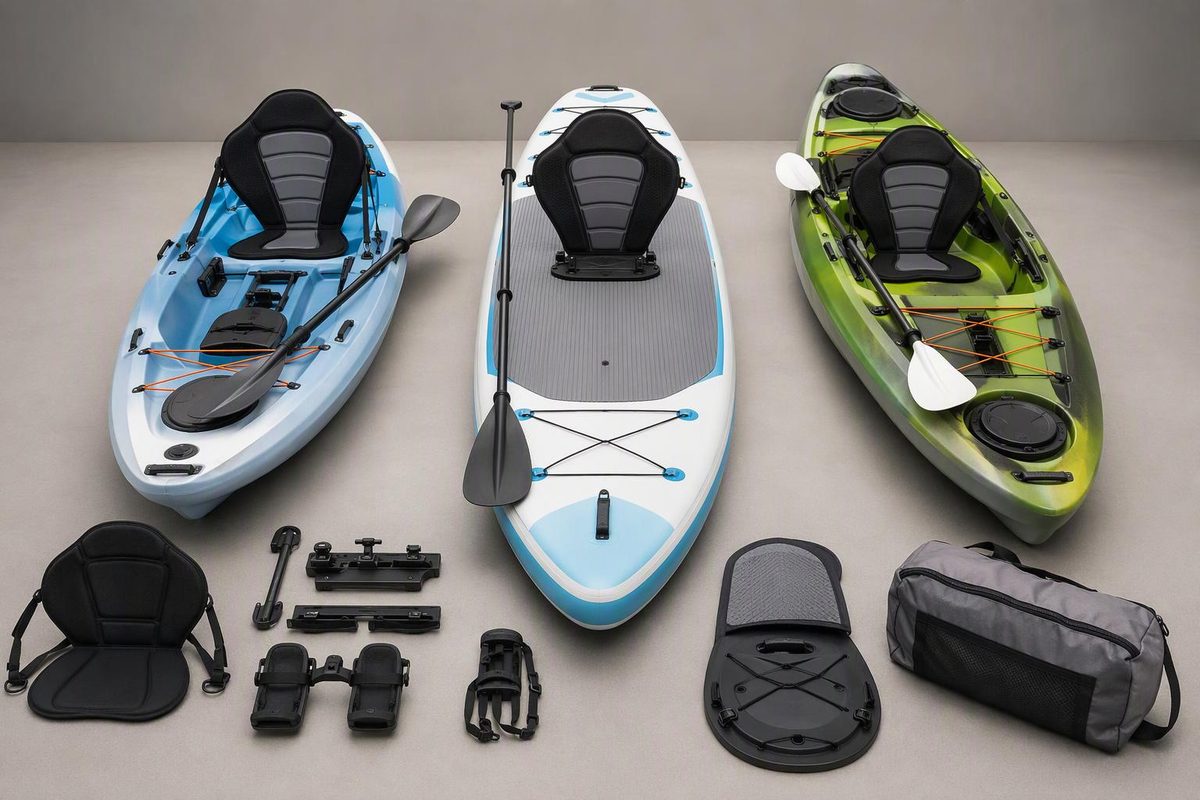
A kayak–stand up paddle board hybrid lets you paddle standing up or sit in an attached seat and use a double-bladed paddle. It makes most sense for relaxed outings on sheltered water when you genuinely want both positions—and have room to store only one craft.
Buy it for the flexibility, not because adding a seat makes a paddleboard equivalent to a touring kayak. The seat changes your posture, not the board’s hull or width. If most of your trips will be seated, compare a dedicated kayak before paying for the hybrid package.
What makes a useful hybrid?
Look for a complete seated setup, not just a backrest clipped onto a board:
- A supported seat: Check the seat base as well as the backrest. Sit in it wearing your paddling PFD and make sure the straps hold your chosen position.
- An adjustable footrest: You should be able to reach it with comfortably bent knees without moving the seat outside the manufacturer’s recommended seating position.
- Suitable attachment points: Verify the manufacturer’s approved seat and footrest connections. Cargo bungees alone do not establish compatibility.
- A paddle for both modes: Some packages include a paddle that swaps its SUP handle for a second blade; others require a separate kayak paddle.
- A clear standing area: Establish where the seat, footrest and spare paddle parts go when removed. “Convertible” is less useful if the accessories occupy your foot space.
For example, ISLE’s Switch 3 includes an elevated seat, foot brace and four-piece SUP–kayak paddle. TAHE’s Beach SUP-Yak 10‘6 package likewise includes a removable seat, adjustable footrest and hybrid paddle. Both use attachment systems that allow you to reposition the seating components.
Two examples—and what their specifications tell you
These are manufacturer-listed specifications checked on October 14, 2026, not results from a Kayaks Hub comparison test.
| Model | Length × width × thickness | Listed board weight | Listed capacity | What to check next |
|---|---|---|---|---|
| ISLE Switch 3 | 11‘6 × 35.5 × 6 inches | 19 lb | 425 lb | Seat and foot-brace fit; total packed weight |
| TAHE Beach SUP-Yak 10‘6 | 10‘6 × 34 × 6 inches | 23 lb | 300 lb maximum rider weight | Package contents and dealer availability; TAHE lists a 32 lb complete backpack package |
TAHE’s US product page showed the package as out of stock on the date checked.
Do not treat the two capacity figures as directly comparable performance ratings. Confirm how each manufacturer defines its limit and include passengers, pets and gear. TAHE’s sizing guide explicitly tells buyers to include those additional weights when choosing a board. Capacity alone does not establish which board will feel steadier or paddle better for you.
Transport deserves the same attention. Board weight is not the full launch load: seat, paddle, pump, bag and personal equipment also need carrying. Check the packed dimensions against your car and storage space, and assess the full load for any walk from parking to water.
Where the compromise shows up
Seated comfort needs a trial. In its Beach SUP-Yak test, OutdoorGearLab reported that getting the seat supportive and the footrest positioned correctly took several tries. That is a useful reason to seek a demo or rental rather than judge comfort from photographs.
Calm-water stability does not settle rough-water performance. The same testers found that their TAHE’s nose lifted over chop and the board bounced around more than others over waves. Their review describes a fixed-fin board, while TAHE’s current listing advertises a removable single fin: do not assume the test covers the exact configuration now offered. Nor does that finding apply to every hybrid. A broad deck and a seat are not enough to choose a craft for exposed crossings.
Conversion adds setup and loose components. Practise it ashore first. For early outings, choose the mode before launching rather than depending on an on-water change. If you expect to switch mid-trip, work out how to secure every removed component without obstructing paddling or reboarding.
If distance, persistent wind or predominantly seated paddling defines your usual trip, start with our kayak versus stand up paddle board comparison.
Already own a SUP? Check before buying a kit
Ask the board maker whether your exact model supports a kayak seat and footrest, which fittings are approved, and where they should attach. Do not assume a universal clip-on seat provides the same setup as a purpose-designed package.
Compare the complete cost: compatible seat, footrest, second paddle blade or kayak paddle, and any missing pump, bag or safety equipment. For a separate paddle, use our kayak paddle sizing guide as a starting point, then verify clearance with the hybrid’s width and seat height.
Plan the first launch around recovery
Wear a properly fitted paddling PFD, dress for immersion, carry communication on your person, and practise getting back aboard with the seat installed in sheltered conditions with help nearby. The RNLI’s paddleboarding guidance recommends lessons that include reboarding, checking weather and tides, and avoiding offshore winds.
Do not treat the bundled leash as automatically suitable. The RNLI warns that ankle leashes may be inappropriate in tidal or flowing water where entrapment is possible, and recommends a quick-release waist leash for those paddleboarding settings. Before using a hybrid on moving water, get instruction from someone familiar with the craft and location. Check that you can reach and operate the appropriate release system in both seated and standing configurations.