
Choose Your Craft by Comfort, Water and Storage
Compare kayaks and stand up paddle boards for seated comfort, touring, wind, storage and recovery skills, then choose the craft that fits your outings.
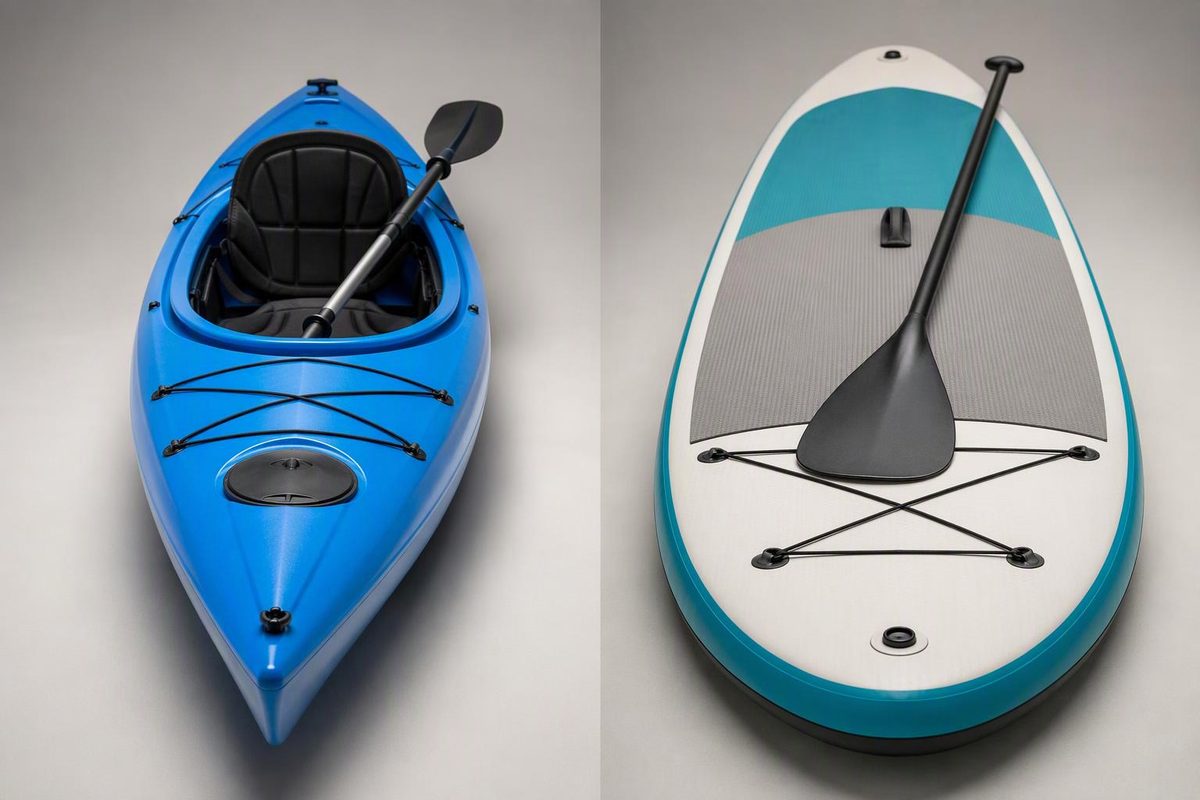
Choose a kayak for seated paddling, destination trips or covered gear storage. Choose a stand up paddle board (SUP) for an open deck and the freedom to stand, kneel or sit. Beginners should start either on sheltered water. If storage decides the purchase, compare an inflatable SUP with an inflatable or folding kayak—not only with a full-size hard-shell boat.
Neither category is automatically safer, faster or more comfortable. The exact craft, your fit and your ability to recover after falling in matter more than the label.
Pick your main priority and storage space to find a starting point for your trial.
Find Your First Craft to Try
Starting Point, Not a Safety Rating
Try a Stable Recreational Kayak
Seated paddling avoids the need to learn standing balance. Check the actual seat, foot support and launch access.
With room for a rigid craft, compare models by fit and the hardest carry or vehicle lift.
Use sheltered water for a beginner trial. Practise recovery with instruction and supervision before relying on either craft.
Source: REI kayak and SUP buying guides and RNLI recovery guidance cited in the article. Recommendations are qualitative, not model rankings.
Compare Craft Built for the Same Outing
These are starting points for ordinary recreational use, not comparisons between racing boards, sea kayaks or whitewater craft.
| Your Priority | Kayak | Stand Up Paddle Board |
|---|---|---|
| Beginner comfort | A stable recreational model lets you paddle seated | Standing adds a balance skill; kneeling is an option |
| Changing position | Mostly seated; seat and foot support must fit | Stand, kneel or sit |
| Destination trips | Consider a day-touring or touring kayak | Consider a touring board rather than a broad leisure board |
| Fishing or equipment | Fishing fittings or covered touring storage | Accessible open deck; secure and waterproof gear |
| Swimming breaks | A sit-on-top can work if you can re-enter it | An open board works if you can climb back on |
| Limited storage | Consider inflatable or folding models | An inflatable packs into a bag; a solid board needs substantial space |
REI’s kayak guide distinguishes recreational, touring and fishing designs. Its SUP buying guide distinguishes leisure boards from efficient displacement-hull touring boards. SUPs are not limited to short trips, but a broad leisure board is not the right comparison for a touring kayak.
Seated Paddling Helps in Wind, but Does Not Guarantee Safety
A low kayak seat reduces the balancing demand compared with standing on a board. Standing also exposes more of your body to the wind—one reason paddle manufacturer Bending Branches favors kayaks in windy conditions.
That does not mean a recreational kayak is suitable whenever a SUP feels difficult. REI’s kayak guide warns that recreational kayaks can be overmatched when whitecaps appear. A narrow performance kayak also will not feel like a wide recreational boat.
For SUP beginners, choose sheltered water and avoid offshore winds. The RNLI warns that offshore winds can make apparently calm water deceptive, carrying a board away from shore and making the return exhausting. Kneeling is a useful skill, not permission to launch in unsuitable weather.
For either craft, check the forecast, gusts, current and possible landing places along the return route—not just conditions beside the launch.
Comfort Depends on Fit and Recovery
A kayak is the better starting point if you want to remain seated. Try the actual seat: check foot support, knee room and whether you can enter and leave the craft at your usual launch. A sit-inside cockpit and a sit-on-top seat pose different access challenges.
A SUP offers more position changes, but kneeling may bother your knees and standing may tire you. A clip-on seat does not prove a board will paddle or support your body as well as a purpose-built kayak. Test the seated setup if that is how you intend to use it.
Include recovery in your trial. With instruction and supervision, practise climbing onto the board or re-entering the kayak while wearing your paddling equipment. A sit-inside kayak may require a wet exit and water removal after capsizing; an open board still requires enough strength and technique to climb aboard.
The RNLI recommends learning and practising both kayak re-entry and getting back onto a SUP, rather than assuming you can manage it when needed.
Compare the Whole Ownership Job
Capacity Must Suit Your Loaded Craft
Add your weight, clothing, water and equipment, plus any passenger or dog. Check the manufacturer’s capacity definition and recommended paddler weight range; a maximum load is not a promise of good handling. REI’s SUP guide explains how loading affects performance, especially on displacement-hull boards.
The Hardest Lift Matters More Than Packed Size
Check whether you can carry the craft from parking to water and load it onto your vehicle alone. For inflatables, include the pump and accessories in the carry load.
Measure the packed bag or rigid craft against your available storage. Consider inflation, assembly, cleaning and drying—not just whether it fits in a closet. A compact package solves a space problem, not necessarily a carrying or setup problem.
If compact storage is your main reason for choosing a SUP, also consider our inflatable kayak guide and folding kayak buying guide.
Compare Complete Setups, Not Package Prices
Include a suitable paddle, personal flotation device (PFD), transport equipment, waterproof storage, necessary safety equipment and instruction. Check what each package actually includes. There are no comparable package prices here, so neither category can be declared the cheaper choice.
Safety Equipment and Skills Can Change the Choice
Wear a properly fitted paddling PFD on either craft, dress for possible immersion rather than warm air alone, and keep a suitable means of calling for help on your body. These are central points in the RNLI’s SUP and kayaking guidance cited above.
For a SUP, leash choice depends on the water. Do not assume the supplied ankle leash is appropriate everywhere: the RNLI recommends a quick-release waist leash in tidal or flowing water where entrapment is a risk. Get instruction in choosing and releasing it before paddling there.
Before committing, rent both on sheltered water. Test comfort, turning and carrying, and arrange supervised recovery practice—not just a few easy strokes. Choose the craft that fits your ordinary outing and your launch, control and recovery skills.