
How to Choose a Kayak That Really Works for Three People
Sea Eagle lists a maximum of three people for the 380x, but its copy says one or two and its displayed multi-seat packages contain only two seats.
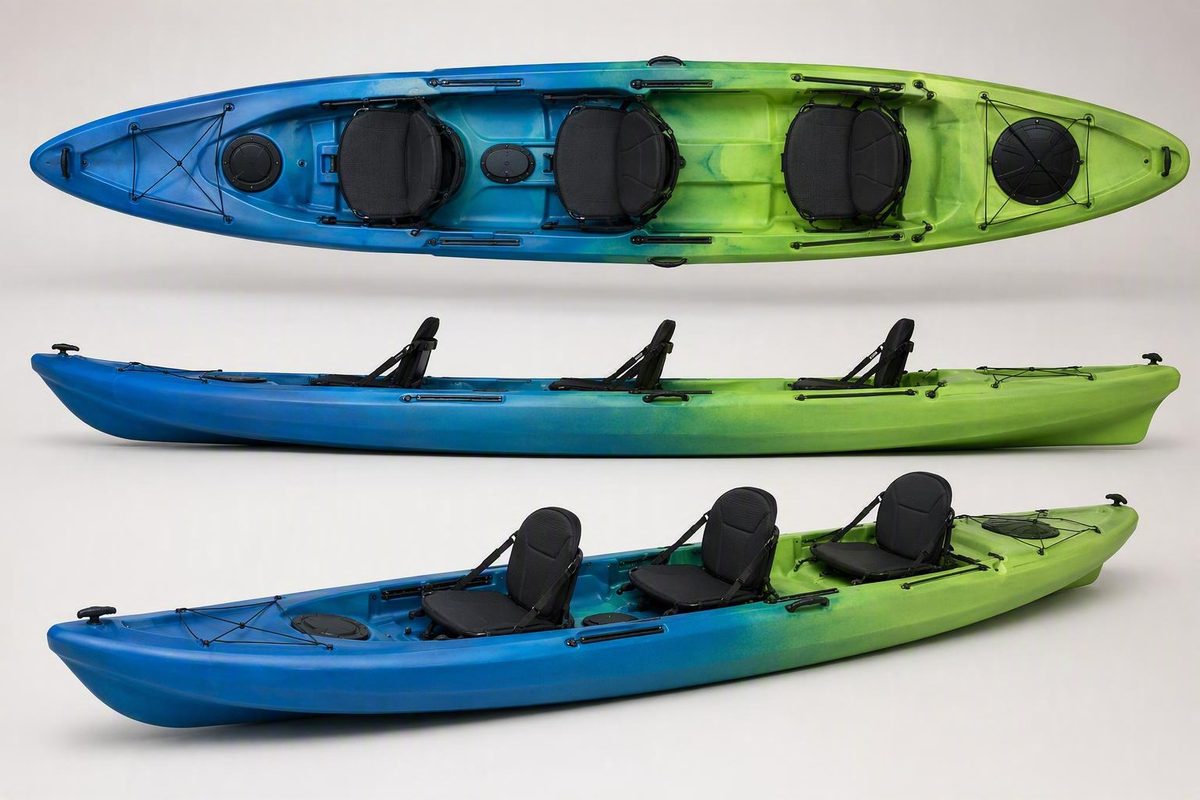
A “three person kayak” label does not necessarily mean three adults can sit, paddle, and control the boat comfortably. It may indicate a maximum occupant rating, an optional third seat, or enough open space for a small child between two adults.
Before buying, separate the marketing label from the questions that matter:
- Who will be aboard?
- Where will each person sit?
- Is every position approved by the manufacturer?
- What will the complete load weigh?
- Is the kayak intended for your water and conditions?
- Can the group transport, launch, recover, dry, and store it?
The available product evidence comes primarily from manufacturers, sellers, marketplaces, directories, and a used-boat listing—not comparable independent testing. This guide therefore provides a specification-led shortlist and buying process rather than declaring an unsupported overall winner.
Editorial review date: August 8, 2026. Prices and availability below are undated captured figures from the supplied product pages and must be rechecked before publication or purchase. Product performance was not independently tested.
What qualifies as a true three-person kayak?
A genuine triple should meet three basic tests:
- The manufacturer approves a three-occupant configuration.
- The maximum payload accommodates all occupants and their equipment.
- The craft has three usable seating positions for the intended people.
The third test is easily overlooked. Positions suitable for two adults and a small child may not fit three adults. A high load rating also says nothing by itself about seat width, cockpit dimensions, legroom, paddle clearance, or correct weight distribution.
Record four answers separately when examining a listing:
- Permitted occupants: Does the manufacturer specify three people, three paddlers, or three adults?
- Supplied seats: Are three seats included in the exact package?
- Maximum load: Does it cover occupants, removable seats, paddles, safety equipment, water, and luggage?
- Usable fit: Are the designated positions realistically sized and spaced for your group?
Do not use one answer as a substitute for another. A 750-pound capacity is not proof of three adult-sized seats. Conversely, three designated positions do not guarantee enough remaining capacity for three larger occupants and their gear.
Some directories and product listings blur these distinctions. A model may require an optional third seat, appear under overlapping categories, or carry a three-person specification while its description and packages emphasize one or two paddlers. Treat directory filters as discovery tools, not confirmation of manufacturer approval.
Three adults and two adults with a child can have the same combined weight while requiring very different layouts. A child may need a smaller center position, but open cargo space or an adult’s lap does not become an approved passenger seat simply because the child fits there.
Warning signs include:
- The headline says “three person,” but the package includes two seats.
- The third seat is an optional accessory.
- Capacity is stated only as a weight, with no occupant limit.
- Photographs show three people, but the manual describes solo or tandem use.
- A gear compartment is treated as passenger space.
- Search results mix kayaks with paddleboards or canoes.
- The seller cannot identify the third-seat attachments or recommended loading arrangement.
A roomy tandem, canoe, or convertible paddleboard may suit a family. It should not be treated as a dedicated triple kayak unless the manufacturer expressly approves the intended number and arrangement of occupants.
Choose for the people aboard, not the passenger number
Start with the crew rather than choosing a boat first and trying to make everyone fit afterward.
Three adults
This is the most demanding interpretation of “three person.” Prioritize:
- Explicit approval for three adults or three paddlers
- Three adult-sized seating positions
- Appropriate seat and footrest adjustment
- Enough separation for three paddle strokes
- A complete loaded weight below the published maximum
- Written confirmation that all three seats and attachments are included
- A realistic plan for carrying, launching, and recovering the hull
Ask for seat-to-seat distances, usable interior width, cockpit dimensions, footrest ranges, and recommended occupant sizes. If a manufacturer says only “up to three people,” ask whether that includes three adults and whether all three positions are intended for active paddling.
A land-based fit check is useful, but it cannot establish handling on the water. When possible, follow it with an appropriately supervised demonstration using the intended seating and load arrangement.
Two adults and one child
Favor a dedicated center seat, center cockpit, or another position expressly approved by the manufacturer. Do not assume a child may ride on an adult’s lap or in a cargo compartment.
A center position may be useful, but verify rather than assume that it provides adequate clearance from both adult paddlers, suitable support for the child, and correct loading for the exact model. Ask whether either adult can control the loaded kayak if the child stops paddling or the other adult must focus on supervision.
A 2008 family-paddling discussion includes personal reports about optional center cockpits and the difficulty of handling large triples ashore. These are useful questions to investigate, not current specifications or professional safety findings. The same discussion cautions that lap seating can interfere with paddler movement and bracing; confirm an approved alternative in the manufacturer’s instructions. The original WestCoastPaddler discussion should be read as dated anecdotal evidence only.
One adult and two children
This arrangement places more responsibility on the adult. Investigate:
- Whether both child positions are approved
- Whether the adult can occupy an effective control position
- How the boat is intended to be used if neither child paddles
- Whether launch and landing are manageable while supervising both children
- What recovery or re-entry procedure the manufacturer specifies
- Whether the planned distance leaves the adult enough energy to return
Age alone does not determine whether a child is ready. Size, maturity, swimming ability, comfort around water, strength, coordination, experience, conditions, and ability to wear a correctly fitted PFD all matter.
REI recommends starting with approximately one adult per child until the group’s abilities are known. It also recommends properly sized PFDs and calm, protected water for introductory family paddling. That is conservative general guidance, not authorization for a specific seating arrangement or a replacement for local requirements. REI’s family paddling guidance provides the full context.
Two active paddlers, plus a third position or expedition gear
Some buyers want a tandem-style craft that can occasionally carry a third occupant. Others need three designated positions but expect only two people to paddle actively. Expedition users may want substantial storage around an unused position.
Establish whether:
- The third seat is standard, optional, or unavailable
- The two-person configuration is approved
- The boat can be loaded and trimmed correctly with two occupants
- An empty position may hold secured equipment
- Gear would obstruct controls, drainage, access, or recovery
- The manufacturer supplies loading diagrams for different configurations
An unused seat area is not unrestricted cargo space. The total load must remain within the stated limit, and equipment must be positioned and secured according to the manual.
Inflatable, rigid, folding, sit-on-top, or sit-inside?
The three-person market includes inflatable, rigid, and folding hulls as well as sit-on-top and sit-inside layouts. In the supplied NauticExpo snapshot, overlapping directory filters showed 20 inflatable, 12 rigid, and two folding products, along with 25 sit-on-top and nine sit-in entries. Because the data are aggregated and categories overlap, those counts do not independently verify individual models. NauticExpo’s three-person kayak directory is best used to discover options for direct manufacturer verification.
Inflatable
An inflatable may solve storage and vehicle-transport problems when a full-length rigid hull will not fit. Packed dimensions matter as much as bare hull weight: verify that the bag fits through storage doors, into the vehicle, and in the area where the kayak will be dried.
Ownership may involve:
- Inflation and pressure checks before launching
- Different pressure limits for separate chambers
- Deflation and packing after use
- Thorough drying before storage
- Inspection of valves, seams, floor, seats, and fins
- Pump and pressure-gauge maintenance
- Carrying a model-compatible repair kit
- Following the manufacturer’s repair limits
Do not assume every inflatable is light, quick to prepare, or manageable by one person. Compare the complete packed package, including seats, pump, paddles, bag, and repair equipment.
Rigid
A rigid kayak avoids inflation and deflation, but storage and transport may dominate ownership. The documented rigid examples in this guide are longer than 20 feet and weigh approximately 93 to 105 pounds, based on their seller listings.
Before buying, rehearse the full journey:
- Remove the kayak from storage.
- Lift it onto the vehicle or trailer.
- Secure it using equipment suitable for the hull and vehicle.
- Unload it at the destination.
- Carry it to the water.
- Repeat the process after the trip.
A long carry, stairs, docks, narrow paths, or a steep launch may matter more in practice than the absence of setup time.
Folding
The supplied directory confirms that three-person folding products exist, but it does not support broad conclusions about setup time, handling, maintenance, speed, or durability.
Evaluate the exact model, its assembly instructions, packed size, component inventory, repair process, and manufacturer-supported seating arrangement.
Sit-on-top versus sit-inside
Buyers must still investigate seat attachments, load placement, drainage, exposure to water, and the manufacturer’s re-entry procedure.
Sit-inside triples introduce additional questions:
- Do all occupants fit the cockpit openings?
- Are there separate cockpits or one open interior?
- What bulkheads or flotation compartments are present?
- How is water removed after swamping?
- What exit procedure applies to every position?
- What recovery technique does the manufacturer prescribe?
- Can the group re-enter the actual loaded configuration?
Those outcomes depend on the individual hull, load, paddlers, conditions, and operating technique.
Storage and transport worksheet
Complete this before ordering:
| Question | Your answer |
|---|---|
| Hull length, width, and height | |
| Packed dimensions, if applicable | |
| Bare hull weight | |
| Complete package weight | |
| Number of people needed to carry it | |
| Vehicle roof and rack limits | |
| Trailer required? | |
| Secure storage dimensions | |
| Drying space for an inflatable | |
| Carry distance from vehicle to water | |
| Stairs, gates, docks, or narrow paths | |
| Time available for assembly or inflation |
A specification-led shortlist of three-person kayak options
This shortlist is based on manufacturer, seller, marketplace, directory, and used-product specifications. It is not a hands-on ranking and does not identify a “best” three-person kayak.
Prices are undated captured figures, not guaranteed current offers. Recheck the exact model, package, delivered price, inventory, and documentation immediately before purchase.
| Model and cited listing | Source type | Construction | Stated occupancy and supplied seats | Dimensions | Hull weight | Maximum load | Stated setup time | Seller-described water or use | Captured price | Main questions to resolve |
|---|---|---|---|---|---|---|---|---|---|---|
| BEYOND MARINA triple | Seller/manufacturer page | Tri-chamber drop-stitch inflatable | Marketed for three; exact standard-package seat inventory is unclear | 15.1 ft × 32 in; image text also says 15 ft 3 in | 41.89 lb | 661 lb | 5 minutes | Primarily calmer recreational water | $799.99 sale price | Exact length, pressure figures, stock, three-seat inclusion, package contents |
| Sea Eagle 380x Explorer | Manufacturer page | Inflatable with removable drop-stitch floor | Specification says three people; copy says one or two; displayed multi-seat packages show two seats | 12 ft 6 in × 3 ft 2 in | 40 lb | 750 lb | 8 minutes | Flat water, open water and manufacturer-rated up to Class IV | $899–$1,249 across displayed packages | Approved third-seat arrangement, adult fit, exact package |
| Bestway Hydro-Force Rapid X3 marketplace result | Marketplace search capture | Inflatable | Listed for up to three people; accessories named in captured result | 12 ft 6 in × 39 in | Not provided by cited source | Not provided by cited source | Not provided by cited source | Not provided by cited source | $280.60 | Stable product page, current load rating, seat layout, pressure, manual, package |
| Wooden Boat USA K157 | Manufacturer/retailer page | Cedar and hardwood with fiberglass and epoxy | Three listed adult seats | 248 in, approximately 20 ft 8 in; width not provided | 92.6 lb | Not provided by cited source | Not applicable | Touring and recreation described by seller | $12,301.66 | Beam, payload, cockpit fit, accessories, availability, transport |
| Northwest Kayaks Seascape 3 | Used-product listing | Rigid; material not established | Three seats | 22 ft 1 in; width not provided | 105 lb | 900 lb | Not applicable | Expedition-oriented used listing | $5,599 used price | Availability, condition, material, accessories, manual, warranty |
BEYOND MARINA triple inflatable
The seller describes a full drop-stitch, tri-chamber inflatable with removable seats and footrests. It also depicts paddles, fins, a carrying bag, and other equipment, but it does not consolidate the standard package into one unambiguous textual inventory.
Several conflicts require written clarification. The title and specifications indicate 15 feet 1 inch, while image text indicates 15 feet 3 inches. The page displays both “more stock coming soon” and an in-stock message. It also presents an 8–10 psi range beside a single 0.55 bar figure, which does not clearly state the complete converted range. The BEYOND MARINA product page should be checked again for the exact package and current instructions.
Treat claims about tracking, stability, rigidity, comfort, durability, and comparative performance as seller marketing rather than controlled test results.
Sea Eagle 380x Explorer
The manufacturer lists three independent chambers, a removable drop-stitch floor, 16 floor drains, and a removable skeg. Different packages contain different combinations of seats, paddles, and accessories.
The occupancy conflict is more important than the headline capacity. The specification states a maximum of three people, but the descriptive copy says the 380x is made for one or two people, and the displayed multi-seat packages contain two seats. Obtain direct confirmation of the approved third seat, attachment points, and three-person arrangement before treating it as a triple. Sea Eagle’s 380x page documents both the specification and the conflicting sales copy.
Sea Eagle gives the model a manufacturer rating up to Class IV whitewater. That is not an independent safety finding or a recommendation for a particular river or paddler. Use in demanding water would still require model-specific instruction, suitable skills and equipment, an appropriate rescue plan, and acceptable conditions.
Bestway Hydro-Force Rapid X3
The supplied Amazon search capture presented the Rapid X3 as an inflatable for up to three people. It named paddles, a hand pump, fins, a carry bag, and a repair patch as included equipment.
The precise price, dimensions, package description, and “Overall Pick” designation came from a dynamic search-results page rather than a stable manufacturer or product-detail page. Search results may vary by time, location, inventory, size, and seller. Amazon’s captured three-person kayak results should therefore be treated only as a marketplace lead.
Do not rely on a marketplace badge, rating, or search placement as evidence of safety, reliability, or comparative performance. Locate the current manual or manufacturer documentation and verify the load rating, approved seating, pressure limits, warranty, and exact package before considering this model.
Wooden Boat USA K157
The K157 illustrates the premium rigid end of the shortlist. Its seller describes three adult seats and cedar-and-hardwood construction protected by fiberglass and polished epoxy.
The page does not provide a maximum load, beam, cockpit dimensions, or complete accessory inventory. It also displays conflicting sold-out and purchase controls. Claims about easy transport, stability, paddling effort, and maneuverability are promotional and should not be treated as established performance facts. The K157 listing needs direct follow-up before any order.
At more than 20 feet long and over 90 pounds, its storage space, vehicle support, lifting plan, and launch access require explicit planning.
Northwest Kayaks Seascape 3
The used listing clearly labels the Seascape 3 with three seats and supplies cockpit measurements in addition to the length, weight, and load capacity shown in the table.
However, much of the promotional narrative discusses a related tandem rather than the triple. Those tandem claims should not be transferred to the Seascape 3. The page also says used-kayak sales are suspended until summer, without establishing immediate availability. The Seascape 3 used listing supports only the specifications clearly attached to that model.
A buyer would still need a condition report, current manual, material and repair information, accessory inventory, transport plan, and confirmation of warranty status and availability.
Shortlist by use case
Instead of choosing a universal winner, sort candidates into practical groups:
- Compact-storage candidates: Inflatable or folding models whose complete packed dimensions suit the vehicle and storage area.
- Dedicated adult-seat candidates: Models that explicitly document three adult positions, adequate fit, and suitable paddle spacing.
- High-capacity rigid craft: Long triples such as the Seascape 3, where the listed load is substantial but transport and storage are demanding.
- Occupancy-clarification candidates: Models such as the 380x, where the person rating, descriptive copy, and supplied-seat packages do not align.
- Incomplete-documentation candidates: Products for which payload, beam, seating details, manuals, or package contents remain unavailable.
Run a loaded-capacity audit before buying
Maximum load must cover more than body weight. Create an inventory containing:
- Every occupant
- Removable seats and footrests
- Paddles and any spare paddle
- PFDs
- Drinking water and food
- First-aid equipment
- Pump and repair supplies
- Clothing and footwear
- Sun and cold-weather protection
- Fishing equipment
- Electronics and dry bags
- Overnight luggage
- Any permitted cart, anchor, motor, or battery carried aboard
Use this paper calculation:
Stated maximum load − total passenger weight − all equipment = remaining numerical capacity
If three occupants and all equipment total 600 pounds, a 661-pound maximum leaves 61 pounds of numerical headroom. That arithmetic does not prove that the seats fit, the kayak is comfortable, the load is correctly distributed, or the hull will handle suitably.
Likewise, a 750- or 900-pound rating may leave more numerical capacity than a 661-pound rating while still failing to establish adult-sized seating, balanced trim, legroom, or paddle clearance.
Avoid planning to reach the published maximum. Preserve a prudent margin for omitted items and real-world variation, but do not apply an unsupported universal percentage. Ask the manufacturer how the stated limit is defined and follow the current model-specific manual.
Request the manufacturer’s loading diagram and check that equipment cannot shift, obstruct a paddler, block drains, impede an exit, or be lost during a capsize.
Remaining below the number is necessary but does not establish suitable fit or handling.
Request these measurements before committing:
- Usable width at each position
- Distance between seat reference points
- Cockpit opening length and width
- Cockpit depth
- Legroom and footrest range
- Seat width and back support
- Third-seat attachment method
- Paddle clearance between occupants
- Recommended occupant arrangement
- Model-specific loading diagram
Whenever possible, have all intended occupants sit in the fully assembled boat on land under dealer supervision before arranging an appropriate loaded demonstration.
Compare the complete package and ownership burden
Headline prices are not directly comparable when packages contain different equipment. One may include seats, paddles, a pump, fins, a bag, and repair supplies; another may include little beyond the hull.
Verify whether the exact package contains:
- Three manufacturer-approved seats
- All third-seat attachment hardware
- Three suitable paddles if all occupants will paddle
- Adjustable footrests
- Manual or electric pump
- Pressure gauge and correct valve adapters
- Fins or skeg
- Carry bag
- Repair kit
- PFDs for every occupant
- Cart or carrying straps
- Roof rack, cradles, tie-downs, or trailer
- Spray skirts or covers where applicable
- Model-specific drainage and recovery equipment
- A current printed or downloadable manual
The captured Bestway search result names paddles, a hand pump, fins, a bag, and a repair patch. BEYOND MARINA depicts several accessories but does not present one complete textual standard-package inventory. Sea Eagle offers multiple package configurations, so compare the package code and contents rather than the hull name alone.
The known bare-hull weights in the shortlist range from approximately 40–42 pounds for the documented inflatables to 92.6 pounds for the K157 and 105 pounds for the Seascape 3.
Inflatable ownership also includes drying, pressure management, inspection, and model-specific repairs. BEYOND MARINA says small pinholes or punctures may be repaired with its supplied kit while seam leaks require replacement. That is seller guidance for its own product, not a universal repair rule.
Before paying, obtain current written details for:
- Delivered price
- Tax and shipping
- Inventory and delivery timing
- Warranty coverage
- Return conditions and costs
- Replacement seats, valves, fins, floors, and other parts
- Applicable certification
- Exact package contents
- Third-seat price and compatibility
- Required transport equipment
Temporary discounts, marketplace badges, seller-selected reviews, and average review scores do not answer the central questions of approved occupancy, fit, load, recovery, or suitability for the intended water.
When a tandem kayak or canoe may be the better answer
A dedicated triple is only one possible solution.
-
Do three occupants need designated positions, shared propulsion, and one-boat coordination? Investigate a purpose-built triple.
-
Will the group normally be two adults and one small child? Consider a manufacturer-approved tandem-plus-child arrangement with a dedicated center position.
-
Are open space and easy access to gear priorities? Compare an appropriately rated canoe.
-
Can a child control a separate kayak in the intended conditions, with suitable supervision and a workable assistance plan? Consider separate boats.
Purpose-built triple
A genuine triple makes sense when three approved positions and coordinated one-boat travel are central requirements. Potential drawbacks include length, weight, storage, transport, and limited practicality when only one person wants to paddle.
Manufacturer-approved tandem-plus-child arrangement
Some tandems are designed for a child in a dedicated center position. Others are strictly two-person craft despite having open space between their main seats.
Do not treat a tandem as a three-person craft merely because a child fits. Confirm:
- Approved occupant count
- Center-seat design and attachment
- Maximum load
- Intended conditions
- Loading arrangement
- Relevant manufacturer instructions
Keeping a child in the same boat may allow an adult to continue paddling when the child tires. That is a practical planning consideration, but user reports about such arrangements do not establish manufacturer approval for a particular model.
Canoe
A canoe may be practical when a family prioritizes open space, access to equipment, and room for children who are not active paddlers. REI describes canoes as a strong option for children under seven and notes that a large canoe may accommodate adults with two or three children, depending on the particular craft and occupants.
A canoe still requires approved seating, a capacity audit, suitable conditions, PFDs, and a recovery plan. Open space can improve convenience but does not remove the possibility of swamping or capsize.
Separate child kayak
A separate kayak may give a capable child independence and an active role. It also creates another craft that may require assistance if the child becomes tired, cold, frightened, or unable to control it.
Use this arrangement only when the child’s skills, supervision, communication plan, conditions, and the group’s assistance capability make it appropriate. Do not rely on a fixed age threshold.
Never use lap seating as a substitute for an approved position, and never strap a child into a kayak or canoe. Old Town advises that straps and cords should secure gear rather than restrain a child. Old Town’s family-paddling guidance also recommends calm water, weather monitoring, sun protection, food, water, and properly fitted PFDs.
Safety and final verification before launch
Before purchase, verify:
- Exact model, year, and variant
- Approved occupant count
- Whether three adults are permitted, if relevant
- Third-seat status and attachment system
- Maximum load and how it is defined
- Complete loaded weight
- Seat, cockpit, and legroom fit
- Intended water classification
- Inflation pressure for every chamber
- Drainage configuration
- Bulkheads and flotation
- Warranty and replacement-parts support
- Applicable certification
- Current owner’s manual
- Manufacturer-prescribed recovery procedure
Every occupant should wear a properly fitted PFD. For U.S. paddling, REI recommends appropriately sized, U.S. Coast Guard-approved PFDs; elsewhere, use equipment approved under the applicable local system. Child and youth models should be selected by fit and labeled size rather than age alone.
Begin on calm, protected water with minimal current. Keep early outings close to an easy landing and short enough to turn back before fatigue becomes a problem. REI suggests approximately 30–60 minutes for a first family trip and advises reviewing wet-exit procedures before launching. Treat the time range as conservative general guidance, not a universal limit or proof that a particular trip is suitable. REI’s guidance for kayaking with children explains those recommendations.
A launch checklist should include:
- Properly fitted PFDs
- Weather and water-condition check
- Appropriate clothing and footwear
- Sun protection
- Drinking water and food
- First-aid supplies
- Communication equipment suitable for the location
- Repair supplies and a pump for inflatables
- A spare paddle or other model-appropriate equipment
- Secure gear retention that does not obstruct occupants
- A float plan or shore contact where appropriate
Before relying on a boat in more demanding conditions, obtain suitable instruction and practice the procedures relevant to its exact layout. Depending on the model, these may include exiting, re-entry, drainage, capsize recovery, towing, and group communication. Use the current owner’s manual and qualified local instruction rather than improvising from generic advice.
A manufacturer’s river or whitewater classification does not establish personal readiness. It cannot replace paddling skill, model-specific instruction, appropriate equipment, local knowledge, acceptable water and weather conditions, or a workable emergency plan.
Do not buy while important facts remain contradictory. Require the seller or manufacturer to resolve occupant count, third-seat approval, dimensions, pressure limits, package contents, and availability in writing.
Frequently asked questions
Can three adults fit in a three-person kayak?
Sometimes, but the label alone is insufficient. Look for explicit manufacturer approval for three adults or three paddlers, three adult-sized positions, adequate legroom and spacing, sufficient paddle clearance, and enough load capacity for everyone plus equipment.
A three-person weight limit is not proof that three adults can sit or paddle comfortably. Ask for an approved seating diagram and fit measurements before buying.
Can two adults and a child use a tandem kayak instead?
Only if the manufacturer approves that occupant arrangement and provides a suitable position. Open space between the main seats is not enough.
Verify the occupant limit, center-seat design, maximum load, intended conditions, and manual. Also consider whether either adult can control the fully loaded boat if the child stops paddling.
How much weight can a three-person kayak carry?
It varies by model, and some listings omit the figure entirely. Calculate the combined weight of passengers, seats, paddles, PFDs, water, food, repair equipment, clothing, and luggage.
Remain below the published maximum with a prudent margin, but remember that numerical capacity does not prove suitable seating, trim, paddle clearance, or handling.
Is an inflatable or rigid three-person kayak easier to own?
It depends on the owner’s constraints. An inflatable may occupy less storage space, but it requires inflation, pressure management, deflation, drying, inspection, and repair planning.
A rigid kayak avoids inflation and deflation but may require a suitable rack or trailer, long-term storage, multiple handlers, and convenient launch access. Compare the complete process from storage to water and back.
Is a three-person kayak better than a canoe for a family?
Not categorically. A purpose-built triple may provide three designated kayak positions and coordinated double-bladed paddling. A canoe may offer more open space and easier access to gear.
The better choice is the individual craft that is approved for the occupants, remains within its load limit, suits the intended water, can be transported and recovered by the group, and supports a realistic safety plan.
The final decision sequence is simple:
- Identify the exact occupant arrangement.
- Confirm three approved positions and determine which seats are included.
- Calculate the complete loaded weight.
- Match the exact model to the intended water.
- Decide whether transport, setup, drying, storage, and recovery are realistic.
- Obtain written clarification wherever occupancy, specifications, package contents, or availability conflict.
The right choice is the craft that fits the actual people, load, venue, safety plan, and ownership constraints—not merely the one carrying a “three person” label.