
Why a Proper Lookout Is Central to Avoiding Boat Collisions
For the common boating-safety question, choose B: failing to keep a proper lookout; broader accident data rank inattention separately.
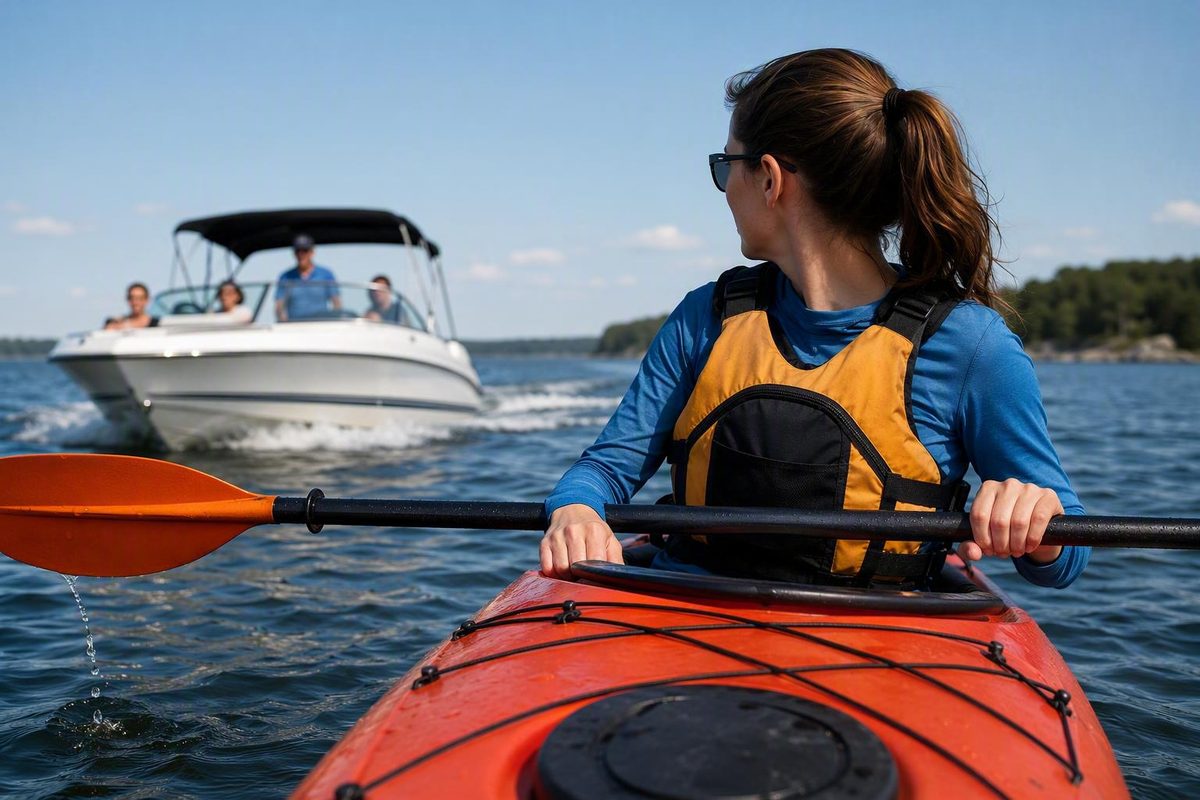
The short answer: failing to keep a proper lookout
For the common boating-safety multiple-choice question, choose B: failing to keep a proper lookout.
The choices are typically:
- Carrying alcohol aboard a vessel
- Failing to keep a proper lookout
- Jumping another vessel’s wake
- Displaying navigation lights incorrectly
The homework page containing this exact question selects failing to keep a proper lookout. Because that page is a third-party homework platform rather than an official boating-safety authority, it is best treated as evidence of the expected quiz answer—not proof of a universal statistical ranking.
The practical reasoning is straightforward. A proper lookout helps the operator detect another vessel, a fixed object, a swimmer, floating debris, or another developing hazard while there is still time to respond. If the hazard is not recognized until it is close, there may be too little room to slow, stop, reverse, or turn safely.
That answer must remain tied to the wording and choices. It does not establish that improper lookout is the leading cause of every boating collision in every year, jurisdiction, or dataset.
What keeping a proper lookout actually requires
Keeping a proper lookout does not mean staring straight over the bow. It means observing continuously by sight and hearing, using other appropriate means available under the circumstances, and building a complete picture of nearby traffic and hazards.
A useful scan covers the entire operating environment:
- Ahead: Watch for crossing traffic, stopped vessels, channel markers, floating objects, shoals, and changes in traffic flow.
- To both sides: Check for traffic before turning, leaving a dock, entering a channel, or crossing another vessel’s path.
- Behind: Look for vessels that may be overtaking and consider how your wake may affect others.
- Upward: Check bridge clearances, power lines, and other overhead hazards.
- Toward the water: Watch for swimmers, paddlers, logs, floating debris, buoys, diver-down flags, and objects that sit low in the water.
This broad approach reflects proper-lookout guidance covering sight, hearing, traffic, overhead hazards, swimmers, debris, and overtaking vessels. The purpose is not merely to see individual objects but to assess the situation and determine whether collision risk is developing.
Hearing is part of that process. An engine outside the current field of view, a horn signal, or a shouted warning may reveal a risk before it becomes visible. Wind, engine noise, passengers, and onboard audio can interfere, so the operator must make a deliberate effort to listen as well as look.
The goal is a traffic picture, not a series of glances
A lookout needs to determine:
- What is moving and what is fixed
- Which direction nearby vessels are traveling
- Whether vessels are crossing, meeting, or overtaking
- Whether the distance is closing
- Whether there is enough room to maneuver
- Whether a vessel or object is becoming a collision threat
That requires repeated observation. One glance shows where another vessel is at a particular moment; continued checks reveal how its position is changing relative to your boat.
Tunnel vision prevents that assessment. Looking only over the bow can conceal an overtaking vessel. Focusing on passengers can allow crossing traffic to develop unnoticed. Fixating on a phone, GPS, chartplotter, or fish finder can leave the actual surroundings unobserved.
Electronic aids can contribute useful information, but they do not replace looking and listening outside the boat.
Can another person serve as lookout?
A capable passenger or crew member can help, especially in crowded water, near swimmers, while docking, or whenever the operator’s view is restricted.
Give that person a specific assignment. “Watch our starboard side for crossing boats” is more useful than “Tell me if you see anything.” Reports should also be clear and early—for example, “Powerboat at two o’clock, moving left”—rather than vague warnings such as “Look out.”
A helper does not remove the operator’s need to remain attentive.
Earlier detection creates more options
A reliable lookout increases the interval between detecting a hazard and reaching it. More time may allow the operator to:
- Reduce speed gradually
- Stop or reverse when appropriate
- Make an early and obvious course alteration
- Communicate with passengers or crew
- Observe what the other vessel does next
- Avoid forcing another operator into an abrupt maneuver
Late detection has the opposite effect. It can transform an ordinary crossing or overtaking situation into an emergency in which even an otherwise suitable response becomes difficult to execute safely.
Improper lookout and operator inattention are related, but not identical
“Improper lookout” and “operator inattention” overlap in everyday language, but accident statistics report them as separate contributing factors.
Improper lookout refers more narrowly to failing to observe and assess vessels, people, objects, or conditions that may create collision risk. Examples include failing to check behind for overtaking traffic, not seeing a swimmer, or failing to track an approaching vessel.
Operator inattention is broader. It can include using a phone, socializing, concentrating on electronics, attending to passengers, or otherwise failing to devote adequate attention to operating the vessel.
Because the categories are reported separately, their counts should not be combined or substituted for one another.
What the 2023 figures say
A secondary summary of 2023 U.S. Coast Guard recreational-boating data reports these contributing-factor counts:
| Reported contributing factor | Accidents |
|---|---|
| Operator inattention | 586 |
| Improper lookout | 421 |
| Operator inexperience | 414 |
| Excessive speed | 299 |
| Alcohol use | 211 |
These are accident-wide counts reported in Sea Tow’s summary of the 2023 Coast Guard statistics. They are not limited to collisions, and a reported contributing factor is not necessarily the sole or legally determined cause of an accident.
The supported conclusion is therefore narrow: operator inattention had the highest accident count among those listed categories. These figures do not support changing that conclusion into “improper lookout caused the most collisions.”
A separate commercial summary of 2024 Coast Guard data reports operator inattention in 551 incidents, placing it first among the recreational-boating accident factors discussed. It again reports accidents generally rather than providing a collision-only ranking. The same 2024 overview reports 3,887 accidents, 556 fatalities, and 2,170 injuries overall.
Why the categories can overlap without being combined
Suppose an operator looks at a phone for too long and fails to see a crossing vessel. In ordinary conversation, the event involves both inattention and a failed lookout.
That does not mean the statistical categories can be added together. Doing so could double-count incidents or blend categories that the underlying reporting system treated independently. The available secondary summaries also do not provide enough record-level detail to determine how frequently both factors appeared in the same accident.
The defensible conclusions are:
- Improper lookout is the expected answer to the specific multiple-choice question.
- Operator inattention leads the cited accident-wide counts.
- The available summaries do not establish which factor leads among collisions alone.
Why the answer changes when the metric changes
Sources may appear to disagree because they are answering different questions. Before accepting any claim about a “leading cause,” identify what is actually being counted.
Three questions are especially easy to confuse:
-
What is the expected answer to this particular quiz? Failing to keep a proper lookout.
-
What is the most frequently reported contributing factor across recreational-boating accidents generally? Operator inattention in the cited 2023 and 2024 summaries.
-
Which listed contributing factor is associated with the most deaths? Alcohol use in those summaries.
All three answers can be true at the same time.
Accident frequency is not the same as fatality frequency
The 2023 secondary summary associates alcohol use with 79 deaths, the highest fatality count among its listed factors. That same summary reports 1,053 collisions with another recreational vessel and 449 collisions with fixed objects. They cannot be used interchangeably or combined into a collision-cause ranking. Those 2023 figures are attributed by the summary to Coast Guard recreational-boating statistics.
The 2024 summary associates alcohol use with 92 fatalities and describes it as the leading contributing factor in fatal boating accidents. That does not mean alcohol caused the greatest total number of reported accidents; operator inattention led the overall accident count in that summary.
A factor can occur in fewer accidents but be associated with more deaths. Conversely, another factor can appear in many nonfatal incidents and lead by total accident count without leading by fatalities.
When a question asks what causes the “most” incidents, determine whether it means:
- The greatest number of reported accidents
- The greatest number of collisions
- The most injuries
- The most deaths
- The expected answer among a limited set of course options
Without a defined metric, a simple ranking can be misleading.
Accident type is not a contributing factor
A collision with another recreational vessel is an accident type. A collision with a fixed object is another accident type.
By contrast, operator inattention, improper lookout, operator inexperience, excessive speed, and alcohol use are reported contributing factors. More than one factor may be associated with the same accident, and the presence of a factor does not necessarily establish the sole cause.
The totals for collisions with vessels and fixed objects therefore do not show which contributing factor occurred most often within those collision cases. Establishing that ranking would require a reliable cross-tabulation of accident type against contributing factor. The cited secondary summaries do not provide one.
A compact way to remember the distinction
| Question | Answer supported here |
|---|---|
| Which option should I select on the common quiz? | Failing to keep a proper lookout |
| Which factor leads the cited overall accident counts? | Operator inattention |
| Which factor leads the cited fatality counts? | Alcohol use |
| Which factor universally causes the most boat collisions? | Not established by the available evidence |
The numerical comparisons come from commercial boating organizations summarizing Coast Guard data, not from an independent audit by this publication. Their scope and limitations must therefore be preserved.
Why clear weather does not remove collision risk
Collisions are not confined to darkness, fog, storms, or rough water. Canadian boating-course guidance says that although some collisions occur at night, many happen during daylight on calm, clear days. It also identifies failure to stay alert and traveling faster than appropriate as recurring collision factors. These observations come from Canadian pleasure-craft safety guidance, not from the U.S. statistics discussed above.
Clear conditions improve the opportunity to see a hazard, but visibility helps only when someone is actively observing and interpreting the surroundings. A bright day does not guarantee that an operator will notice a low-profile paddler, swimmer, floating object, or vessel approaching from outside the current field of view.
Launch areas, marinas, and channels can still create complicated crossing and overtaking situations when the water is calm.
Glare and background clutter add difficulty.
The bounded lesson is not that clear days are more dangerous than poor visibility. It is that good conditions do not replace a continuous lookout.
Lookout and safe speed work together
Detecting a hazard is useful only if the vessel has enough time and distance to respond. Lookout and safe speed should therefore be treated as parts of the same collision-avoidance system.
A practical definition of safe speed is a speed that permits effective collision-avoidance action and allows the vessel to stop within an appropriate distance for the circumstances. That speed may be far below the boat’s mechanical maximum.
Relevant considerations include:
- Visibility: Fog, darkness, rain, spray, glare, and obstructions affect detection.
- Traffic density: More vessels create more crossing, meeting, and overtaking situations.
- Maneuverability: Turning ability and response differ among vessel types.
- Stopping distance: Momentum, propulsion, hull form, load, and conditions affect how a boat responds.
- Background lighting: Shore lights may make other vessels’ lights harder to distinguish.
- Wind, water, and current: These conditions can alter movement and maneuvering effectiveness.
- Nearby hazards: Docks, swimmers, shoals, rocks, markers, and narrow channels may limit available options.
- Depth relative to draft: Shallow water may restrict where a vessel can safely maneuver.
Canadian boating guidance likewise identifies both failure to stay alert and traveling faster than appropriate as common collision factors. The speedometer alone cannot determine whether a particular speed is safe.
Speed consumes reaction time
Collision avoidance involves a sequence:
- A hazard becomes observable.
- The operator detects it.
- The operator identifies it.
- The operator assesses whether risk is developing.
- The operator selects an action.
- The vessel responds.
It also increases the distance traveled while the operator is looking elsewhere, evaluating the situation, or waiting for the vessel to respond.
A good lookout cannot fully compensate for a speed that leaves inadequate stopping distance or maneuvering room. The reverse is also true: moving slowly does not excuse poor observation.
Maximum speed and safe speed are different
A vessel may be capable of traveling quickly in open water, but the same speed may be unsuitable near a marina, launch ramp, swimming area, narrow channel, bridge, blind bend, or group of anchored vessels.
Reducing speed before the encounter becomes close-quarters preserves more options. Waiting until the hazard is obvious may require abrupt action and make the operator’s intentions harder for others to interpret.
Speed limits, no-wake zones, and distance requirements vary by jurisdiction. Do not treat an example from one boating course or state as a universal rule. Check the navigation and operating requirements that apply where you boat.
A practical collision-avoidance routine
A repeatable routine makes it easier to maintain awareness when traffic becomes complicated. This sequence is general guidance, not a replacement for the navigation rules governing a particular encounter.
1. Scan continuously
Move your attention around the entire scene rather than holding it in one direction. Scan ahead, to both sides, behind, upward where overhead hazards exist, and toward the water.
Use short, repeated checks. Look for change: a vessel becoming larger, a paddler emerging from behind an anchored boat, or an object moving relative to your bow.
In crowded areas, ask a capable passenger to scan a defined sector and provide clear reports. Continue monitoring the situation yourself.
2. Listen for information you cannot yet see
Listen for engines, horn signals, shouted warnings, and changes in nearby vessel noise. Sound may reveal an overtaking vessel or traffic hidden by an obstruction.
Limit avoidable noise when approaching a blind turn, congested marina, bridge opening, or another area where hearing may supplement vision.
3. Identify and classify targets
For each relevant target, ask:
- Is it fixed or moving?
- Is it another powerboat, a sailboat, a paddler, a swimmer, or an obstruction?
- Is it crossing, meeting, or overtaking?
- Is its movement limited by a channel, shallow water, nearby traffic, or another hazard?
- Is the distance closing?
Do not assume another operator has seen you. Continue monitoring the encounter even when your own course appears predictable.
4. Check relative movement
An approaching vessel whose compass bearing remains approximately steady while the range closes can indicate collision risk. A changing bearing may suggest that the vessel will pass ahead or astern, but bearing change alone is not an all-clear: either vessel may alter course or speed, and visual estimates can be unreliable.
Continue tracking distance, direction, and movement until the vessels are safely clear. If there is doubt about whether collision risk exists, treat the risk as present and take appropriate action. Supported responses may include slowing, stopping, reversing when appropriate, or making an early and readily apparent course alteration, subject to the applicable navigation rules and the full circumstances of the encounter. These risk-assessment and response principles are set out in boating guidance on collision risk, safe speed, and early action.
5. Reassess speed and maneuvering room
Ask whether the current speed leaves enough room to respond if another vessel changes course or speed. Consider:
- Stopping distance
- Turning room
- Water depth
- Wind and current
- Traffic on the other side
- Hazards that make one direction unsafe
- How the vessel responds when loaded
Slowing early can create time to understand the encounter. It may also make your actions easier for other operators to recognize than a last-second maneuver.
6. Act early and make the action apparent
Do not choose a maneuver from a generic checklist without considering the complete encounter. The appropriate response depends on the vessels involved, their relative positions, the applicable navigation rules, nearby traffic, available depth, and handling characteristics.
Avoid a sequence of small, ambiguous course changes. When a course change is appropriate, an early and readily apparent alteration is easier for another operator to observe and incorporate into their decisions.
7. Confirm that the risk is resolving
Do not stop monitoring after taking action. Confirm that the other vessel’s relative position is changing in a way that increases passing distance, and be prepared to reassess if it alters course or speed.
Continue scanning for secondary hazards. Turning away from one vessel can place another vessel or obstruction ahead, while slowing in a channel may affect traffic approaching from behind.
Control common distractions
Simple controls can improve lookout quality:
- Put the phone away while underway.
- Use navigation displays for brief, purposeful checks rather than continuous fixation.
- Set up routes and equipment before entering busy water.
- Pause nonessential conversation during docking and close-quarters situations.
- Ask passengers not to obstruct the operator’s view.
- Keep frequently used controls and safety equipment accessible.
- If something aboard requires prolonged attention, slow or stop in an appropriate place before handling it.
Electronic navigation aids support awareness but represent only part of the operating environment. They do not eliminate the need to scan for nearby vessels, swimmers, paddlers, debris, and local hazards.
This routine is general safety information, not a substitute for an approved boating course or the navigation requirements in your jurisdiction. Kayaks Hub similarly presents its material as general information rather than a warranty or replacement for formal requirements.
Frequently asked questions
Which of these causes the most boating collisions: alcohol aboard, improper lookout, wake jumping, or incorrect navigation lights?
For that specific multiple-choice question, choose improper lookout, usually worded as failing to keep a proper lookout.
The answer is limited to those choices. It should not be generalized into a claim that improper lookout universally ranks first in every collision dataset.
What is the leading reported cause of recreational-boating accidents overall?
Operator inattention leads the cited U.S. recreational-boating accident summaries for 2023 and 2024.
Those rankings concern accidents generally, not collisions alone. Improper lookout appears as a separate reported category and should not be treated as a statistical synonym for operator inattention.
What contributing factor is associated with the most fatal boating accidents?
Alcohol use has the highest fatality count among the contributing factors listed in the cited 2023 and 2024 summaries.
That fatality ranking does not mean alcohol produced the greatest overall number of reported boating accidents. The answer changes depending on whether the metric is accidents, injuries, collisions, or deaths.
How can a boat operator tell whether another vessel poses a collision risk?
Observe the vessel repeatedly. If it remains in approximately the same direction relative to your boat while the distance closes, collision risk may exist.
A changing bearing does not by itself guarantee safe passage. Continue monitoring range, course, and speed until the vessels are safely clear. If uncertainty remains, treat the risk as present and respond in accordance with the applicable navigation rules.
Can boat collisions happen during daylight and calm weather?
Yes. Canadian boating-safety guidance says many collisions occur during daylight on calm, clear days.
Good visibility creates an opportunity to see hazards, but it cannot compensate for distraction, complacency, inappropriate speed, or failure to scan continuously.
For the likely boating-course question, the answer remains failing to keep a proper lookout. The broader operational lesson is that avoiding collisions requires continuous observation, an appropriate speed, and early, understandable action. Statistically, keep the categories separate: operator inattention leads the cited overall accident counts, alcohol leads the cited fatality counts, and the available evidence does not establish a universal collision-only ranking.