
How to Match a Trailer to Your 16-Foot Boat Without Guessing
Calculate usable capacity, measure transom-to-bow-eye length, check hull support and clearance, then verify tongue weight and tow limits.
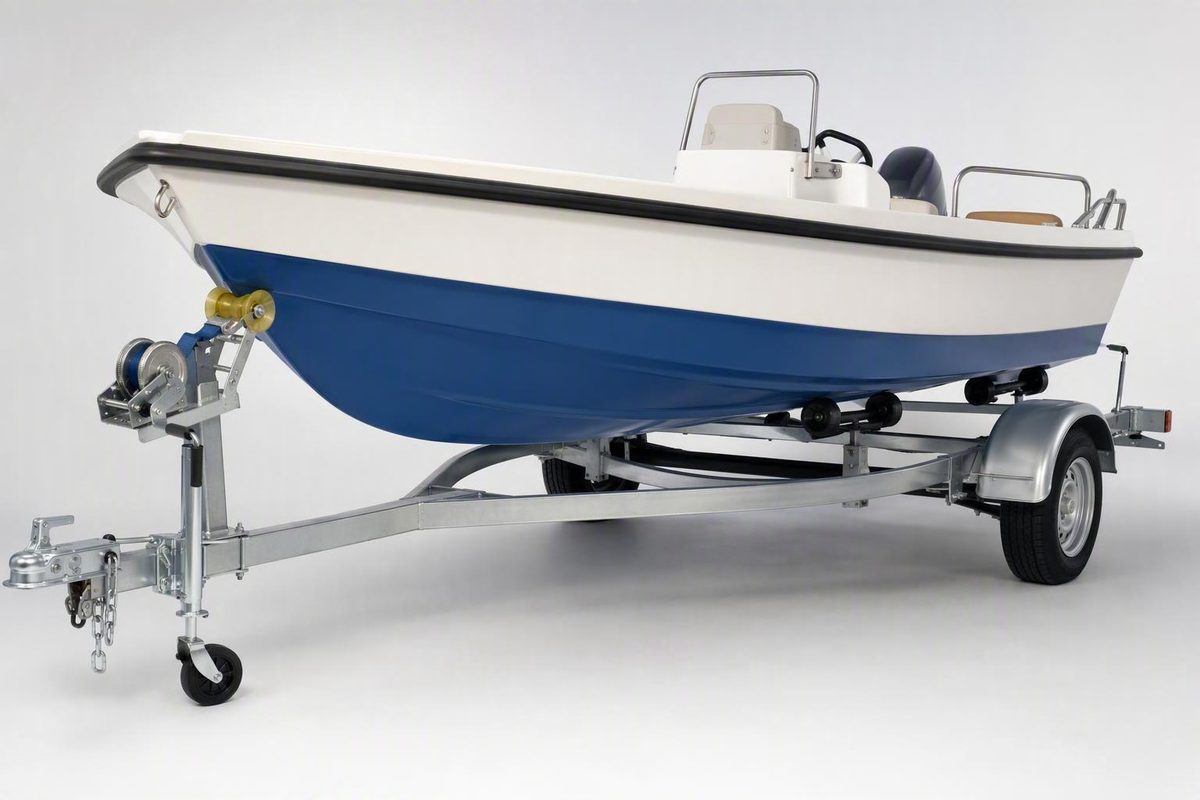
There is no universal boat trailer for every 16-foot boat. Use the 16-foot label to create a shortlist, then confirm usable carrying capacity, transom-to-bow-eye length, hull width and geometry, propulsion clearance, loaded tongue weight, tow-vehicle limits, and local requirements before buying.
The short answer: start with weight and hull fit, not the 16-foot label
A light 16-foot jon boat and a fiberglass 16-foot deep-V with a large outboard can require very different trailers. Even boats with the same published length may differ in loaded weight, beam, bow-eye position, deadrise, strakes, steps, and propulsion hardware.
Either range might work, but neither confirms compatibility. The deciding factors are capacity, dimensions, hull support, and adjustment limits.
Collect these five essentials before comparing models:
- Normal loaded boat weight: Hull, engine, fuel, batteries, water, equipment, accessories, and the gear normally carried.
- Transom-to-bow-eye length: More useful than nominal overall length for checking frame, tongue, and winch-post fit.
- Beam or bottom width: Use whichever measurement the trailer manufacturer requests.
- Hull geometry: Include deadrise, chines, strakes, steps, pads, and acceptable support zones.
- Propulsion configuration: Outboard, inboard, sterndrive, or jet, including hardware that must clear the frame and crossmembers.
Use this six-stage buying path:
- Length screen: Find models whose published range includes the measured boat.
- Capacity calculation: Eliminate trailers without enough usable payload.
- Hull-fit check: Confirm support locations, bow-eye reach, width, and clearances.
- Tow-vehicle check: Compare the complete loaded trailer and tongue load with vehicle and hitch ratings.
- Local-rule check: Verify the requirements that apply where the trailer will be registered and operated.
- Loaded setup verification: Place the normally loaded boat on the trailer and check support, balance, clearances, and tongue weight.
Calculate the carrying capacity you actually need
Dry weight is not towing weight. A published dry figure may omit the engine, fuel, batteries, water, electronics, accessories, and stored equipment. Build your estimate around the boat as it is normally towed.
| Weight item | Your figure |
|---|---|
| Hull or published dry weight | ___ lb |
| Engine and installed propulsion equipment | ___ lb |
| Gasoline: gallons × approximately 6 lb | ___ lb |
| Batteries | ___ lb |
| Water, including livewells or tanks | ___ lb |
| Anchors and safety equipment | ___ lb |
| Electronics and permanent accessories | ___ lb |
| Coolers, tackle, luggage, and normal gear | ___ lb |
| Estimated loaded boat weight | ___ lb |
Approximately 6 pounds per gallon is a planning estimate for gasoline. For diesel or another fuel, use the appropriate density or the engine or boat manufacturer’s data. Venture Trailers also advises including fuel, water, batteries, gear, and accessories and recommends a trailer rating roughly 10–15% above calculated loaded boat weight as general guidance—not as a legal rule (Venture’s loaded-weight and measurement guide).
Next, distinguish GVWR from usable carrying capacity:
Usable carrying capacity = trailer GVWR − trailer empty weight
GVWR covers the trailer and everything loaded on it. A trailer with a 3,000-pound GVWR and a certified empty weight of 600 pounds therefore has 2,400 pounds of usable capacity, subject to the manufacturer’s ratings and loading instructions.
Hypothetical example: If the normally loaded boat weighs 1,800 pounds, a 10–15% planning margin produces:
- 1,800 × 1.10 = 1,980 pounds of usable capacity
- 1,800 × 1.15 = 2,070 pounds of usable capacity
If the trailer’s official empty weight is 500 pounds, the corresponding minimum GVWR would be approximately:
- 1,980 + 500 = 2,480 pounds
- 2,070 + 500 = 2,570 pounds
Verify those results against the rating plate and official specification sheet. Do not assume a model advertised as “2200” provides 2,200 pounds of payload unless the manufacturer defines it that way.
Loaded boat weight is also different from total towing weight. The tow vehicle and hitch must handle the complete loaded trailer: boat, trailer, spare tire, trailer-mounted equipment, and cargo. Use the vehicle manufacturer’s rating for the exact engine, drivetrain, axle ratio, and equipment configuration.
Measure the boat where it contacts the trailer
Published overall length can include a swim platform, bow pulpit, bracket, or other hardware that does not rest on the trailer. Measure the structural hull and the points that control its position.
- Transom-to-bow-eye length: Determines the required frame and tongue length and whether the bow eye can reach the winch post.
- Hull length: Measure the supported hull, excluding unsupported platforms and projecting hardware.
- Bow-eye height from the keel: Controls winch-post height, bow-stop position, and bow seating.
- Beam or bottom width: Affects frame, fender, guide, and bunk-spacing compatibility.
- Transom deadrise: Influences bunk angle and crossmember configuration.
- Strake offsets from the keel: Identify areas the supports may need to avoid.
- Chine offsets from the keel: Help establish side-bunk position.
- Steps and flat pads: Affect bunk contact and crossmember clearance.
- Transom and drain locations: Reveal possible conflicts at the rear support.
- Propulsion dimensions: Include the outboard skeg and propeller or, as applicable, the rudder, shaft, strut, tracking fin, sterndrive, or jet intake.
Do not estimate deadrise from a photograph. Obtain it from the boat manufacturer, ask a marine professional, or measure it carefully.
For a remote fitment review, send clear photographs of:
- The bow eye from the front and side
- The complete hull bottom
- The transom and drain plug
- Strakes, chines, steps, keel, or pad
- Engine brackets and swim platforms
- The outboard skeg and propeller in relevant trim positions
- Rudder, shaft, strut, tracking fins, or jet intake where fitted
Include a ruler or tape in close-ups when scale is unclear. Photographs can help screen candidates, but they do not replace a final inspection with the loaded boat on the trailer.
Match the support system to the hull
Bunks and rollers are alternative support systems; neither is universally better. Suitability depends on the hull, ramp conditions, trailer design, and the instructions supplied by the boat and trailer manufacturers.
Hull type provides a starting point:
- Flat-bottom and jon boats may need long or widely spaced bunks for broad contact.
- Utility-V boats can require different bunk or roller geometry from flat-bottom hulls.
- Deep-V fishing boats need support angles and spacing that follow the deadrise.
- Bass and pleasure boats may have pads, strakes, steps, or lower hardware that limit safe contact zones.
With the boat centered, verify that:
- The bow eye reaches the winch post and seats correctly at the bow stop.
- Bunks or rollers support the hull through the transom.
- Supports contact approved hull areas rather than bearing directly on strakes, spray rails, steps, drains, or underwater hardware.
- The keel clears the frame and tongue plate.
- The hull clears the fenders and crossmembers.
- The drain plug remains accessible.
- The outboard can be positioned without the skeg or propeller striking the trailer or road.
- Inboard, sterndrive, and jet hardware remains clear.
As one manufacturer-specific example, ShoreLand’r’s fitting procedure calls for at least 2 inches between the keel and tongue-plate cover and at least 3/4 inch at the fenders and crossmembers. It also directs that the bunks or rollers finish flush with the transom (ShoreLand’r boat-to-trailer fitting procedure). Those are ShoreLand’r checkpoints, not universal dimensions; follow the instructions for the trailer being considered.
Engine type changes both clearance and balance. Outboards concentrate weight toward the stern, while inboards, sterndrives, and jet systems create different requirements for bunk height, axle position, and clearance. Assess the complete rig rather than an unrigged hull.
Compare frame, axle, and towing considerations
Galvanized steel and aluminum are both plausible choices. Compare corrosion exposure, complete trailer weight, required maintenance, purchase price, hardware, and whether the trailer will be immersed primarily in fresh, brackish, or salt water. The evidence does not support declaring one material universally superior.
Single-axle trailers appear frequently among candidates for 16-foot boats, but boat length alone should not determine axle count. Match the axle arrangement to the loaded package, axle and tire ratings, towing conditions, braking needs, and manufacturer specifications. Spring and torsion suspensions are both available in this size class; neither is a universal winner.
During setup, establish the specified tongue load by positioning the boat fore and aft before completing the final bunk or roller adjustment. Too little tongue load may contribute to sway, while too much may overload the trailer tongue, coupler, hitch, or tow vehicle. General percentage guidance exists, but the controlling limits are those for the exact trailer, hitch, and vehicle. Use a suitable tongue-weight scale or another reliable weighing method when uncertain (Trailer Depot’s weight-and-balance guidance).
Before towing, verify:
- Configuration-specific vehicle towing capacity and GCWR where applicable
- Receiver, ball mount, hitch ball, and coupler ratings
- Complete loaded trailer weight and measured tongue load
- Trailer tire type, load rating, condition, and cold inflation
- Spare tire and installation tools
- Wheel fasteners and hub condition
- Lights and electrical connector
- Brake equipment and operation where fitted
- Winch, bow safety connection, transom tie-downs, and safety chains
The trailer’s weight must be included when comparing the package with the tow vehicle’s rating, and the hitch can impose a separate limit even when the vehicle itself has sufficient capacity (BOATERexam’s towing-capacity overview). America’s Boating Club advises crossing safety chains beneath the coupler and checking their condition before towing (boat-trailer selection and safety guidance).
Ask the appropriate motor-vehicle or transportation authority which brake, lighting, registration, width, and safety-chain requirements apply to the trailer where it will be registered and operated. Do not rely on a threshold quoted for another jurisdiction.
Candidate trailers worth screening—not confirmed fits
These are preliminary candidates, not recommendations. A published length range, capacity figure, or model name does not confirm fit for a particular boat.
| Preliminary candidate | Published specifications | Support and suspension | Still to verify |
|---|---|---|---|
| EZ Loader A90BS 14-16 2200 | 14–16 ft; 2,200-lb stated capacity; ST185/80R13D tires; 73-in fender clearance; 90-in width; 18 ft 8 in length; 500-lb shipping weight (EZ Loader specifications) | Two bunks; spring | Capacity definition, GVWR, certified empty weight, brakes, adjustment limits, price, and hull compatibility |
| EZ Loader A90BT 14-16 2350 | 14–16 ft; 2,350-lb stated capacity; ST185/80R13D tires; 73-in fender clearance; 90-in width; 18 ft 8 in length; 600-lb shipping weight | Two bunks; torsion | Capacity definition, GVWR, certified empty weight, brakes, adjustment limits, price, and hull compatibility |
| EZ Loader 16–20 models | 16–20 ft; detailed entries span 2,450–3,100 lb; listed length 21 ft 2 in | Two bunks; spring or torsion varies | Exact model specifications, capacity definition, fit, brakes, and adjustment range |
| Kokopelli 15/17-3500 | 15–17 ft; advertised at $4,895 in an undated listing (retailer listings for this and the Karavan model) | Single axle; support details not supplied | GVWR, empty weight, payload, hull limits, brakes, tires, dimensions, and included equipment |
| Karavan KB-1470-56 | 14–17 ft; advertised at $3,195 in the same undated listing | Details not supplied | Full specifications, capacity, adjustment range, and compatibility |
| Load Rite galvanized small single-axle bunk category | For boats 18 ft and under; no model-level capacity supplied (Load Rite category) | Bunk; single axle | Exact model, GVWR, empty weight, payload, dimensions, brakes, price, and fit |
EZ Loader’s page contains conflicting page-level capacity summaries, so use the detailed entry and official specification sheet for the exact unit being sold.
Retailer prices are undated shopping leads, not guarantees of current price, stock, warranty, or compatibility.
Use this dealer checklist before paying
Send the manufacturer or dealer this request:
Please confirm trailer compatibility for my [year, make, and exact boat model]. It has a [hull type] hull and [outboard/inboard/I/O/jet] propulsion with [engine model and power].
My measurements are:
- Transom-to-bow-eye length: ___
- Hull length excluding unsupported platforms or hardware: ___
- Bow-eye height from keel: ___
- Beam or bottom width: ___
- Transom deadrise: ___
- Normal loaded boat weight: ___
Please provide written compatibility confirmation and the official trailer specification sheet.
The specification sheet should state:
- GVWR and certified empty weight
- Definition of the advertised capacity
- Usable payload
- Maximum supported boat dimensions and hull types
- Tire and axle ratings
- Brake configuration
- Bunk, roller, winch-post, crossmember, and axle adjustment limits
Confirm whether the quote includes the winch, bow stop, tongue jack, tie-down points, lights, hubs, safety chains, and spare tire. Request a setup sheet recording support positions, axle position where adjustable, tire pressures, loaded tongue weight, and the final boat position relative to the transom supports.
Verify delivered price, setup charges, taxes, registration costs, warranty terms, and stock directly. Also check overall length and width, garage and gate clearance, driveway angle, swing-tongue availability, storage restrictions, towing terrain, and typical ramp conditions.
Before the first tow, inspect the normally loaded rig for transom support, bow seating, hull and propulsion clearances, tire condition and pressure, lights, brakes where fitted, coupler engagement, restraints, and safety chains.
Can I use an 18-foot trailer for a 16-foot boat?
Possibly. Its adjustment range must allow the supports to reach the transom, the bow eye to meet the winch post, and the boat to achieve the specified tongue load without interfering with the frame, fenders, crossmembers, or propulsion hardware. Also check usable capacity and storage length.
How do I know whether a listed trailer capacity is payload or GVWR?
Ask for the official specification sheet and rating-plate information. GVWR is the permitted weight of the trailer and load together; payload is GVWR minus certified empty trailer weight. Do not interpret an unexplained “2,200-lb capacity” yourself.
Should a 16-foot boat use a 14–16-foot or 16–20-foot trailer?
Either may work. Choose between them using loaded weight, transom-to-bow-eye length, full transom support, hull width, propulsion clearance, adjustment range, and loaded balance—not the range label alone.
Do I need brakes on a trailer for a 16-foot boat?
Boat length does not settle the question. Ask the relevant official authority which requirements apply to the trailer’s rating, configuration, registration jurisdiction, and operating area, then confirm that the equipment also complies with the tow vehicle manufacturer’s instructions.
Do not purchase until the trailer has documented usable capacity above the boat’s normal loaded weight, supports the exact hull through the transom without contacting strakes or hardware, stays within vehicle and hitch limits, meets current local requirements, and has been checked for loaded balance and tongue weight. The model label and advertised boat-length range are only the start.