
Choose the Mount Before You Choose the Grill
Compare rail, pedestal, rod-holder and approved tabletop setups, then verify weight, ratings, clearances, fuel and storage before buying.
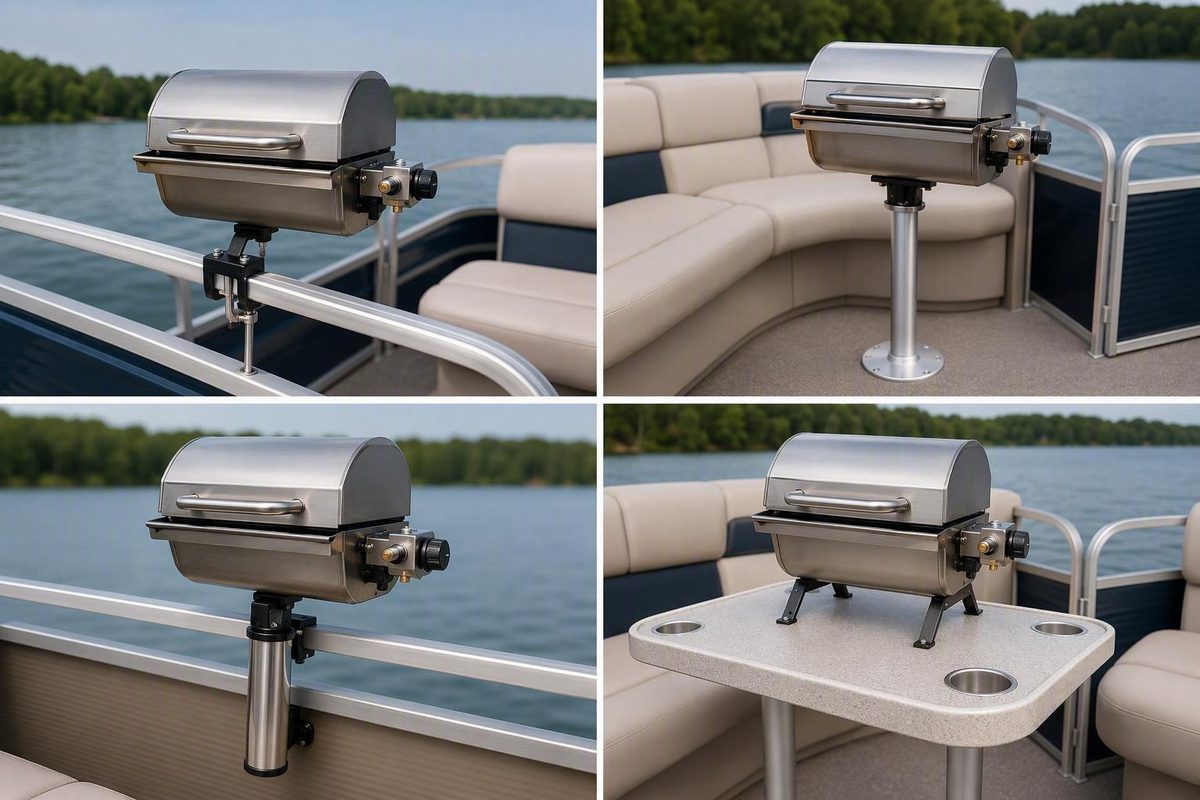
The first decision when shopping for a gas grill for a pontoon is not the brand, burner output, or cooking area. It is where and how the grill can be installed on your boat.
This is a compatibility-planning guide, not a declaration that any named grill or mounting system will fit a particular pontoon. The available product pages do not consistently disclose the grill weight, mount load rating, required clearance, fuel arrangement, or package contents needed to approve an installation. Obtain those details from current grill, mount, fuel-component, and pontoon documentation before buying.
Identify an approved location, choose a suitable mounting system, and verify the supporting structure, dimensions, hardware ratings, clearances, and storage space. Only then should you compare cooking capacity and features.
That mount-first approach matters because pontoon rails, deck framing, gates, seating, bimini tops, storage openings, fitted covers, and manufacturer requirements vary. Marina policies and local rules vary too. A grill that works on one pontoon may be impossible—or inappropriate—to install on another.
Start With the Boat, Not a Best-Grill Ranking
There is no universally best pontoon grill. There is only a grill-and-mount combination that may be suitable for a specific boat, location, and operating plan.
Four configurations cover the principal options:
- Square-rail mount: Attaches to a compatible pontoon rail and may position the grill outside the passenger area.
- Rod-holder mount: Inserts into a suitable, rated rod holder using a compatible adapter.
- Floor pedestal: Uses a deck-mounted base with a fixed or removable post.
- Manufacturer-approved secured tabletop setup: Places a portable grill on an approved surface using the securing method required by the grill and pontoon manufacturers.
Treat the grill and mount as separate purchasing and load-bearing decisions. Cooking capacity says nothing about whether a bracket can support the appliance or whether the boat’s rail or deck can carry the resulting load. Likewise, a mount advertised for a particular rail dimension does not establish that the rail is approved to hold a hot appliance.
Use this decision path:
- Identify a location permitted by the pontoon manufacturer.
- Select a mount type appropriate for the available structure.
- Verify dimensions, grill weight, mount rating, and structural support.
- Check operating, lid-opening, and passenger clearances.
- Choose only the cooking capacity you can install and store.
- Identify every component required and calculate the installed cost.
- Check the grill manual, boat instructions, marina policy, and local rules.
Those advantages do not remove the risks associated with flame, hot surfaces, grease, wind, or pressurized fuel. Bennington similarly distinguishes propane’s convenience from the precautions still required for onboard cooking in its pontoon grill guide.
Pontoon Grill Compatibility Worksheet
Complete this worksheet before ordering the grill or mount. Measure the actual boat rather than relying on a claim about what “most pontoons” use.
| Compatibility item | Your measurement or verified answer |
|---|---|
| Rail shape: square, rectangular, round, or other | |
| Rail outside width | |
| Rail outside height | |
| Rail-wall or structural information, if documented | |
| Nearest supported post or stanchion | |
| Distance from proposed mount to stanchion | |
| Proposed mounting location | |
| Pontoon manufacturer permits this location? | |
| Grill model | |
| Published grill weight | |
| Weight of cylinder and removable components | |
| Mount model | |
| Published mount load rating | |
| Grill footprint with controls and connector fitted | |
| Lid-opening width and height envelope | |
| Required clearance from bimini and fabric | |
| Required clearance from upholstery | |
| Clearance from gates and passenger passages | |
| Clearance from doors, lockers, and openings | |
| Direction of heat, exhaust, and grease | |
| Storage-compartment opening width and height | |
| Cooled grill fits through the storage opening? | |
| Grill and mount clear the fitted boat cover? | |
| Regulator and fuel connection verified compatible? | |
| Current manuals confirm acceptable location and clearances? |
A bracket advertised for a 1.25-inch square rail is not universal. The rail may have a different profile, trim, fastener arrangement, stanchion position, or structural capacity. One seller offers a grill package for that rail dimension, but its page does not establish compatibility with every pontoon and does not disclose the complete installed weight or required clearance (Bunker Up Fishin product page).
Measure the full operating envelope
Do not measure only the closed grill body. Include:
- The fully open lid
- Handles and control valves
- The permitted fuel cylinder, hose, or regulator
- Grease tray or catch pan
- Warming rack, if fitted
- Mounting arms and retaining pins
- Space needed to install and remove the grill
- Room for the operator without blocking a gate or passage
- Movement caused by opening the lid or operating controls
The location must clear the bimini, upholstery, gates, passenger routes, storage openings, and combustible materials by the distances stated in the applicable instructions. Check where heat and exhaust travel with the lid both open and closed. Confirm that the grease system remains correctly oriented and does not discharge toward the deck, passengers, upholstery, or a walking area.
If the manuals do not state the necessary clearances or permissible orientation, request written guidance from the manufacturer. Do not invent a distance.
Match the mount to the actual structure
Rail and rod-holder compatibility are separate questions. A grill that fits a rod-holder adapter has not thereby been shown to fit a pontoon rail. A square-rail bracket cannot be assumed to fit or load a rod holder correctly.
For a rail installation, a point near a supported stanchion may be more stable than the middle of a long, unsupported span. One mount seller recommends positioning its square-rail system around a stanchion for added support, but that is product-specific guidance—not permission to exceed the mount or rail rating (V-Lock installation example).
Stop the purchase or installation if you cannot verify:
- Grill weight
- Mount load rating
- Compatibility between the grill and mount
- Suitability of the supporting rail, holder, deck, or surface
- Required operating clearances
- Fuel connection and cylinder requirements
- Safe cooled storage
A vague “universal” description is not a substitute for those answers.
Rail, Pedestal, Rod-Holder, or Tabletop: Which Setup Fits?
Each arrangement solves a different problem. The appropriate choice uses permitted structure, preserves passenger movement, and can be removed or stored as required.
| Setup | Main advantages | Main compromises | Best candidate |
|---|---|---|---|
| Square-rail mount | Preserves deck space; may position heat outward; often removable | Depends on rail profile and capacity; may interfere with gates or covers | Boat with a documented compatible rail and supported mounting point |
| Floor pedestal | Dedicated station; does not load the perimeter rail; post may be removable | Uses deck space; base may remain installed; drilling may be required | Boat with a manufacturer-approved deck location and accessible supporting structure |
| Rod-holder mount | Quick removal; limited new installation if a suitable holder exists | Many pontoons lack a suitable rated holder; leverage may be substantial | Boat with an approved holder and matching adapter |
| Approved secured tabletop | Portable; useful ashore; avoids permanent rail or deck modification | Requires a permitted, heat-safe surface and approved restraint; consumes surface area | Boat and grill whose manufacturers permit the proposed surface and securing method |
Square-rail mounts
A rail mount can preserve deck area and move the grill away from seating. Removable hardware may simplify storage and allow the attachment point to serve another purpose.
The tradeoff is dependence on the rail. A bracket can fit dimensionally while the rail remains unsuitable for the grill’s weight and leverage. Evaluate the rail, stanchion, rail fasteners, bracket, and retaining mechanism as one load path. Dry-fit the boat cover as well: a receiver or outward-projecting arm may prevent it from seating properly.
In a 2017 pseudonymous forum report, one pontoon owner said removable aftermarket brackets used with a Coleman RoadTrip saved deck space and came off easily. That account can identify questions worth checking, but it is not controlled testing and cannot establish compatibility or safety for another boat (iboats discussion).
Floor pedestals
A pedestal avoids loading the perimeter rail and creates a dedicated station. A removable post may leave only a low base plate after the grill is stored.
The costs are deck space and possible permanent modification. Before drilling, determine what lies beneath the proposed location. Framing, cross members, wiring, controls, and other hidden systems may be present. Obtain the pontoon manufacturer’s instructions for the location, backing, fasteners, and installation.
A Springfield installation demonstration shows one system with a floor base, removable two-piece pedestal, spring-button lock, and an inspection for cross members before drilling. In that particular installation, some fastener locations aligned with aluminum cross members. It is an example of one product on one boat—not a drilling template for another pontoon (direct installation video).
Rod-holder mounts
A rod-holder installation can be highly removable and may require little new hardware when a suitable holder already exists.
Verify the holder’s documented purpose, rating, angle, attachment, and backing, along with the adapter’s compatibility. A shaft fitting into the opening does not establish that the holder can safely carry the grill or the leverage it creates.
Secured tabletop setups
A portable tabletop grill can offer shore-use versatility and avoid drilling or clamping to a rail. Evidence is not uniform, however: one comparative test used a tabletop grill successfully, while general retailer guidance favors securely mounted boat grills to reduce tipping risk.
Do not assume that generic restraint makes every portable grill suitable onboard. Confirm that both the pontoon and grill manufacturers permit the proposed surface, location, and securing method. The surface must meet the grill maker’s load and heat requirements, and controls, fuel components, exhaust, and grease must remain away from passenger traffic.
A seat base, plastic table, loose board, or improvised pad should not be treated as suitable without manufacturer approval.
Drilling or welding is not a universal do-it-yourself step. Obtain written guidance before modifying the pontoon, mount, or grill.
How Much Grill Do You Actually Need?
Choose capacity for the group you normally feed, not the largest party you can imagine.
A practical way to organize the search is:
- Roughly four to six people: Compact rectangular grill or small kettle
- Around six to eight: Medium rectangular grill or larger kettle
- Up to ten: Larger rectangular grill, provided the boat, mount, clearances, and storage can accommodate it
Magma advertises the 9-by-18-inch Cabo and Anacapa for up to six people. Its collection also lists the 12-by-18-inch Catalina Infrared for up to eight and the 12-by-24-inch Monterey Classic for up to ten. These are manufacturer-stated capacities, not independently measured meal capacities, and the supplied collection page contains some inconsistent metadata (Magma pontoon-grill collection).
Serving capacity depends on the menu. Six burgers present a different space problem from burgers, vegetables, buns, and foods needing separate heat zones. If cooking in batches is acceptable, a smaller grill may be the more practical onboard choice.
Rectangular, kettle, and modular formats
Round kettle designs can be compact and may offer stove-like or oven-like versatility, depending on the model. Modular systems can support different cooking tasks but may add components, storage volume, and cost.
Potentially useful features include:
- Electronic ignition
- Lid thermometer
- Warming rack
- Removable grease tray
- Positive lid latch
- Folding tabletop legs
- Removable mounting hardware
These features improve convenience. They do not prove durability, even heating, wind resistance, structural compatibility, or safety.
Burner geometry, grate mass, lid design, ventilation, weather, and cooking technique all affect performance.
Finally, measure storage with the grill in its actual stowed configuration. Include protruding controls, latches, grease components, legs, and mounting pieces. A grill that fits the rail but cannot pass through the storage opening after it cools is not a good fit for the boat.
Evidence-Based Grill Shortlist by Use Case
This shortlist identifies products and formats worth investigating. It is not a ranking, and none should be assumed to fit a pontoon until the compatibility worksheet is complete.
The evidence pack did not provide a price-capture date. Every price below is therefore an undated historical snapshot, not a current offer. Confirm current specifications, package contents, availability, and price directly with the manufacturer or seller.
Compact and portable: Magma Cabo
Manufacturer-stated: The Cabo has a 9-by-18-inch cooking surface, folding table legs, and advertised capacity for up to six people. The undated captured manufacturer price was $231.99.
Why investigate it:
- Compact rectangular format
- Built-in tabletop legs
- Capacity aimed at smaller routine groups
- Lower captured grill-only price than the other listed Magma rectangular examples
Still unverified in the supplied evidence:
- Published grill weight
- Appropriate mount model and mount rating
- Whether mounting hardware is included
- Required clearance
- Complete fuel arrangement
- Current price and availability
More cooking features: Magma Anacapa
Manufacturer-stated: The Anacapa has a 9-by-18-inch surface, table legs, thermometer, lined shell, and advertised capacity for up to six people. Its undated captured manufacturer price was $399.99. These Cabo and Anacapa figures come from Magma’s product collection, which does not establish a complete compatible installation for a specific pontoon (Magma product collection).
The Anacapa may suit a buyer who wants the same listed cooking dimensions as the Cabo but values the additional monitoring and construction features. Those features do not resolve mounting compatibility.
Larger groups: Magma Catalina Infrared and Monterey Classic
Manufacturer-stated: The Catalina Infrared is listed at 12 by 18 inches for up to eight people, with electronic ignition, thermometer, and warming rack. Its undated captured manufacturer price was $567.99.
The Monterey Classic is listed at 12 by 24 inches for up to ten people, with similar convenience features. Its undated captured manufacturer price was $583.99.
Their greater size may increase storage, clearance, and mounting demands. Advertised serving capacity should therefore begin the comparison rather than decide it.
Package advertised with a pontoon rail mount: Bunker Up Fishin
Seller-stated: This propane package is advertised with a 12,000-BTU burner, adjustable bracket for a 1.25-inch square rail, thermometer, warming rack, grease tray, folding legs, and an undated promotional price of $299.
The seller’s page gives conflicting primary cooking-area figures and inconsistent dimensions. Neither disputed cooking area nor either dimensional set should be treated as definitive. The page also does not provide the total weight or required clearance. Confirm the actual grill dimensions, weight, package contents, regulator, connector, bracket rating, and installation instructions in writing before purchase (seller product listing).
Tested mounting caution: Magma Marine Kettle
Independently observed in one group test: The tested Marine Kettle included a rail mount, but the grill began swiveling and the testers retightened its retaining bolt. That episode does not prove every example will loosen. It does show why retaining hardware and unexpected rotation deserve attention during a cold pre-light inspection.
Tested wind example: Magma Newport 2
Independently observed in the same group test: The Newport 2 cooked unevenly in strong wind until the lid was lowered. A short comparison cannot establish performance in every condition, but the observation illustrates why burner output alone is an incomplete buying metric.
Best cooking result may still be the wrong installation: Cobb Premier Gas+
Independently judged: Motor Boat & Yachting selected the Cobb Premier Gas+ from its four-grill comparison for versatility and build quality. The tested product had no rail-mount option and required use on a tabletop or pontoon surface. That same test documented the Marine Kettle’s swiveling mount and the Newport 2’s wind-related unevenness (four-grill comparison).
That result captures the central tradeoff: the strongest cooking result in a limited test may not satisfy a pontoon owner’s installation requirements.
What the evidence still does not establish
The supplied sources do not provide a complete, directly comparable set of:
| Candidate | Weight | Compatible mount model | Mount rating | Mount included? | Required clearance | Verified installed total |
|---|---|---|---|---|---|---|
| Magma Cabo | Unverified | Unverified | Unverified | Unconfirmed | Unverified | Cannot calculate |
| Magma Anacapa | Unverified | Unverified | Unverified | Unconfirmed | Unverified | Cannot calculate |
| Catalina Infrared | Unverified | Unverified | Unverified | Unconfirmed | Unverified | Cannot calculate |
| Monterey Classic | Unverified | Unverified | Unverified | Unconfirmed | Unverified | Cannot calculate |
| Bunker Up Fishin package | Unverified | Seller advertises rail bracket | Unverified | Advertised as included | Unverified | Cannot calculate |
Do not fill these gaps with estimates. Obtain current first-party documentation before reducing the list to a purchase decision.
Calculate the Complete Installed Cost
The sticker price is rarely the whole budget. A grill may be sold without a rail bracket, pedestal, rod-holder adapter, cover, backing hardware, or installation fasteners. The regulator and connector arrangement may also be unclear.
Use this worksheet:
| Candidate | Grill price and date checked | Mount included or unconfirmed | Separate mount price | Regulator/connector status | Cover | Installation hardware | Shipping/tax | Estimated total |
|---|---|---|---|---|---|---|---|---|
| Grill A | $ | $ | $ | $ | $ | $ | ||
| Grill B | $ | $ | $ | $ | $ | $ | ||
| Grill C | $ | $ | $ | $ | $ | $ |
In the undated supplied marketplace capture, visible complete grills ranged from $231.99 to $349, while visible separate pedestal mounts were approximately $99.99 to $109.19. The results mixed grills, mounts, and accessories, so sorting by headline price could compare unlike products (Amazon marketplace results).
Separately, the undated Magma manufacturer capture listed selected rectangular grills as high as $583.99. That figure must not be combined with marketplace prices as though all entries had identical package contents or were checked on the same documented date.
Do not calculate a definitive installed total until every relevant line is known. Ask the seller or manufacturer to confirm in writing:
- Exact grill and mount model numbers
- Published grill weight
- Published mount load rating
- Whether the mount is included
- Compatible regulator and propane connection
- Included grease-management components
- Cover inclusion
- Required fasteners and backing hardware
- Shipping and oversized-item charges
- Compatibility with the measured boat structure
General retailer guidance notes that boat grills often need a separate compatible mounting kit, reinforcing the need to price the system rather than the appliance alone (BBQGuys boat-grill FAQ).
Discounts, stock labels, ratings, review counts, and marketplace badges are dynamic snapshots. They do not establish structural compatibility, safety, durability, or long-term value.
Installation Checks Before You Drill or Light
Follow this sequence even if the product is advertised as easy to install:
- Obtain the current pontoon, grill, mount, and fuel-component instructions.
- Ask the pontoon manufacturer whether the proposed location and installation are permitted.
- Confirm the exact grill and mount models, compatibility, weight, and published ratings.
- Inspect the rail, stanchion, rod holder, deck, or approved tabletop structure.
- Locate framing, wiring, controls, and other hidden systems.
- Assemble and dry-fit the system without connecting propane.
- Open the lid fully and test gates, passages, seats, and storage openings.
- Check the fitted cover for interference.
- Confirm that the cooled grill and removable hardware can be stored securely.
- Conduct the manufacturer-prescribed cold inspection and movement checks.
For a rail mount, inspect the clamps, fasteners, retaining pins, contact points, balance, and rail support before use. Look for rotation, flexing, looseness, cracking, or distortion. Positioning near a stanchion may reduce flex in some systems, but only the applicable instructions and documented ratings can establish suitability.
For a pedestal, the installation example described earlier fastened a base through the deck and aligned some holes with cross members. That single installation is not a universal method. Another pontoon may have different framing, deck materials, wiring routes, controls, or manufacturer restrictions.
Do not drill into a grill body or attach an improvised bracket unless the grill manufacturer authorizes the modification. Changes can affect component fit, structural integrity, grease management, and warranty treatment.
Before attaching fuel, carefully check the cold, empty installation in every relevant direction using the procedure permitted by the manufacturer. It should not tip, rotate unexpectedly, obstruct a passage, unlatch, or visibly load an unsupported structure. Do not invent a torque value, load limit, or acceptable amount of movement.
If any component moves unexpectedly or any load path cannot be verified, stop and obtain qualified guidance.
Propane Grilling Safety From Setup to Cooldown
Use a pontoon grill only while the boat is anchored or tied securely in a location where grilling is permitted—never while underway. Being tied to a dock does not automatically grant permission because some marinas restrict or prohibit grills and open flames. Check the pontoon instructions, grill and mount manuals, marina policy, and local rules before lighting (Bennington pontoon-grilling guidance).
The exact boat, grill, cylinder, regulator, and mount instructions govern. The general guidance below is based on pontoon-manufacturer and retailer material, not a substitute for a primary safety standard or model-specific manual.
Choose an open, well-ventilated location permitted by the manufacturers. Position the grill so wind carries heat, exhaust, and grease away from people, openings, bimini fabric, upholstery, and other combustible materials. Follow model-specific clearances rather than guessing a universal distance.
Pre-light checklist
- [ ] Boat is anchored or tied securely where grilling is allowed
- [ ] Current boat, grill, mount, and fuel instructions have been followed
- [ ] Mount and retaining hardware are correctly engaged
- [ ] Rail, pedestal, holder, or approved surface shows no damage or unexpected movement
- [ ] Grill has the required clearance from fabric, upholstery, openings, and traffic
- [ ] Grease tray and drainage components are clean and correctly fitted
- [ ] Permitted cylinder, regulator, hose, seals, and connections show no visible damage
- [ ] No fuel odor is present
- [ ] Wind and boat movement allow operation within the manufacturer’s instructions
- [ ] Children and passengers are outside the cooking area
- [ ] A separate suitable fire extinguisher is accessible
- [ ] A responsible operator will remain with the grill continuously
Retailer safety guidance states that propane is heavier than air and may collect in low enclosed spaces. It advises protecting cylinders and keeping them above deck in a ventilated location rather than in lockers, companionways, or other low spaces. Confirm the permitted cylinder and storage arrangement in the cylinder, grill, and pontoon instructions; vessel configurations can differ (BBQGuys boat-grilling safety guide).
If fuel odor is present, do not attempt ignition. Keep people away and follow the exact leak-response and shutdown procedure in the applicable manufacturer instructions.
While cooking:
- Attend the grill continuously.
- Keep passengers from leaning on the mount or supporting rail.
- Keep bags, towels, clothing, and serving items outside the hot zone.
- Monitor wind direction and boat movement.
- Stop using the grill if the mount loosens, the grill rotates, fuel odor appears, or conditions deteriorate.
After cooking, follow the prescribed shutdown sequence promptly. A closed lid or lack of visible flame does not establish that the grill is cool.
No general guide can declare a setup compliant with every legal requirement, marina policy, standard, or boat instruction. The final decision depends on the exact pontoon, grill, mount, fuel arrangement, and operating location.
Cleaning, Corrosion Control, and Seasonal Storage
Clean cooking and grease-management components after use according to the owner’s manual.
After salt exposure, rinse components with fresh water where the manufacturer permits it and dry them fully before storage. Use a fitted cover only as instructed, and never cover or stow a grill that remains hot.
Inspect these points routinely:
- Burner ports and burner condition
- Regulator and fuel connection
- Hose, seals, and visible fittings where applicable
- Grease tray, catch bowl, and drainage route
- Mounting bolts and clamps
- Retaining pins and spring locks
- Rail contact points and stanchions
- Pedestal base and surrounding deck
- Lid latch and handles
- Visible corrosion, cracking, distortion, or looseness
Disconnect fuel and store the cooled grill and cylinder as directed by their manuals. Do not place propane in an enclosed low space where leaked gas could collect.
As general retailer advice, BBQGuys recommends cleaning after use and conducting a full disassembly and cleaning at least once annually. That is not a universal manufacturer-prescribed interval; the grill manual may specify a different procedure or schedule (BBQGuys maintenance guidance).
“Stainless steel” and “marine-grade” do not by themselves prove a specific steel grade, corrosion life, salt resistance, or warranty coverage. Pseudonymous owner reports about marine grills are mixed, so inspect actual materials and warranty language rather than relying on the label alone (The Hull Truth discussion).
Before each season, repeat the compatibility review. Confirm that:
- The boat layout has not changed
- The rail, deck, holder, or approved surface remains sound
- The mount has not loosened, corroded, or distorted
- Storage still works
- Current product instructions have not changed
- The marina still permits grilling
Frequently Asked Questions
Can I use a regular portable propane grill on a pontoon?
Possibly, but “portable” does not establish suitability for onboard use. You still need a location and securing method permitted by the pontoon and grill manufacturers, along with verified clearances, compatible fuel components, and secure storage after full cooldown.
A purpose-built marine model may offer mounting choices intended for boating, but a marine label is not proof of fit. Conversely, a forum report describing a successful adaptation does not prove that every camping grill can be safely mounted on every pontoon. Do not modify the grill without manufacturer authorization.
Will a 1.25-inch pontoon rail mount fit my boat?
Not necessarily. Measure both outside dimensions and confirm the rail shape, trim, stanchion location, clamping area, structural capacity, and required clearance. Match those findings to the exact mount instructions.
Even if the clamp fits physically, the rail may not be approved for the grill’s weight and leverage. A supported location near a stanchion may be preferable for some systems, but the applicable rating and manufacturer approval still govern.
Is a rail mount or pedestal mount better for a pontoon grill?
A rail mount may be preferable when deck space is limited and the boat has a documented compatible rail and supported attachment point. It may also be easier to remove and can position the grill outward.
A pedestal may be preferable when the rail is unsuitable and the pontoon manufacturer approves a dedicated deck location. It avoids relying on the perimeter rail but consumes deck space and may require permanent drilling.
Neither is inherently better for every boat. Compare the verified structure, installation requirements, passenger layout, storage plan, cover interference, grill weight, and mount rating.
Can I use a propane grill while the pontoon is moving?
No. The supplied pontoon-manufacturer and retailer guidance says to grill only while anchored or tied securely where grilling is permitted—not while underway. Shut the grill down promptly after cooking and allow it to cool fully before the boat moves.
Where should I store a propane cylinder on a pontoon?
General retailer safety guidance advises keeping the cylinder protected, above deck, and in a ventilated location because leaked propane can collect in low enclosed spaces. Do not put it in a locker, companionway, or other enclosed low area.
The exact cylinder, grill, and pontoon instructions take priority. Secure the cylinder against movement and damage, keep it away from heat and ignition sources, and inspect it and its permitted connection before use.
Make the Final Mount-First Decision
The right gas grill for a pontoon is not a universal product winner. It is a grill-and-mount system whose weight, rating, structure, clearances, fuel arrangement, and storage plan have all been verified for the specific boat.
Measure the pontoon, identify a manufacturer-permitted and adequately supported location, and evaluate the grill and mount together. Buy only as much cooking capacity as you can install, operate, cool, and store according to the applicable instructions.
If the weight, load rating, clearance, fuel specification, or package contents remain unknown, the correct decision is to pause—not estimate.
Final go-or-no-go checklist:
- Fit confirmed
- Grill weight and mount load data verified
- Supporting structure and location approved
- Operating and storage clearances confirmed
- Fuel components and connection verified
- Complete installed cost calculated
- Cylinder storage follows the applicable manuals
- Suitable extinguisher accessible
- Marina and local rules checked
- No grilling while underway