
Every Vessel Needs a Lookout—Here Is Who Remains Responsible
All vessel operators are responsible, including recreational boat and PWC operators. A passenger may help, but responsibility stays with the operator.
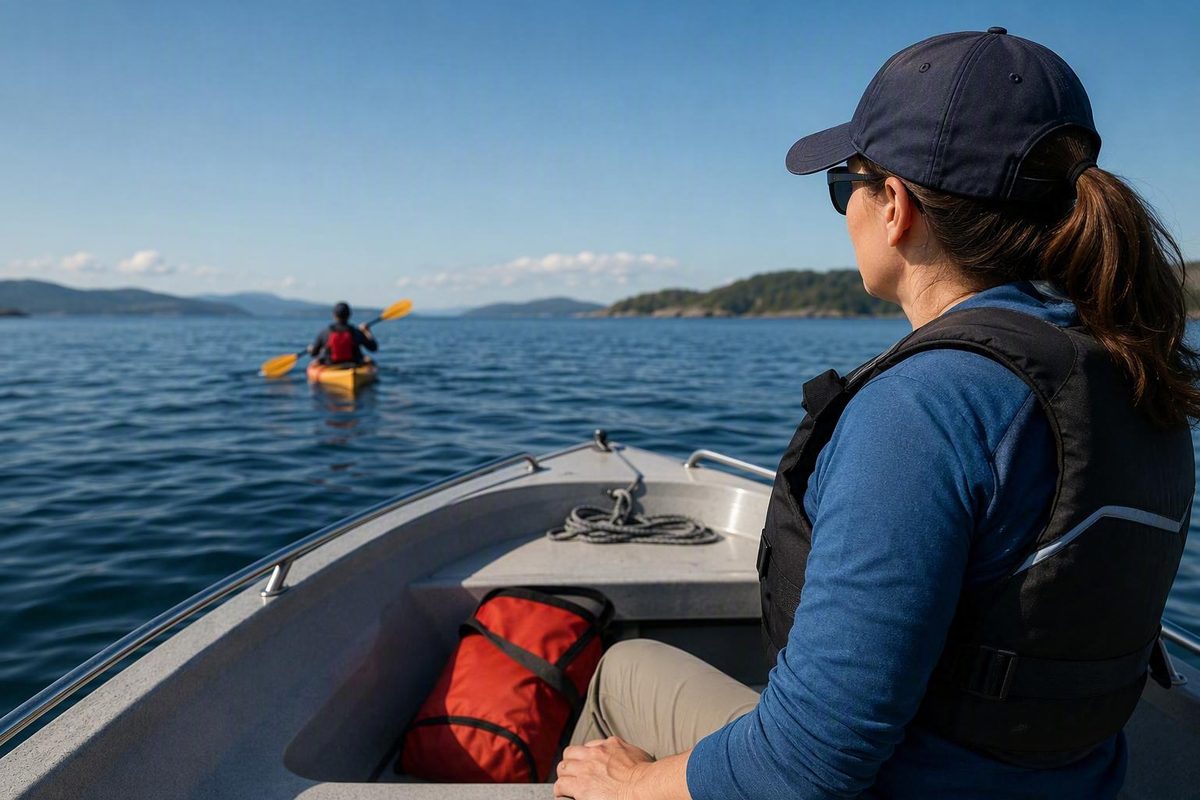
The direct answer: all vessel operators
The exam-style answer is: all vessel operators are responsible for ensuring that their vessel maintains a proper lookout. This includes operators of recreational boats and personal watercraft, not only commercial captains or operators of large ships. Indiana boating-course guidance, for example, directs every boat or PWC operator to keep a proper lookout using sight and hearing while watching for vessels, radio communications, navigational hazards, and people engaged in water activities. See the course’s operator-responsibility summary.
The wording requires an important distinction. Rule 5 is commonly quoted as imposing the obligation on every vessel. Boating-safety guidance translates that vessel-level obligation into practical responsibility for the operator or captain: the person controlling the vessel must ensure that an effective lookout is maintained. The concise “all operators” answer is therefore boating-course terminology, not a claim that every applicable rule is written in operator-specific language.
The general principle is not limited to:
- Powerboat operators
- Operators of large vessels
- Commercial captains
- Licensed or experienced mariners
- Boats carrying multiple crew members
- High-speed or offshore vessels
It also covers ordinary recreational operations, including someone driving a runabout, fishing boat, pontoon, or PWC. Alabama’s state-specific water-traffic summary, for example, says that a vessel operator must maintain a proper lookout and separately subjects PWC operators to its waterway rules. That guidance applies to Alabama waters rather than establishing the rule everywhere. Review Alabama’s boating-rules summary.
This article focuses on vessels being operated on the water. It does not determine how the governing rules apply to every anchored, drifting, moored, or docked situation. Vessel status, location, and the applicable Inland, International, state, or local rules may matter. For the usual boating-course question, however, the reliable practical answer remains:
Every operator must ensure that the vessel maintains a proper lookout.
What Rule 5 means by a proper lookout
A proper lookout is not merely someone facing forward. It is an active, continuing process of gathering enough information to understand the vessel’s surroundings and assess whether a collision risk is developing.
Rule 5 is commonly summarized as requiring a lookout by:
- Sight
- Hearing
- All other available means appropriate to the prevailing circumstances and conditions
Its stated purpose is to make a full appraisal of the situation and the risk of collision. The Water Sports Foundation reproduces that Rule 5 wording and connects it to the operator’s responsibility to maintain an unobstructed view and monitor the surrounding water. Read its Rule 5 summary and practical guidance.
Each part of that standard matters.
Sight requires more than an occasional glance ahead. The operator should scan for other vessels, people in the water, markers, fixed hazards, floating objects, and changes in the operating environment. A boat that initially appears distant may develop into a crossing situation, while a vessel astern may begin to overtake.
Hearing provides information that may not yet be visible. Listening remains part of the lookout even in clear daylight.
Other available means can include suitable navigational equipment or information already available aboard. The appropriate means depend on the vessel, its equipment, the operating area, visibility, and other conditions. Turning on a display is not enough; relevant information must be used to assess the situation.
Continuity is also essential. Looking around before leaving a ramp, entering a channel, or accelerating does not account for what happens during the next several minutes. Traffic moves, visibility changes, and hazards emerge from blind areas. A proper lookout therefore involves repeated observation and reassessment.
The lookout should help answer practical questions:
- What is around the vessel now?
- Which objects are moving, and in what direction?
- Is another vessel crossing, meeting, or overtaking?
- Is the available water becoming narrower or more obstructed?
- Has visibility or weather changed?
- Is there enough time and room to respond?
- Could a hazard be hidden by waves, glare, passengers, or part of the vessel?
The sources cited here are boating-safety guidance and educational summaries. They are not substitutes for consulting the current official Navigation Rules and any state or local requirements governing a particular waterway.
What to watch and listen for in every direction
A useful lookout covers the complete operating environment, not only the water directly over the bow. Pennsylvania’s boating guidance tells operators to scan all around for swimmers, other boats, and obstructions, to listen for dangerous situations, and to ask passengers to assist when appropriate. See Pennsylvania’s navigation guidance.
An adaptable scan might proceed as follows:
- Look well ahead. Check the intended course for traffic, channel bends, markers, congestion, shorelines, shoals, bars, and floating objects.
- Scan to starboard. Sweep from the bow through the beam and toward the quarter.
- Check astern. Look for overtaking vessels and any problem developing in the wake.
- Scan to port. Sweep from the stern back toward the bow.
- Inspect nearby water. Watch for swimmers, paddlers, floating lines, and low or partly submerged objects.
- Look above when relevant. Check bridges, cables, power lines, and other clearance restrictions.
- Check instruments briefly. Compare their information with what can be seen and heard, then return attention outside.
This is a practical example, not a mandatory scan order. The frequency and pattern should fit the vessel, location, traffic, and visibility.
Common things to monitor include:
- Powerboats, sailboats, fishing boats, PWCs, and paddle craft
- Crossing, meeting, and overtaking traffic
- Swimmers and people entering the water
- Water-skiers, wakeboarders, tubers, and other towed participants
- Divers and diver-down flags
- Buoys, daymarks, and other navigation markers
- Fish-net buoys, mooring floats, and floating lines
- Logs, branches, weeds, trash, and partly submerged debris
- Shoals, bars, rocks, stumps, and changing shorelines
- Docks, pilings, breakwaters, and construction
- Bridges, bridge openings, cables, and power lines
- Changes in weather, visibility, wind, and water conditions
- Other hazards peculiar to the operating area
Checking astern matters because traffic can approach and overtake from behind. Although the overtaking vessel has particular maneuvering responsibilities, the vessel being overtaken still needs to recognize the developing situation.
Listening should be treated as another scanning channel. Relevant sounds may include:
- Engines approaching from outside the field of view
- Horns, whistles, bells, and other sound signals
- Marine-radio communications concerning nearby traffic
- Shouts or whistles from swimmers, passengers, or other boaters
- Warnings from an assisting lookout
- Changes in wind, rain, waves, or surf
- Unusual mechanical sounds from the vessel
The operator also needs a usable field of view. Passengers, coolers, raised equipment, canvas, glare, and spray can create blind areas. If people or gear block an important sightline, the practical response is to reposition them or otherwise account for the obstruction rather than accept the blind spot.
No hazard list is exhaustive. A low kayak may be difficult to see among waves. A small fishing boat near a bridge may need to monitor traffic, current, pilings, and overhead clearance at the same time. The lookout must fit the actual trip.
Solo operator, passenger helper, or crew lookout
When only one person is aboard, the operator necessarily performs the lookout function while also controlling the vessel. That means steering, speed control, navigation, and other tasks must be managed without allowing attention to remain away from the surroundings for prolonged periods.
A solo operator can reduce avoidable workload by preparing navigation information before departure, securing loose gear, keeping essential controls accessible, and limiting unnecessary device use. If conditions make it difficult to maintain awareness while completing another task, slowing or otherwise reducing workload may be appropriate.
When other people are aboard, an alert passenger or crew member can strengthen the lookout. Additional help may be especially useful in:
- Heavy or confusing traffic
- Darkness
- Fog or rain
- Areas with substantial background lighting
- High ambient noise
- Narrow channels
- Restricted helm sightlines
- Waters containing many swimmers or paddlers
- Operations involving frequent maneuvering
A specific assignment is more useful than a vague request to “keep an eye out.” For example:
“Watch astern and off the port quarter. Tell me immediately if a boat is closing, and point toward it when you report it.”
Useful reports are short and specific: “boat closing from starboard,” “swimmer ahead near the buoy,” or “log off the port bow.”
Designating a helper does not transfer the operator’s overall responsibility. The helper expands coverage, while the operator continues to scan, evaluate collision risk, control the vessel, and decide how to respond. Practical Rule 5 guidance expressly distinguishes between using a lookout helper and surrendering operator responsibility.
The supplied evidence does not establish that every recreational boat carrying passengers must appoint a separate lookout in every circumstance. Some boating sources recommend assigning another person when possible; others advise asking passengers to assist or adding a lookout when conditions become demanding. Unless a separate rule applies to a particular vessel or activity, that should be understood as prudent guidance rather than a universal requirement for a distinct crew position.
A passenger who is distracted, impaired, asleep, wearing headphones, facing the wrong direction, or unsure how to report a hazard cannot replace operator awareness.
The sound arrangement on a crewed recreational boat is cooperative: the helper watches an assigned sector, while the operator retains command of the complete picture.
How vessel type and size affect—or do not affect—the duty
The general Rule 5 principle is framed in terms of every vessel rather than a particular propulsion method, purpose, or size. A larger powered vessel may have more personnel and equipment, but those resources change how the lookout is maintained—not whether one is needed. A small boat’s limited crew and equipment likewise do not excuse inattention.
Navigation guidance recognizes categories such as power-driven vessels, sailing vessels, fishing vessels, vessels restricted in their ability to maneuver, and vessels not under command. Those categories can affect other navigation responsibilities, but the supplied guidance does not present them as lookout exemptions. BoatUS also notes that Inland and International Rules have differences and that operators must know which rules govern their boating area. See the BoatUS Rules of the Road guide.
The principle translates to common recreational craft in different ways:
Personal watercraft: PWC operators are included in the supplied boating guidance.
Powerboats and fishing boats: Operators may need to balance traffic awareness with depth, fishing activity, passengers, and equipment. Canopies, rods, electronics, and people near the helm can obstruct sightlines. Slow trolling does not eliminate the need to watch for faster vessels approaching from behind.
Sailboats: Operating under sail does not create a lookout exemption in the supplied guidance. Alabama’s separate exemption for sailboats from one above-plane-speed obstruction provision should not be confused with its distinct proper-lookout requirement.
Larger powered vessels: Additional crew and navigational equipment may expand the available means of observation. The lookout arrangement should reflect the vessel’s helm layout, maneuverability, equipment, and operating conditions.
Kayaks, canoes, and other paddle craft: The broad vessel concept in the supplied navigation guidance supports treating watercraft used for transportation as vessels in principle. Definitions and detailed requirements can vary with the governing rules, however, so paddlers should verify the provisions applicable to their waters rather than relying on a broad summary.
Looking behind periodically, listening for engines, and avoiding prolonged focus on fishing, photography, or equipment can improve awareness.
Size and speed affect lookout technique, not the basic need for attention. A slow boat can still enter a crossing situation, and a small craft can still strike a swimmer, another vessel, or an obstruction.
Using radar, radio, AIS, and other available means
Sight and hearing are the foundation of a proper lookout, but Rule 5 summaries also refer to all available means appropriate to the prevailing circumstances and conditions. Depending on what is installed or otherwise available aboard, useful aids may include:
- Radar
- Automatic Identification System information
- Marine radio
- Binoculars
- Depth and navigation instruments
- Charts or chart displays
- Compasses
- Other installed navigational aids
These tools supplement human observation; they do not replace it. The supplied evidence identifies radar and AIS as possible lookout aids without establishing that every recreational vessel must carry them. See the discussion of available lookout resources.
A simple operating pattern is to scan outside, check a relevant instrument briefly, compare the information, and return attention outside. An electronic target should be related to the visible environment when possible, while an object seen outside should not be disregarded merely because it does not appear on a display.
Navigational aids should also be distinguished from distractions. Properly used radar, radio, or navigation information may improve situational awareness. A phone conversation, prolonged app setup, entertainment screen, or loud stereo can instead consume attention or mask useful sounds.
The important question is not simply whether a device is electronic. It is whether using it helps the operator make a fuller appraisal of the situation or pulls attention away from that task.
Adjusting the lookout for fog, darkness, traffic, and blocked views
The need for an effective lookout does not disappear when conditions become difficult. Reduced visibility, congestion, noise, and obstructions increase the concentration—and sometimes the assistance—required.
Fog and rain shorten the distance at which hazards may become visible. Sound and suitable installed equipment may become more important, but an operator should not assume another vessel has detected them electronically.
Darkness reduces detail and depth cues. Navigation lights, shore lighting, and glare may complicate identification, so the operator may need more time to determine what is being observed.
Heavy traffic creates multiple moving targets. A helper can monitor one sector or track a particular vessel while the operator maintains the broader picture.
Background noise can mask engines, sound signals, radio calls, and shouted warnings.
Blocked sightlines should be corrected where practical. Passengers or gear can be repositioned, or a competent helper can be assigned to monitor a sector that the operator cannot see clearly.
Lookout effectiveness is closely connected to safe speed. The operator needs enough time and distance to detect a hazard, understand the situation, decide what to do, and take effective action. Pennsylvania’s guidance accordingly lists maintaining a proper lookout and operating at a safe speed among the operator’s related responsibilities.
There is no single numerical speed that is safe in every condition. Slowing may be appropriate when visibility, traffic, weather, water conditions, maneuvering room, or operator workload makes a full appraisal difficult. It can provide more time to identify a light, hear a signal, track another vessel, or react to a partly submerged object.
Lookout, safe speed, and good seamanship operate as a collision-avoidance system:
- The lookout detects and tracks the situation.
- Safe speed preserves time and room to respond.
- Good seamanship turns available information into timely action.
Early detection offers limited protection if the boat is moving too fast to respond effectively. Conversely, low speed does not excuse an operator who is not watching or listening.
A practical pre-departure and underway lookout checklist
This checklist is an adaptable routine, not a substitute for the applicable Navigation Rules or a mandatory sequence for every vessel.
Before moving:
- Confirm that the helm or operating position provides a clear view.
- Move passengers and gear out of important sightlines.
- Make sure appropriate installed navigational aids are accessible and understood.
- Set radio and entertainment volume so engines, signals, and warnings remain audible.
- Review the immediate departure path, nearby traffic, markers, and visible hazards.
- Secure loose gear that could demand attention underway.
- Brief passengers not to obstruct the operator’s view.
- If someone will assist, assign a sector and explain how to report hazards.
While operating, repeat an all-direction scan:
- Ahead and along the intended course
- Starboard bow, beam, and quarter
- Astern
- Port quarter, beam, and bow
- Water immediately around the vessel
- Overhead clearances when relevant
- Appropriate instruments or electronic aids
- Back outside, then repeat
The timing should fit the circumstances. A leisurely scan may be inadequate near a crowded ramp or in a narrow channel. At the same time, concentrating on one vessel for too long can cause the operator to miss another developing risk.
Listen for:
- Engines and propeller noise
- Horns, whistles, and other sound signals
- Relevant radio calls
- Shouts or whistles from people in the water
- Warnings from passengers or an assisting lookout
- Changes in wind, rain, or waves
- Unusual sounds from the vessel
Reassess speed when:
- Visibility deteriorates
- Darkness or glare makes targets harder to identify
- Traffic becomes denser
- The channel narrows
- Water or weather conditions change
- Maneuvering room decreases
- Passengers or gear interfere with visibility
- Operator workload increases
- A developing encounter remains uncertain
Do not wait until another vessel or obstruction becomes an immediate threat. The purpose of a proper lookout is to recognize a developing situation while there is still time and room to respond.
Is a separate lookout required on every boat?
Not necessarily. The general requirement is that the vessel maintain a proper lookout. The supplied evidence does not establish a universal rule requiring a separate passenger or crew member to serve as lookout on every recreational boat.
An additional helper may be prudent when traffic, darkness, fog, noise, or restricted sightlines make it difficult for the operator to maintain an effective appraisal alone. Separate vessel-, activity-, or jurisdiction-specific requirements should be checked independently.
Can the operator serve as the lookout when boating alone?
Yes. When only one person is aboard, the operator necessarily performs the lookout function while controlling the vessel.
That makes workload management important. A solo operator should continue scanning and listening, minimize avoidable distractions, maintain clear sightlines, and adjust boat handling when conditions make awareness harder to sustain.
Does assigning a passenger as lookout transfer responsibility from the operator?
No. A passenger or crew member can assist, but the operator remains responsible for ensuring that the vessel maintains an effective lookout.
The operator should continue scanning, listening, assessing the situation, and controlling the boat. The helper expands coverage rather than replacing the operator’s judgment or oversight.
Must a recreational boat carry radar or AIS to maintain a proper lookout?
The supplied evidence does not establish that every recreational boat must carry radar or AIS. Equipment requirements can depend on the vessel, location, and governing rules.
When suitable equipment is installed, available, and appropriate to the conditions, it can contribute to situational awareness. Radar, AIS, radio, and other aids still do not replace sight, hearing, or operator judgment.
Does the lookout rule apply only while a vessel is underway?
This article does not provide a universal answer for anchored, drifting, moored, or docked vessels. The supplied educational summaries use different framing, and they do not establish how every vessel status must be treated under each applicable rule or jurisdiction.
Operators should consult the current Inland or International Navigation Rules and any relevant state or local provisions for the vessel’s location and status. While operating, the practical rule is clear: ensure that the vessel has a continuous, effective lookout using sight, hearing, all-direction awareness, and appropriate available aids. A capable helper can improve coverage but does not take responsibility away from the operator. Pair vigilant observation with safe speed and good seamanship.