
Prevent Trouble on the Water Before It Becomes an Emergency
Maintaining a safe speed is the most likely quiz answer in this setting, but it cannot be confirmed without the original answer options.
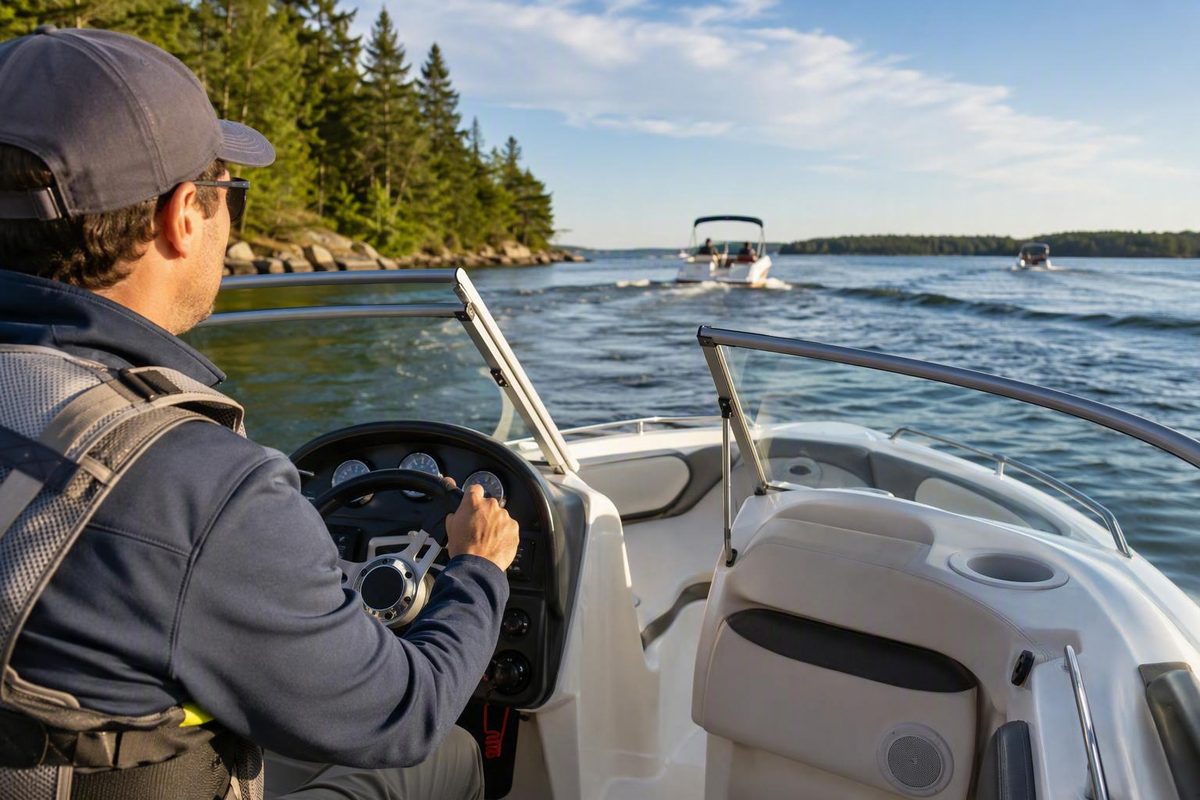
The short answer: maintain a safe speed
The likely quiz answer is: maintain a safe speed based on boat traffic, visibility, weather, water conditions, maneuvering room, and nearby hazards.
Boating-course material connects three practices with a lower chance of an accident: maintaining a safe speed, paying close attention to other boats and potential hazards, and following the navigation “rules of the road.” It presents these practices as risk management—recognizing warning signs, acting before an accident develops, and limiting the effects if one occurs. Boat-Ed’s risk-management lesson explains that connection directly.
In practical terms, slowing down gives an operator more opportunity to:
- Detect another vessel, paddler, swimmer, marker, dock, shoal, or floating object.
- Recognize that a collision risk is developing.
- Decide whether to change course, reduce speed, or stop.
- Maneuver without making a rushed correction.
- Limit the severity of contact if avoidance fails.
There is also an important limitation: the original multiple-choice answers were not supplied. A particular course could instead expect an answer such as “perform a pre-departure check,” “take a boating-safety course,” or “leave a float plan,” depending on the lesson and available choices. Safe speed is the most likely answer when the question concerns reducing accident risk while underway, but it cannot be confirmed without the answer options.
It also helps to distinguish among three kinds of protection:
- Incident prevention: safe speed, an active lookout, navigation-rule compliance, sober operation, maintenance, and conservative decisions.
- Consequence reduction: wearing a properly fitted life jacket and carrying suitable emergency equipment.
- Rescue readiness: communications, passenger briefings, signaling equipment, and a float plan.
These layers complement one another. No single precaution eliminates boating-emergency risk.
Safe speed changes with the situation
An operator should follow applicable restrictions while recognizing that traffic, visibility, weather, or limited space may require a substantially lower speed.
Reassess speed whenever any of the following changes:
-
Visibility: Fog, rain, darkness, spray, glare, and background shore lighting can make vessels, markers, and objects harder to detect.
-
Water depth: Shallow or unfamiliar water can introduce grounding and submerged-object hazards.
- Maneuvering room: Narrow channels, bridges, docks, marinas, locks, and crowded launch areas leave less room for correction.
-
Nearby hazards: Swimmers, paddlers, anchored boats, fishing activity, structures, debris, and shorelines call for additional caution.
-
Operator familiarity: An unfamiliar boat or waterway warrants a larger margin.
A speed that is appropriate in clear, open water may be unsafe in a congested marina or unfamiliar channel.
Situations that call for slowing down
Congested waterways: Reduce speed before boats are close. Watch for crossing traffic, vessels leaving slips, small craft that may be difficult to see, and wakes that could affect other water users.
Fog, darkness, or heavy rain: Reduced visibility limits how early hazards can be detected.
Deteriorating weather: Rising wind, building waves, lightning, or worsening visibility may justify slowing down, changing course, seeking shelter, returning, or deciding not to depart.
Shallow or unfamiliar water: Open-looking water may contain shoals, rocks, stumps, or other submerged hazards. Use appropriate navigation information while allowing for uncertainty.
Docks, swimmers, launch ramps, and fixed structures: These areas combine close-range hazards with people or vessels that may move unexpectedly. Slow before entering the area rather than waiting until a conflict is obvious.
Limited maneuvering room: Tight turns, current, narrow passages, nearby structures, and dense traffic reduce the number of safe options. General boating guidance similarly emphasizes weather checks, capacity discipline, navigation rules, safe operating practices, and reduced risk around heavy traffic. Lake Norman Marina summarizes these complementary precautions.
Do not invent or rely on a universal numerical threshold. Instead, ask:
- Can I see far enough ahead to make a controlled response?
- Is there enough space to slow, stop, or turn?
- Can I respond if another vessel or person moves unexpectedly?
- Are my speed and wake appropriate around people, small craft, and structures?
- Would slowing down make the next decision easier?
If the answer is uncertain, reduce speed and reassess.
Pair speed control with a continuous lookout and navigation rules
Reduced speed helps only when the operator is actively detecting and interpreting hazards. An inattentive operator can miss a paddler, crossing vessel, marker, weather change, or floating obstruction even while traveling slowly.
Three underway habits therefore work together:
- Maintain a speed appropriate to the circumstances.
- Keep a continuous lookout.
- Follow the navigation rules applicable to the situation.
A lookout involves more than facing forward. Regularly scan ahead, to both sides, and behind. Check areas obscured by passengers, equipment, roof supports, sails, or the bow. Listen for engines, sound signals, breaking waves, and warning calls. Continue monitoring detected vessels rather than assuming that their course and speed will remain unchanged.
One secondary overview attributes operator inattention, improper lookout, inexperience, excessive speed, and machinery failure to U.S. Coast Guard accident reporting. Although that summary should not be treated as a current statistical ranking, the listed factors illustrate why speed control must be combined with attention, experience, and a serviceable vessel. The overview provides the underlying attribution and broader safety context.
Limit distractions and assign a capable operator
The operator should remain sober, alert, and focused. Manage necessary tasks so that a capable person continues to watch the water.
If a passenger assists as lookout, give clear directions. Asking someone to monitor a particular blind sector and immediately report vessels, swimmers, markers, debris, or visibility changes is more useful than simply saying, “Tell me if you see anything.”
Use navigation lights, but do not rely on them alone
Navigation lights support detection and help operators interpret the relative position of vessels at night or in restricted visibility. They do not replace scanning, listening, speed control, or knowledge of the applicable navigation rules.
Treat those limitations as reasons to strengthen the lookout and reduce speed.
The display and use of navigation lights may be governed by rules that depend on the vessel and operating area. Confirm current requirements with the authority responsible for the waters where the vessel will operate.
Respect capacity and weight distribution
Follow the vessel’s capacity guidance and account for passengers and equipment, not just the number of people aboard. Distribute the load so the vessel remains stable and the operator has a clear view and effective control.
Overloading or uneven weight distribution can impair handling and stability. Ask passengers to remain in suitable positions while underway, and secure gear so it cannot shift suddenly.
Use an engine cut-off switch when appropriate
On an equipped motorboat or personal watercraft, connect and use the engine cut-off switch as intended. Its purpose is to stop the engine if the operator is thrown away from the controls, reducing the chance that the powered vessel will continue running uncontrolled. The marina’s safety guidance describes that function.
A cut-off switch is only one layer of protection. It does not replace appropriate seating, speed selection, passenger discipline, or attentive operation.
Use a pre-departure checklist before every trip
A repeatable inspection can identify missing equipment or vessel problems while the boat is still at the dock or launch site. Use the same basic sequence each time, then adapt it to the craft and trip. A kayak, pontoon, personal watercraft, sailboat, and offshore powerboat do not have identical systems or equipment needs.
1. Conditions
- Check the local and marine forecast for the route and expected return period.
- Consider visibility, wind, waves, current, tides where relevant, storms, and temperature.
- Compare expected conditions with the operator’s experience and the vessel’s limits.
- Identify shelter and possible alternate landing points.
- Make a conservative go-or-no-go decision.
Do not treat the forecast as a one-time formality. Conditions can change during the trip, and weather at the launch may differ from conditions farther along the route.
2. Propulsion and controls
- Confirm adequate fuel or battery energy for the planned trip, contingencies, and a reserve.
- Check for visible leaks, damage, loose connections, or abnormal odors.
- Verify engine function as appropriate.
- Check steering and throttle response.
- Confirm that essential gauges and displays work.
- Inspect the propeller or drive area when it is safe to do so.
- Check the engine cut-off-switch setup when applicable.
- Carry the keys, charged controls, or other equipment needed to start the vessel.
Avoid planning to use nearly all available fuel or battery capacity.
3. Hull systems
- Inspect the hull and visible fittings for damage.
- Install and verify the drain plug where the vessel requires one.
- Test the bilge pump and check that its intake and discharge are clear.
- Check battery security and essential electrical connections.
- Test navigation lights.
- Inspect hatches, lines, through-hull fittings, and other vessel-specific systems.
- Investigate unexplained water in the bilge.
A more careful inspection is appropriate after storage, transportation, repair, or a long period without use.
4. Safety equipment
Equipment should be appropriate to the vessel, trip, water, and applicable rules. Depending on those factors, the check may include:
- A correctly sized life jacket for each person.
- Throwable flotation where appropriate or required.
- A horn, whistle, or other sound-producing device.
- Suitable signaling equipment.
- A serviceable fire extinguisher where appropriate.
- First-aid supplies.
- A waterproof light or flashlight.
- An anchor and adequate line where suitable.
- A communication method appropriate to the route.
- Basic tools and vessel-specific emergency supplies.
Check condition and accessibility, not just presence. A buried life jacket, damaged buckle, discharged phone, corroded extinguisher, or radio no one knows how to use offers less protection than checked, accessible equipment. A practical pre-departure checklist can also cover fuel, battery condition, engine operation, drain plugs, bilge-pump function, navigation lights, sound signals, communications, first-aid supplies, and drinking water. This pre-launch guide provides a compact example.
Choose communications for the operating area.
5. Trip readiness
- Confirm the passenger count.
- Follow capacity guidance and distribute people and equipment appropriately.
- Secure loose gear.
- Carry drinking water and suitable basic supplies.
- Review the route, launch point, destination, known hazards, and alternatives.
- Set an expected return or check-in time.
- Leave a float plan with a dependable person ashore.
- Brief passengers before departure.
- Recheck reserve fuel or energy against the actual route and conditions.
This framework is not a universal list of legal requirements. Equipment, education, carriage, and operating rules can vary by jurisdiction, vessel, propulsion, operator, activity, and operating area. Confirm current requirements with the relevant boating authority before departure.
Wear a life jacket to reduce the consequences when prevention fails
A life jacket generally does not prevent the initial collision, capsize, swamping, or fall overboard. Its principal role begins after someone enters the water: it provides flotation and can reduce drowning risk.
That distinction matters when answering a quiz. If the question asks which practice helps prevent an underway accident, safe speed may be the expected choice. If it asks what reduces danger after an unexpected entry into the water, wearing a personal flotation device is more likely.
Wear a properly fitted and fastened life jacket rather than assuming that storing one aboard is enough. An unexpected fall may leave no practical time to retrieve and put one on. The person may be injured, unconscious, disoriented, separated from the vessel, or struggling in cold or rough water. National Safety Council guidance recommends life-jacket use for both motorized and non-motorized boating and notes the danger of relying on swimming ability after an unexpected fall. Its recreational-boating guidance explains why wearing flotation matters.
Before departure, check that each life jacket is:
- Suitable for the intended person and activity.
- Correctly sized.
- In serviceable condition.
- Free from damaged fabric, flotation, straps, and buckles.
- Put on correctly.
- Fastened and adjusted so it will remain secure.
- Immediately accessible if it is not already being worn.
Approval, carriage, and mandatory-wear rules vary by location and activity. Verify current requirements with the relevant boating authority rather than treating a general checklist or commercial safety article as law.
Life-jacket use complements safe speed, lookout, maintenance, communications, and trip planning. Prevention aims to keep people aboard; flotation helps when prevention fails.
Leave a float plan and brief everyone aboard
A float plan is a private trip record left with a reliable person ashore. For an ordinary recreational trip, it is not routinely submitted directly to the Coast Guard. The shore contact keeps the information and acts if the vessel does not return or check in as agreed. Safe Boating America’s guide explains this distinction and the information commonly included.
A useful float plan should identify:
- The vessel, including its type, color, name or registration details where applicable, and distinguishing features.
- The operator and passengers.
- The launch point.
- The intended route and significant waypoints.
- The destination or activity area.
- The planned departure and expected return or check-in time.
- Communication methods and contact details.
- Safety and signaling equipment carried.
- Vehicle and trailer information when relevant.
- Instructions stating when the contact should begin checking and when to seek help.
- The emergency authority appropriate to the operating area.
Agree in advance on what the shore contact should do if no one checks in. If the route, passenger list, destination, or schedule changes, update that person as soon as practical. Close the plan immediately after returning so an unnecessary emergency response is not started.
A float plan cannot prevent an engine failure, collision, capsize, or storm. Its value is that someone can recognize that the vessel is overdue and provide responders with a description, probable route, timing, and occupant information.
Give passengers a concise safety briefing
Before getting underway, show passengers:
- Where life jackets are and how to put them on.
- Where emergency and signaling equipment is stored.
- How to use the available communication equipment to summon help.
- How to provide the vessel’s position if known.
- How to stop the engine or control the boat if the operator becomes unable to do so.
- What to do if someone falls overboard.
- Where to sit and how to move safely.
Keep the briefing appropriate to the vessel and trip, but do not skip it solely because the outing is short. An informed passenger may be the person who can stop the boat, provide flotation, make a call, or explain the emergency.
A float plan does not replace onboard communications, life jackets, inspections, or conservative operating decisions.
Build safety around maintenance, sobriety, training, and conservative decisions
Boating safety is a system of complementary practices. Speed control addresses operational risk. Maintenance reduces equipment-related surprises. Sober operation supports judgment and coordination. Education can help operators recognize hazards and understand navigation practices. Passenger preparation and a float plan improve readiness if something still goes wrong.
Inspect and maintain the vessel
Follow a maintenance schedule appropriate to the boat and its equipment. Depending on the vessel, that may include:
- Engine and propulsion components.
- Fuel tanks, hoses, fittings, and ventilation.
- Batteries, terminals, charging systems, and wiring.
- Steering and throttle systems.
- Bilge pumps, alarms, and drainage.
- Navigation lights and essential electronics.
- Hull, hatches, fittings, and through-hulls.
- Lines, anchors, trailers, and vessel-specific safety systems.
Investigate hard starting, unusual vibration, steering stiffness, intermittent electrical operation, fuel odors, warning alarms, or unexplained bilge water before departure. Use qualified service help when the work exceeds your knowledge.
Assign a sober operator
Alcohol can impair judgment, balance, coordination, reaction time, and the ability to respond to changing conditions. Assign a capable operator who remains sober and attentive for the entire trip, including docking and loading afterward. This general safety guide discusses those effects alongside loading, maintenance, and passenger preparation.
The operator should also consider fatigue, illness, medication effects, heat, cold, glare, and seasickness. If attention or physical control is impaired, increase the safety margin or do not operate.
Learn before relying on improvisation
Boating-safety education can introduce navigation practices, markers, emergency procedures, equipment use, and applicable laws. Boat-Ed describes safety education, close attention to hazards, navigation-rule knowledge, safe speed, and life-jacket use as parts of boating risk management. Its course summary sets out that layered approach.
Practical instruction can also help with docking, close-quarters handling, person-overboard recovery, anchoring, communications, and emergency-equipment use. Practice should take place under controlled conditions appropriate to the vessel.
Monitor conditions throughout the trip
A forecast checked before departure does not remain permanently valid. Continue watching visibility, wind, waves, current, traffic, fuel or battery state, passenger condition, and distance from shelter.
Use conservative decision points:
- Slow down when visibility or control deteriorates.
- Change course when a hazard is developing.
- Turn back while safe options remain.
- Seek shelter before conditions become severe.
- Stay ashore when conditions exceed the operator’s experience or the vessel’s capabilities.
A schedule or destination should not override changing conditions.
Control the load
Follow capacity guidance and account for people, fuel, batteries, coolers, and other equipment. Position heavy items appropriately, prevent gear from shifting, and avoid passenger arrangements that create instability or obstruct the operator’s view.
The details differ by craft.
A useful routine is:
Inspect. Equip. Plan. Communicate. Operate sober. Watch continuously. Reassess.
No single step makes boating risk-free. The benefit comes from using several precautions together.
Know the first priorities if an emergency still happens
Prevention remains the priority, but operators and passengers also need a basic response framework. The correct action depends on the emergency, vessel, conditions, equipment, and available assistance. The following is general guidance, not a substitute for practical training, vessel-specific procedures, or responder instructions.
In general:
- Remain as calm as possible.
- Identify the immediate danger.
- Inform passengers and give clear instructions.
- Have everyone put on life jackets if they are not already wearing them.
- Summon help when needed using the best available method.
- Act promptly without creating another casualty.
- Continue reassessing the situation.
When asking for help, provide the vessel’s position if known, the nature of the emergency, the number of people involved, a vessel description, and the assistance needed.
If a person is in the water
Slow down and keep the person in sight. Approach cautiously, provide flotation, and turn off the engine when close enough for the propeller to present a danger.
Avoid putting another person into the water unless the conditions, plan, and available training support doing so. Recovery methods vary among powerboats, sailboats, pontoons, kayaks, and personal watercraft.
America’s Boating Club recommends slowing down, approaching cautiously, throwing flotation, and switching off the engine when close to reduce propeller danger. Its emergency-response guide outlines these priorities.
If the boat is taking on water
Try to identify and slow the source of the inflow if that can be done safely. Activate the bilge pump where fitted, ensure life jackets are being worn, summon help, and prepare signaling and survival equipment.
Do not delay an urgent call for assistance while trying to make a repair. If the situation cannot be controlled, follow responder directions and the vessel’s emergency procedures. Do not treat this short overview as a complete abandonment procedure; decisions about leaving a vessel depend on the immediate danger, vessel, conditions, and available rescue assistance.
Avoid compounding the emergency
Do not rush into moving machinery, enter hazardous water without a workable plan, or assign an untrained passenger a task beyond that person’s ability. Fire, electrical faults, fuel leaks, rough water, and moving propellers present different hazards and may require different responses.
The central lesson is that emergency response begins before departure. A worn life jacket, working communication device, briefed passenger, checked bilge pump, known route, and completed float plan are easier to use than equipment or knowledge being sought for the first time under pressure.
Frequently asked questions
Is maintaining a safe speed the likely quiz answer?
Yes. Without the original choices, the most likely answer is maintain a safe speed appropriate to traffic, visibility, conditions, maneuvering room, and hazards.
The answer is not certain without the options. A lesson focused on preparation could instead expect a pre-departure inspection, boating-safety education, or a float plan.
Does wearing a life jacket prevent a boating emergency or reduce its consequences?
It primarily reduces the consequences. A life jacket does not generally prevent the initial collision, capsize, swamping, or fall overboard. It provides flotation after someone enters the water and can reduce drowning danger.
Wear a properly fitted and fastened life jacket rather than relying on one stored aboard. Flotation complements safe operation; it does not replace speed control, lookout, maintenance, or planning.
What should a pre-departure boating checklist include?
Adapt the checklist to cover:
- Weather, visibility, wind, waves, and route conditions.
- Fuel or battery reserve.
- Engine, steering, throttle, and cut-off switch where applicable.
- Hull condition, drain plug, bilge pump, electrical systems, and navigation lights.
- Correctly sized life jackets and suitable emergency equipment.
- Signaling, sound-producing, fire-safety, first-aid, lighting, and communication equipment.
- Capacity, passenger count, load distribution, supplies, route, and expected return.
The list is not exhaustive. Different vessels and operating areas require different checks.
What information belongs in a float plan, and who should receive it?
Give the plan to a reliable person ashore. Include the vessel description, operator and passengers, launch point, route, waypoints, destination, expected return or check-in time, communication methods, equipment carried, and instructions for seeking help. Vehicle and trailer details may also be useful.
Update the contact if plans change and close the plan immediately after returning.
Do boating-safety and equipment requirements vary by location and vessel?
Yes. Requirements can vary by jurisdiction, vessel type and size, propulsion, operating area, operator age, and activity. Education, life-jacket, lighting, signaling, and fire-safety rules are not necessarily identical for a kayak, personal watercraft, pontoon, or offshore powerboat.
Use general checklists as planning tools, then confirm current requirements with the authority responsible for the waters where the vessel will operate.
The practical answer remains: maintain a safe speed for the traffic, visibility, conditions, and hazards. Combine that practice with a continuous lookout, sober operation, maintenance, and pre-departure checks. Reduce harm by wearing a properly fitted life jacket, and improve rescue readiness with communications, passenger briefings, and a float plan.
Because the original answer choices are missing, another response may fit a particular course. Whatever the quiz expects, no single practice removes every risk.