
Shark Encounters Are Not Kayaking’s Main Fatal Risk
See what the kayak-shark record shows, why viral encounters distort risk, and why a worn PFD matters more when a kayak capsizes offshore.
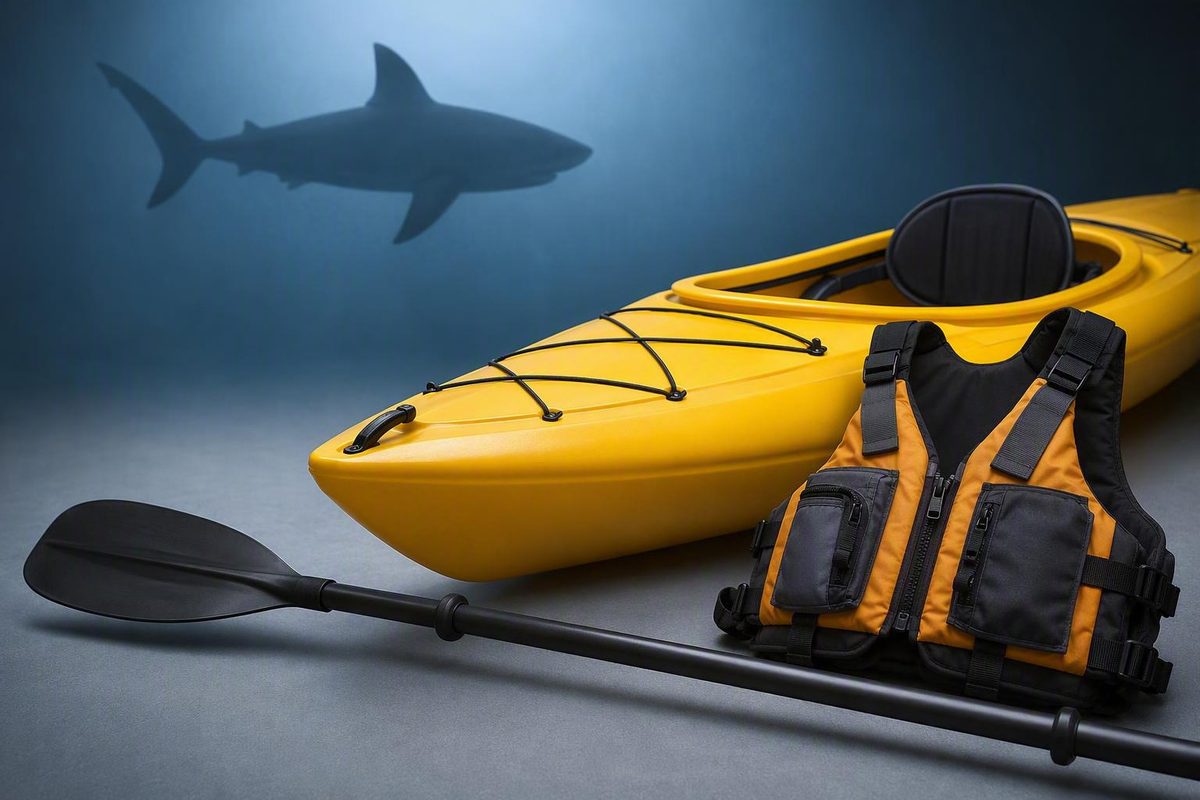
Shark attacks on kayaks are exceptionally uncommon in the documented record: Paddling Magazine reports 21 incidents since the early 1900s, including two fatalities. Three separate shark-kayak encounters went viral in August 2026, but they do not overturn boating’s broader safety record: drowning remains the dominant fatal hazard, making capsize preparation and a worn PFD more consequential than planning around a shark strike. Paddling Magazine attributes the historical count to the Global Shark Attack File.
The exact probability of a shark incident on any given trip is unknown. No available source supplies both a reliable kayak-incident count and the total number of comparable ocean-kayak trips, miles or paddling hours. Claims such as “one attack per X trips” would require a denominator the public record does not provide.
Set your paddling conditions and choose the hazard on your mind; the tool shows which risk deserves priority.
No source provides incidents per paddling hour, so this tool does not manufacture a rate. It compares the available counts, evidence quality and conditions you can control.
| Concern | Available Count | Per Paddling Hour | What The Evidence Supports |
|---|---|---|---|
| Shark | 21 reported incidents; 2 fatalities since the early 1900s | — | Documented but exceptionally uncommon; most occupants in a separate 31-case review were uninjured |
| Capsize/drowning | Kayak-only count: — | — | Drowning remains the dominant recreational-boating fatality cause |
| Lightning | — | — | No comparative figure supplied |
| Sunburn | — | — | No comparative figure supplied |
Source note Paddling Magazine’s Global Shark Attack File attribution; informal 2005–2014 Hobie forum review; Florida Museum International Shark Attack File; Coast Guard findings summarized by Seapower. “—” means the supplied sources provide no figure.
Why The Viral Clips Feel Like A Pattern
The consensus reaction is understandable. One report described a tiger shark ramming a kayak on August 1. Another showed a great white sending a fisherman overboard on August 28. A third clip, published August 29, showed a great white “torpedoing” toward a kayak. Three vivid incidents in four weeks can make open-water paddling look as though it carries a meaningful and rising shark risk.
A kayak also offers little psychological separation from the water. A large animal can be visible directly beneath the hull, and even harmless contact can destabilize a narrow craft. If a shark damages or overturns a kayak offshore, the resulting loss of stability is a genuine emergency.
That is where the consensus is right: paddlers should not dismiss a close approach, hull strike or capsize merely because no bite has occurred. Fishing activity, distance from assistance and the condition of the boat can all make an encounter more consequential.
The clips do not establish that shark incidents are common or increasing, however. A trend requires consistent definitions, comparable reporting and a measure of kayaking exposure over time. Three widely shared accounts provide none of those. They may reflect an unusual cluster, increased camera use or greater distribution of dramatic footage rather than a change in the underlying rate.
The broader International Shark Attack File recorded 47 unprovoked attacks worldwide in 2024 across all water activities. Its annual worldwide average is approximately 70 unprovoked human bites and five resulting deaths, covering swimmers, surfers, divers, paddlers and other water users rather than kayakers alone. The Florida Museum describes the database and its worldwide statistics.
The Available Kayak Counts Cannot Produce Personal Odds
Two reported kayak-incident counts appear repeatedly, but they cover different periods and use different methods.
| Source | Period | Incidents | Reported Outcomes |
|---|---|---|---|
| Paddling Magazine, citing the Global Shark Attack File | Since the early 1900s | 21 | Two fatalities |
| Informal Hobie forum review | Jan. 2005–Oct. 2014 | 31 of 1,100 reviewed shark incidents | One fatality; three nonfatal injuries |
The Paddling Magazine figure is a secondary attribution. “Since the early 1900s” is imprecise, the article gives no database retrieval date, and the supplied primary material does not independently confirm the count. It should be treated as a reported historical figure rather than a complete, current worldwide total.
The second count comes from a pseudonymous forum analysis posted in 2015. Its author reviewed 1,100 shark incidents and categorized 31 as kayak-related, possibly including some canoes. The analysis was not peer-reviewed, its methodology has not been independently verified, and it does not claim to represent every kayak encounter. The original forum post provides the incident list and reported outcomes.
Dividing 31 by 1,100 produces approximately 2.8%, but that is the share of incidents in that particular shark-incident review associated with kayaks. It is not the percentage of kayakers attacked, the percentage of outings involving a shark or an individual paddler’s risk.
A defensible trip estimate would use this calculation: kayak incident risk per outing equals qualifying shark incidents involving kayaks divided by total comparable ocean-kayak outings.
Neither source supplies that denominator. The totals also should not be added or averaged because their periods, databases, definitions and geographic coverage may differ. Some incidents could overlap.
The Global Shark Attack File cited by Paddling Magazine and the Florida Museum’s International Shark Attack File should not be treated as interchangeable names. Similar subject matter does not establish identical records or classification methods.
Most Listed Incidents Involved The Hull, Not An Injured Paddler
The informal 2005–2014 review reported one fatality, three nonfatal injuries and no occupant injury in most of its 31 kayak-related cases. The listed events included kayaks being bumped, bitten, rammed, scratched, damaged, capsized or overturned.
The reported fatality involved a Maui kayak fisher in 2013 whose leg was bitten while dangling in the water. According to the forum account, the victim died from blood loss. That case demonstrates that a fatal outcome is possible, but it does not make the informal list a valid injury-rate study.
A useful incident scale separates outcomes that headlines often combine:
- A sighting with no approach.
- An approach or following behavior.
- A bump, scratch or other hull contact.
- A bite or strike that damages the vessel.
- A capsize or overturning.
- A bite to the occupant.
- A nonfatal or fatal injury.
Calling every level an “attack on a kayaker” makes the outcomes appear more uniform than they are. A shark contacting only the hull is materially different from biting the occupant.
“No occupant injury” does not mean “no danger.” A hard impact can throw someone into the water. A puncture can make the kayak unseaworthy. An overturned paddler may then face cold water, waves, current and distance from assistance even if the shark leaves immediately.
Nor does a bump prove the shark’s intent. The outcome data support saying that hull contact was more common than occupant injury within the limited review. They do not establish whether each shark was investigating, feeding, reacting defensively or striking for another reason.
Capsize And Drowning Are The Risks The Boating Record Elevates
The most recent Coast Guard annual boating-safety report covered by Seapower recorded the fewest recreational boating fatalities in more than 50 years. Drowning—not animal strikes—remained the dominant cause across the Coast Guard’s prior annual reports. Seapower summarizes the Coast Guard’s boating-fatality findings.
The supplied material does not provide a kayak-only fatality rate, a capsize-without-PFD count or paddling-hour exposure figures. A numerical shark-versus-capsize rate comparison therefore is not possible from these sources.
The practical ranking is still clear. Shark incidents occupy a tiny historical record with uncertain completeness, while drowning repeatedly dominates nationwide recreational-boating fatalities. A PFD also addresses the immediate consequence of being unexpectedly placed in the water, whether the cause is a wave, wake, failed brace, collision, medical problem or hull contact.
That does not mean a PFD prevents capsizing or guarantees survival. It means wearing one manages a documented boating-fatality pathway without requiring the paddler to predict why entry into the water might occur.
A shark bump that overturns a kayak ultimately creates a capsize problem too. Once the paddler is in the water, flotation, re-entry ability, companionship and distance from help can matter more than identifying what motivated the animal.
Fishing Changes What Is Happening Around The Kayak
Touring and fishing both place a small craft on coastal water, but fishing can add bait, berley or chum, fish blood, struggling hooked fish, exposed catches and residue on the hull or deck. Sharks may approach that activity without initially targeting the paddler or kayak.
The available evidence does not quantify how much fishing changes the chance of an encounter. It does not support claiming that kayak fishing causes shark attacks. It does support treating food activity around the boat as a controllable factor.
A New Zealand kayak angler describes sharks taking hooked fish and approaching kayaks during fishing. His precautions include containing bait and catches, removing blood and residue, keeping limbs inside the boat and leaving after an encounter. His decades without a shark-related injury are personal experience, not a statistical estimate. The kayak-fishing account describes those encounters and precautions.
Anglers can reduce avoidable exposure by keeping catches out of the water, limiting the time a bleeding or struggling fish remains beside the kayak and leaving when sharks repeatedly take fish from a line. Saving a catch or lure should not take priority over stability and departure.
Classification also matters. The International Shark Attack File treats bites involving feeding, handling, harassing, unhooking or removing sharks from nets as provoked. Merely carrying a fishing rod does not determine the classification; the facts of the interaction do. The Florida Museum explains provoked and unprovoked classifications.
What To Do During A Close Approach
If a shark approaches, keep hands, feet and catches out of the water. Avoid unnecessary splashing, alert companions and maintain control of the kayak. Leave deliberately when conditions allow rather than making abrupt movements that compromise stability.
If fishing, stop introducing bait, blood or struggling fish into the water. Do not feed, touch, hook or attempt to handle the shark. Repeated approaches to catches are a reason to stop fishing and leave the area.
After a hull strike, the immediate problem is seamanship rather than interpreting the shark’s intent. Check whether the kayak remains stable and seaworthy without leaning over the side or putting your hands into the water. Stay with companions and head toward assistance. If the craft cannot be used safely, call for help rather than continuing the outing.
General encounter-reduction guidance also favors paddling with others, remaining within reasonable reach of shore, avoiding unnecessary activity around feeding fish and using additional caution in low light or murky water. Georgia Aquarium identifies baitfish, fishing areas, sandbars and steep drop-offs as contexts for added caution. Georgia Aquarium summarizes these precautions.
There is not enough evidence to rank kayak shark risk reliably by hull color, material or design. A particular color or plastic construction should not be presented as shark-proof or inherently attractive without supporting data.
The Honest Answer Remains Bounded
Documented shark encounters with kayaks are real, and some have caused vessel damage, capsize, injury or death. The limited historical sources nevertheless indicate that serious attacks on occupants are exceptionally uncommon, with most cases in the informal review ending without a shark-inflicted injury.
No source establishes exact odds per trip, mile or paddling hour. That uncertainty is a reason to avoid false precision, not a reason to give viral clips the same weight as the broader boating-fatality record.
Manage the event that repeatedly kills boaters: unexpected entry into the water followed by drowning. Wear the PFD, know how to re-enter the kayak, stay within a workable distance of assistance and keep fishing attractants contained. If a shark appears, treat it seriously and leave under control—but do not mistake three dramatic videos for the base rate.