
Choose the Right Motor for Your Boat, Load and Water
Size by fully loaded weight, then check thrust, voltage, battery count, shaft length, water rating, mounting clearance and wiring.
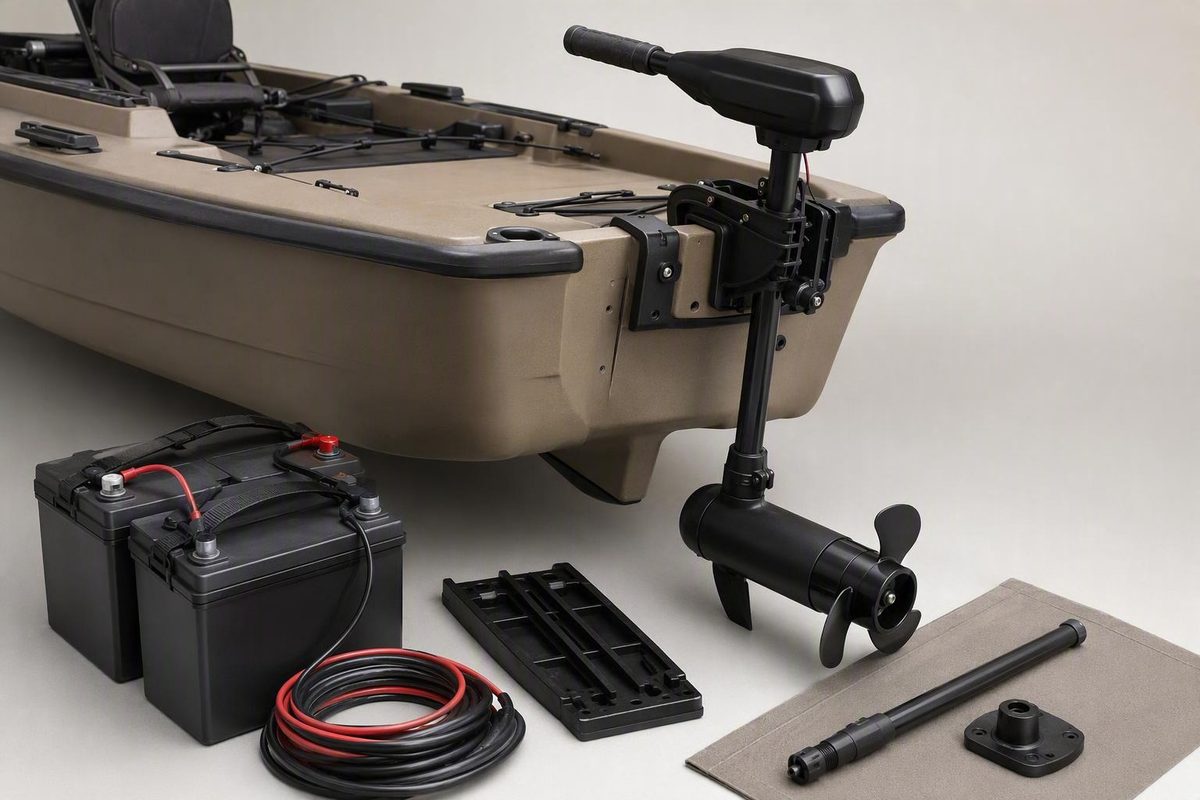
Choose a transom mount trolling motor by configuration before brand. Calculate the boat’s fully loaded operating weight, allow for wind and current, match thrust to that load, confirm voltage and battery count, measure for shaft length, select the correct freshwater or saltwater rating, and verify that the mount, controls and wiring fit your boat. Boat length is a useful cross-check, but loaded weight is the primary sizing input.
The short answer: choose in this order
Use this seven-step selector:
-
Calculate fully loaded weight. Count the hull, occupants, batteries, fuel when carried, safety equipment and every item of gear.
-
Identify the water type. Decide whether the motor will operate in freshwater, saltwater or brackish water.
- Choose minimum thrust. Use total operating weight as the main input and boat length only as a secondary check.
- Identify voltage and battery count. Confirm that the boat has room and carrying capacity for the required electrical system.
- Measure from the transom to the waterline. Use that measurement—not boat length—to choose shaft length.
- Verify the installation as a system. Check clamp fit, transom contact area, steering and tilt clearance, cable routing, storage, wiring requirements and the current manual for the exact model.
A transom-mount trolling motor is an electric motor secured at the stern and commonly steered with a hand tiller. As one documented example, MotorGuide’s R5 design uses a clamp bracket, transom clamp screws, depth adjustment, tilt controls and a twist tiller with variable forward and reverse operation. The manual lists separate freshwater and saltwater configurations, illustrating why the complete model description matters—not merely the family name.
| Buyer input | What it determines | Common mistake |
|---|---|---|
| Fully loaded weight | Minimum thrust and likely voltage | Using empty hull weight |
| Wind, current and waves | Whether to add margin above minimum | Sizing only for calm water |
| Water type | Required environmental rating | Assuming freshwater covers brackish water |
| Transom-to-waterline distance | Shaft length | Choosing by boat length |
| Battery space and capacity | Whether the voltage system is practical | Pricing the motor but not its batteries |
| Mount and steering clearance | Physical fit and usability | Ignoring tiller swing or tilt clearance |
This process can narrow the field to a suitable configuration. It does not establish which brand is fastest, quietest, most durable or best value; those conclusions would require comparable independent testing under controlled loads and conditions.
Match loaded boat weight to thrust and voltage
Start with operating weight, not the number printed in a hull brochure. A simple worksheet prevents the battery bank, passengers and fishing equipment from disappearing from the calculation.
| Load item | Weight |
|---|---|
| Hull and installed equipment | ___ lb |
| Trolling motor | ___ lb |
| Propulsion batteries | ___ lb |
| Fuel and tank, when carried | ___ lb |
| Passengers | ___ lb |
| Fishing and safety equipment | ___ lb |
| Coolers, anchors and other gear | ___ lb |
| Total loaded operating weight | ___ lb |
If passenger and gear loads change significantly, calculate both a normal trip and the heaviest trip you reasonably expect. Size for the heavier credible load rather than an unusually light outing.
Minn Kota publishes the following general minimum recommendations. They are manufacturer guidelines, not guaranteed speed or performance figures and not independent test results. Loaded weight is the main sizing factor, while length is an accompanying guide; Minn Kota also advises considering additional thrust where wind or current are major factors (Minn Kota motor-selection guide).
| Total loaded weight | Approximate length | Minimum thrust | Voltage |
|---|---|---|---|
| Up to 1,599 lb | About 14 ft | 30–40 lb | 12V |
| 1,600–2,599 lb | About 16–17 ft | 40–55 lb | 12V |
| 2,600–3,599 lb | About 17–18 ft | 70–80 lb | 24V |
| 3,600–4,599 lb | About 18–19 ft | 80–90 lb | 24V |
Treat these as starting minimums.
Worked example: A 16-foot boat totals 2,200 pounds after adding passengers, batteries and gear. Applying the cited Minn Kota table, it falls within the 1,600–2,599-pound range, corresponding to 40–55 pounds of thrust at 12V. If persistent current is part of normal use, choosing toward the upper end may be sensible. That calculation does not predict speed or runtime, which depend on the specific hull, motor, battery and conditions.
Avoid two shortcuts:
- Do not use empty hull weight. It excludes people, batteries and equipment the motor must move.
- Do not select by length alone. Length can reveal an implausible result, but boats of equal length can differ considerably in loaded weight and wind exposure.
Understand what 12V, 24V and 36V change
Voltage follows the selected motor configuration. In Minn Kota’s cited sizing table, the lower thrust ranges use 12V, while the 70- to 90-pound ranges use 24V.
Documented MotorGuide examples show the same broad progression: R5 freshwater models rated at 70 and 80 pounds use 24V, while the 105-pound freshwater configuration uses 36V (MotorGuide R5 owner’s manual). That does not mean every motor at a given thrust uses the same electrical design; verify the exact model.
| System voltage | Battery count | Documented examples | Practical checks |
|---|---|---|---|
| 12V | One | 30–55 lb in cited Minn Kota ranges | Space, weight, current manual |
| 24V | Two | R5 70 and 80 lb | Series wiring, cable route, charging |
| 36V | Three | R5 105 lb | Three-battery space, weight, charger |
A category-level buying guide cannot turn “24V” into a defensible number of hours.
Plan the complete electrical system before purchasing. Do not infer wire gauge, breaker or fuse rating, connector type, maximum cable length, torque values or lithium-battery compatibility from general guidance. Use the current manufacturer requirements for the exact model and revision.
On a small craft, confirm that the complete system can be carried without creating an impractical layout or blocking movement, drainage or access needed in an emergency.
Measure shaft length at the transom
- Load the batteries and typical equipment.
- Place the boat in calm water where it can be measured safely.
- Measure vertically from the top of the mounting transom to the waterline.
- Match that distance to the manufacturer’s transom-mount chart.
- Check that the selected motor is offered with the required shaft.
- Confirm propeller depth and clearance after mounting.
Minn Kota maps a 0–10-inch measurement to a 30-inch shaft, 10–16 inches to a 36-inch shaft and 16–22 inches to a 42-inch shaft. Its guidance also calls for keeping the propeller tip at least 12 inches below the waterline and adding about 5 inches to the waterline measurement when rough-water fishing is expected (Minn Kota shaft-length guidance).
| Transom to waterline | Recommended shaft |
|---|---|
| 0–10 in | 30 in |
| 10–16 in | 36 in |
| 16–22 in | 42 in |
Worked example: A 14-inch measurement maps to a 36-inch shaft under the cited chart. If the boat will regularly fish rough water, apply Minn Kota’s approximately 5-inch adjustment and then check the available shaft lengths and adjustment range for the specific motor. Do not automatically buy the longest shaft.
The same Minn Kota chart includes a 55-inch recommendation specifically labeled for an RT Transom product at a deeper measurement. That label should not be generalized to every transom-mounted motor. If your measurement falls outside the basic ranges above, consult the live chart and manual for the exact product.
Compare verified motor configurations, not marketing superlatives
Comparison becomes useful after you know the required thrust, voltage, shaft and water rating. Before that, a low price may simply indicate a motor that is too small or electrically incompatible.
Minn Kota lists Endura, Endura Max and Traxxis as freshwater, hand- or tiller-controlled transom-mount families. Prices checked on September 14, 2026, were $169.99–$289.99 for Endura, $279.99–$329.99 for Endura Max and $439.99–$659.99 for Traxxis. The storefront also displayed an Endura 50-pound hand-control model with a 42-inch shaft for $189.99 on sale from $239.99, plus an Endura C2 55-pound hand-control model with a 42-inch shaft and battery meter for $259.99 (Minn Kota freshwater transom-mount listings).
| Family or model | Water rating | Control type | Displayed price |
|---|---|---|---|
| Endura family | Freshwater | Hand/tiller | $169.99–$289.99 |
| Endura Max family | Freshwater | Hand/tiller | $279.99–$329.99 |
| Traxxis family | Freshwater | Tiller | $439.99–$659.99 |
| Endura 50 lb hand model | Freshwater | Hand | $189.99 sale |
| Endura C2 55 lb model | Freshwater | Hand | $259.99 |
| Family or model | Thrust | Voltage | Shaft |
|---|---|---|---|
| Endura family | — | — | — |
| Endura Max family | — | — | — |
| Traxxis family | — | — | — |
| Endura 50 lb hand model | 50 lb | — | 42 in |
| Endura C2 55 lb model | 55 lb | — | 42 in |
The battery meter is established only for the exact Endura C2 listing described above. It does not show that battery meters—or features such as Spot-Lock or i-Pilot—are standard across transom-mounted motors.
MotorGuide’s R5 manual documents five specific configurations (MotorGuide R5 owner’s manual).
| Model | Water rating | Control type | Displayed price |
|---|---|---|---|
| R5-70 FW Digital | Freshwater | Twist tiller | — |
| R5-80 FW Digital | Freshwater | Twist tiller | — |
| R5-105 FW Digital | Freshwater | Twist tiller | — |
| R5-80 SW Digital | Saltwater | Twist tiller | — |
| R5-105 SW Digital | Saltwater | Twist tiller | — |
| Model | Thrust | Voltage | Shaft |
|---|---|---|---|
| R5-70 FW Digital | 70 lb | 24V | 42 in |
| R5-80 FW Digital | 80 lb | 24V | 42 in |
| R5-105 FW Digital | 105 lb | 36V | 42 in |
| R5-80 SW Digital | 80 lb | 24V | 42 in |
| R5-105 SW Digital | 105 lb | 36V | 50 in |
These examples show how water rating, voltage and shaft length can change within one product family. They do not establish independent differences in speed, runtime, noise, efficiency, corrosion resistance, durability or value.
Treat every displayed price as a dated snapshot, not a promise. Before paying, verify current price, stock, specifications, package contents and model status. A family description or listing photograph is not a substitute for the exact model number and manual.
Choose the correct water rating and control layout
Buy a motor explicitly rated for the environment where it will operate. A freshwater listing establishes freshwater use; it does not establish saltwater or brackish-water suitability. The separate FW and SW designations in the R5 examples show why a suffix or complete model description can matter as much as the headline thrust number.
If your intended water is brackish, do not assume it is “mostly fresh.” Check how the manufacturer classifies that environment for the exact model and what cleaning or maintenance it requires.
The documented R5 tiller provides variable forward and reverse operation. Before buying, sit or stand in the intended operating position and check the complete movement:
- Can you reach the tiller without twisting continuously?
- Can it swing through the required steering arc?
- Will it strike a seat, gunwale, outboard, rudder or cargo?
- Can the motor tilt without colliding with the hull or equipment?
- Can you reach the depth and steering-tension adjustments?
- Does the layout leave a clear route for boarding and moving around?
This is particularly important on kayaks, dinghies and compact jon boats, where a few inches can decide whether the operating position is comfortable or awkward.
Retailer guidance positions transom mounts as options for smaller boats, buyers preserving deck space and people working within tighter budgets. Those are commercial recommendations rather than comparative handling tests (retailer overview of transom-mount motors). They do not prove that a transom mount handles better than a bow mount or electric outboard. The appropriate layout depends on the hull, operating position, steering needs and intended use.
Pre-purchase, mounting and safety checklist
Print or save this checklist and complete it against the exact motor listing and current manual.
Boat and operating load
- [ ] Hull and installed-equipment weight recorded
- [ ] Motor and battery weight included
- [ ] Fuel included when carried
- [ ] Maximum expected passenger load included
- [ ] Fishing, safety and other gear included
- [ ] Total loaded operating weight calculated
- [ ] Typical wind, current and waves considered
Motor configuration
- [ ] Minimum thrust selected from loaded weight
- [ ] Boat length used only as a cross-check
- [ ] Freshwater, saltwater or brackish use identified
- [ ] Exact model explicitly approved for that environment
- [ ] Required voltage confirmed
- [ ] Battery count confirmed
- [ ] Battery space, weight and charging arrangements checked
- [ ] No runtime assumption made from voltage alone
Shaft and mounting fit
- [ ] Top-of-transom-to-waterline distance measured while loaded
- [ ] Shaft selected using the manufacturer’s transom chart
- [ ] Rough-water allowance considered
- [ ] Propeller can reach the specified operating depth
- [ ] Adequate shallow-water clearance remains
- [ ] Transom geometry and clamp contact area inspected
- [ ] Clamp screws can be reached and tightened correctly
- [ ] Motor can tilt and adjust without obstruction
- [ ] Tiller clears seats, gunwales, outboards and equipment
- [ ] Motor can be stored or removed as required
Electrical and documentation
- [ ] Safe cable route planned
- [ ] Wire size taken from the exact manual
- [ ] Manufacturer-specified circuit protection identified
- [ ] Connector requirements confirmed
- [ ] Battery chemistry confirmed as compatible
- [ ] Appropriate charger selected
- [ ] Current model manual obtained
- [ ] Model and serial numbers recorded
This general guidance does not establish an exact transom-thickness limit, wire gauge, breaker or fuse rating, connector specification, cable length, torque value or battery capacity for your motor. The selected model’s current instructions and manufacturer requirements control those details.
Be precise when shopping for replacement hardware. A complete trolling motor is different from an electric outboard. A complete replacement transom mount is also different from clamp screws, pins, brackets, kits and other individual hardware; parts sellers categorize complete mounts and individual components separately (complete mounts and mount-parts categories). Record the motor’s exact model, serial number and manufacturer part number before ordering. Do not assume similarly named families such as Endura and Endura Max use interchangeable components.
A quick-connect may simplify removal, but compatibility, current capacity, circuit protection and cable requirements still need model-specific confirmation. Convenience hardware is not automatically included with every motor.
Before relying on the installation, perform a low-risk function check in accordance with the manual. Confirm secure mounting, steering movement, tilt operation, propeller clearance and correct direction control. Route wiring neatly and away from boarding or walking routes.
MotorGuide instructs operators to stop the motor when swimmers are near the boat and while passengers are boarding or unloading, and it advises routing cables neatly to reduce tripping hazards (MotorGuide R5 owner’s manual). Wear a life jacket whenever you are on the water (Kayaks Hub water-safety notice).
The final buying rule is simple: the right transom mount trolling motor must clear five checks—enough thrust for the fully loaded boat and normal conditions, a voltage system the boat can accommodate, a shaft matched to the measured transom, an explicit rating for the intended water, and safe physical and electrical compatibility. If loaded weight, shaft measurement, water rating, voltage or fit cannot be confirmed, pause the purchase rather than guessing.