
The Strongest-Supported Boat Batteries for Every Kind of Job
Comparable star averages, verified-purchase review counts and independent ratings do not cover the same batteries. Compare hands-on picks by use case.
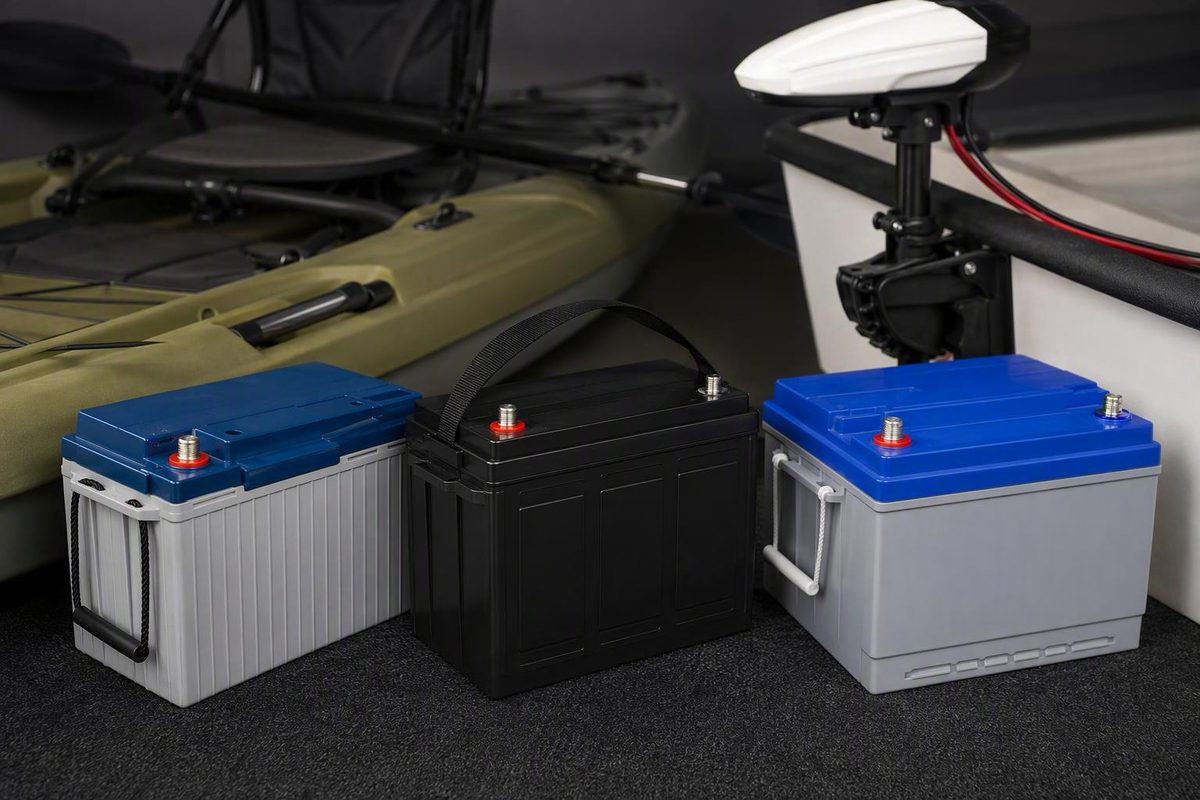
Editorial methodology: This guide synthesizes third-party editorial selections, retailer guidance, and manufacturer-published technical guidance. Kayaks Hub did not conduct the battery tests described below; its broader editorial approach emphasizes attribution and hands-on boating experience. Product specifications and policies should be verified against current manufacturer documentation before purchase or installation.
Quick verdict: what “best rated” can—and cannot—mean here
The available evidence does not identify a true highest-rated marine battery. It contains no comparable customer-star averages, verified-purchase review counts, or independent ratings database covering the same products under consistent criteria.
The strongest-supported best-overall editorial pick is the MillerTech Lithium 12V 135Ah Dual Purpose Battery. Wired2Fish selected it after reporting hands-on use, recorded usage, battery-behavior monitoring, trials in different watercraft, and interviews with battery engineers. The publication says the battery can start an outboard and power electronics, lists it at 1,500 CCA, and reports that more than half its charge remained after several trips without recharging. Those observations are useful practical evidence, but they are not a standardized runtime test, long-term reliability study, or customer-ratings result. Wired2Fish also discloses that it may earn commissions from links in its marine-battery buyer’s guide.
Outdoor Life reached a different conclusion under a different methodology, naming the 36V Lithium Pro TM3165-36 its best all-in-one marine battery. The author based the selections on experience trying batteries during more than a decade of boat ownership. This model and the 12V MillerTech do not compete for every installation: the Lithium Pro is intended to replace a three-battery 36V configuration, while the MillerTech is a 12V dual-purpose candidate. Outdoor Life participates in affiliate programs, and its marine-battery selections were not produced under a shared testing protocol with Wired2Fish.
This guide uses three evidence labels:
- Hands-on editorial pick: A model selected by an editorial publication based at least partly on reported use or author experience.
- Retailer guidance: General or product-specific advice from a store that sells batteries.
- Manufacturer claim: A specification, warranty, cycle-life figure, or performance assertion published by a battery maker or repeated by a seller or editorial outlet.
These distinctions matter. Editorial experience can identify promising candidates and practical trade-offs, but it does not establish market-wide superiority or multi-season reliability. Retailers and manufacturers can supply useful technical information, yet they have direct commercial interests. Recurring coverage of MillerTech, Dakota Lithium, or Optima BlueTop shows that those names receive serious consideration; it does not prove that they are universally better.
The governing rule is simple: choose the battery’s role and confirm system compatibility before considering editorial awards, features, warranty, or price.
Because the supplied evidence does not include current manufacturer datasheets for every shortlisted model, this article is a research shortlist—not an installation approval. Verify model status, dimensions, terminals, electrical limits, charger requirements, warranty terms, included equipment, and engine compatibility before ordering.
Best marine batteries by use case: the shortlist
Every row labeled Wired2Fish, including its source-reported specifications and category titles, comes from that publication’s buyer’s guide cited above.
Every row labeled Outdoor Life, including its source-reported specifications and category titles, comes from that publication’s selections cited above.
| Use case | Model | Evidence label | Voltage | Stated capacity | Cranking output | Weight or group size | Notable features | Major limitation |
|---|---|---|---|---|---|---|---|---|
| Best-overall editorial pick | MillerTech Lithium 12V 135Ah Dual Purpose | Hands-on editorial pick: Wired2Fish | 12V | 135Ah | 1,500 CCA | Unavailable | Reported as suitable for outboard starting and electronics; more than half its charge reportedly remained after several trips | Engine approval, dimensions, BMS limits, and charging compatibility require confirmation |
| 36V all-in-one configuration | Lithium Pro TM3165-36 | Hands-on editorial pick: Outdoor Life | 36V | Unavailable | Unavailable | Group 31; 42.9 lb | Intended to replace three 12V batteries; Bluetooth monitoring reported | Costly and limited to compatible 36V applications |
| Trolling motor | MillerTech 36V 50Ah Sport Series | Hands-on editorial pick: Wired2Fish | 36V | 50Ah | Not supplied | Unavailable | Bluetooth identified in the selection | Motor voltage, current demand, BMS limits, and runtime requirements must match |
| Kayak electronics | MillerTech 12V 40Ah Sport Series | Hands-on editorial pick: Wired2Fish | 12V | 40Ah | Not supplied | Unavailable | Bluetooth monitoring and low-temperature charging protection reported | Runtime depends on the total load; dimensions and current limits require confirmation |
| Kayak electronics | Norsk Guardian 14.8V 30Ah | Hands-on editorial pick: Wired2Fish | 14.8V | 30Ah; 444Wh stated | Not supplied | Unavailable | Bluetooth, charge display, waterproof USB-A and USB-C ports, and charger reported | A 14.8V output is not interchangeable with every nominally 12V device |
| Very compact kayak power | Dakota Lithium kayak-sized 12V option | Hands-on editorial pick: Outdoor Life | 12V | Unavailable | Not intended for large-outboard cranking | Under 3 lb; approximately 6 × 2.5 × 4 in | Extremely compact and light | Not intended for multiple high-draw accessories |
| Compact AGM installation | Optima BlueTop family | Hands-on editorial pick: Outdoor Life | Unavailable by variant | Unavailable by variant | Unavailable by variant | Listed variants weigh 38–59 lb | Several sizes and reserve capacities | Relatively heavy; specifications vary substantially by part number |
| Budget lithium category | Goldenmate 12V 100Ah Orion 1000 | Hands-on editorial pick: Wired2Fish | 12V | 100Ah | Unavailable | Unavailable | Lithium budget-category selection | Current price and complete electrical limits were not supplied |
| Budget lead-acid category | EverStart Marine 29DC | Hands-on editorial pick: Wired2Fish | Unavailable | Unavailable | Unavailable | Unavailable | Conventional budget-category selection | Current price, size, weight, and complete ratings were not supplied |
| Budget category | Interstate Deep Cycle | Hands-on editorial pick: Outdoor Life | Unavailable by variant | Unavailable by variant | Not supplied | Group 24, 27, and 31 versions reported | Multiple physical sizes | Described as less powerful than some newer alternatives; current price unavailable |
| Lead-acid deep-cycle | Deka Marine Master | Hands-on editorial pick: Outdoor Life | Unavailable by variant | Unavailable by variant | Not supplied | Group 24, 27, and 31 versions reported | Conventional lead-acid deep-cycle range | Heavy; model-specific ratings require confirmation |
| “Most reliable” editorial category | LiTime 12V 100Ah Bluetooth | Hands-on editorial pick: Wired2Fish | 12V | 100Ah | Not supplied | Unavailable | Bluetooth 5.0 and low-temperature cutoff reported | The category title is not independent proof of market-leading reliability |
“Budget” means the category assigned by the relevant publication. It does not establish that the Goldenmate, EverStart, or Interstate is the least expensive option today. Prices, promotions, shipping, required chargers, and installation costs can change the result.
Kayak choices require particular care. The MillerTech is listed at 12V, while the Norsk is listed at 14.8V; the small Dakota option occupies a lighter-duty niche. Match voltage to the device, verify connector type and polarity, total the expected load, and estimate the required operating time. Similar physical size does not make batteries electrically interchangeable.
The Optima BlueTop is a family rather than a single specification. Outdoor Life reports variant weights from 38 to 59 pounds and reserve capacities from 10 to 155 minutes. A family-level award cannot determine which BlueTop fits a particular tray, terminal arrangement, cranking requirement, or accessory load.
Start with the job: starting, deep-cycle, or dual-purpose
A battery’s functional type is different from its chemistry. Starting, deep-cycle, and dual-purpose describe the work it is designed to perform. Flooded lead-acid, AGM, gel, and LiFePO4 describe how it stores energy.
A starting battery supplies a short burst of high current to crank an engine. It is not intended to run lights, pumps, fish finders, or other accessories for extended periods while being repeatedly discharged.
A deep-cycle battery supports sustained loads and repeated discharge-and-recharge use. Typical applications include trolling motors, fish finders, GPS units, radios, lights, livewell pumps, bilge pumps, and house electronics.
A dual-purpose battery attempts to provide both cranking output and useful cycling capacity. It can be practical for a small boat with one battery compartment, but it remains a compromise. A dedicated starting battery may provide stronger specialized cranking performance, while a dedicated deep-cycle battery may offer greater endurance for accessories.
Begin with the boat and engine manuals. Sea Tow’s marine-battery selection guidance recommends checking the specified battery size, type, and ratings and retaining a successful existing setup unless a particular need justifies changing it.
Consider five common scenarios:
- Basic outboard with modest accessories: Dependable ignition power is the primary requirement. Start with the engine maker’s specified chemistry and minimum cranking and reserve ratings.
- Electric trolling motor: This is a sustained deep-cycle load. Match the motor’s required system voltage before comparing capacity or brand.
- Fishing kayak: The load may include a fish finder, navigation light, phone charger, or small motor. Weight and dimensions can matter nearly as much as capacity.
- Small boat with one battery compartment: A correctly approved dual-purpose battery may be practical if it satisfies both the engine’s cranking requirement and the expected accessory load.
- Electronics-heavy vessel: Separate starting and house banks can reduce the risk that accessory use leaves insufficient power to start the engine.
The same principle applies to trolling-motor boats. A separate starting battery preserves ignition capacity, while a dedicated deep-cycle bank handles propulsion. A vessel with large electronics, pumps, refrigeration, or long periods between charging opportunities may similarly benefit from distinct starting and house banks.
A “dual-purpose” label does not prove that a battery can crank a particular outboard. Nor does it prove that the battery will run a demanding electronics package for the required time. Check both functions independently.
If the existing type has performed well and the boat has not gained new loads, a like-for-like replacement is often the lowest-risk approach. A chemistry change, added trolling motor, larger electronics package, or revised bank design should be treated as an electrical-system redesign rather than a simple battery swap.
What the leading editorial picks actually offer
The MillerTech 12V 135Ah Dual Purpose has the clearest case for the best-overall editorial label because Wired2Fish describes more than a specification-sheet comparison. The publication reports using and monitoring batteries in different watercraft, then identifies this model as capable of starting an outboard while powering electronics. It lists the battery at 1,500 CCA and says more than half its charge remained after several trips without recharging. These are source-reported observations and specifications, not current first-party verification or a standardized runtime result (Wired2Fish).
The reported charge result lacks a standardized load profile, trip duration, ambient temperature, starting frequency, and measured beginning-and-ending capacity. A boat with networking equipment, pumps, sonar, lighting, or different charging behavior may produce a substantially different result.
The Lithium Pro TM3165-36 addresses another problem: simplifying a 36V bank. Outdoor Life lists it as a 36V Group 31 battery weighing 42.9 pounds and says it is intended to replace three 12V batteries. The article also reports Bluetooth monitoring and a claim that the battery can be charged more than 3,000 times without losing effectiveness. That cycle statement is not verified comparative durability (Outdoor Life).
The same caution applies to the LiTime 12V 100Ah Bluetooth. Wired2Fish reports Bluetooth 5.0 monitoring, low-temperature cutoff protection, and a cycle-life claim exceeding 4,000. The feature descriptions may help buyers identify questions for the manufacturer, but the cycle figure is not measured service life under a defined marine test.
For kayaks, the MillerTech 12V 40Ah reportedly includes Bluetooth monitoring and low-temperature charging protection. Its source also reports a cycle-life claim exceeding 5,000 and a 10-year warranty. Neither figure guarantees actual life in a damp, vibrating, and frequently transported installation.
The Norsk Guardian 14.8V 30Ah is listed at 444Wh and reportedly includes Bluetooth monitoring, a charge display, waterproof USB-A and USB-C ports, and a charger. Those conveniences may suit portable electronics, but buyers must verify that the voltage, connectors, and output limits suit every attached device.
Outdoor Life’s compact Dakota Lithium kayak option is described as weighing under 3 pounds and measuring approximately 6 by 2.5 by 4 inches. The same source warns that it is not intended for multiple power-hungry accessories or cranking a large outboard. Its size is advantageous only when its electrical output and energy capacity match the intended load.
The Optima BlueTop must be evaluated by exact part number. Outdoor Life’s listed variants cover weights from 38 to 59 pounds and reserve capacities from 10 to 155 minutes, making a single family-wide specification misleading.
Before buying: Obtain the current manufacturer datasheet and warranty. Confirm model status, voltage, capacity, dimensions, weight, terminal arrangement, included accessories, charger requirements, BMS current limits, temperature limits, starting approval, availability, and warranty conditions. If a purchase-critical figure is unavailable, pause rather than infer it from a model name or editorial category.
Lithium vs. AGM vs. flooded lead-acid
Chemistry affects weight, maintenance, charging behavior, usable discharge, self-discharge, initial price, and installation requirements. It does not replace the need to choose the correct functional type.
The broad comparisons below summarize retailer and vendor guidance rather than controlled tests of the shortlisted products. West Marine reports estimated cycle-life ranges of 200–500 cycles for flooded batteries, 500 or more for gel, 400–600 for AGM, and 2,000–3,500 or more for lithium. It also lists approximate monthly self-discharge of 6–7% for flooded batteries, 3% for gel and AGM, and less than 1% for lithium, while warning that charging practice, brand, and depth of discharge affect results (West Marine).
| Chemistry | Initial cost | Weight | Maintenance | Usable discharge | Charging and installation | Typical role |
|---|---|---|---|---|---|---|
| Flooded lead-acid | Generally lowest | Usually highest | Water checks, terminal care, ventilation, upright installation | Shallower discharge is generally preferred | Requires regular charging and an appropriate profile | Budget starting or house bank where maintenance access is good |
| AGM | Midrange to premium | Heavy compared with LiFePO4 | Sealed and low-maintenance | Better suited to cycling than a typical starting battery, but repeated deep discharge still affects life | Requires correct charging voltage | Starting, dual-purpose, or deep-cycle service when correctly designed and sized |
| Gel | Midrange to premium | Generally lead-acid-like | Sealed and maintenance-free | Intended mainly for deep-cycle work | Requires carefully regulated charging and is sensitive to overcharging | Specialized house-bank or deep-cycle installations |
| LiFePO4 | Generally highest upfront | Usually substantially lighter | Low routine maintenance | Sources generally associate it with access to more rated capacity | Requires compatible charging, temperature protection, and suitable BMS limits | Frequent cycling, trolling motors, house loads, and weight-sensitive boats |
Flooded lead-acid
Flooded batteries remain attractive because they are widely understood and generally have the lowest purchase price. Their disadvantages are practical: serviceable models require water-level checks, they must remain upright, and charging can require ventilation. They also benefit from regular recharging rather than being stored in a depleted state.
For a boater with easy battery access, an existing compatible charger, modest usage, and a strict purchase budget, those trade-offs may be acceptable. Flooded batteries become less attractive when access is difficult, weight is critical, or the bank is heavily cycled.
AGM
AGM is sealed lead-acid technology in which fiberglass matting holds the electrolyte. Sources generally characterize AGM batteries as low-maintenance, spill-resistant, and more resistant to vibration than conventional flooded construction.
AGM can serve starting, deep-cycle, or dual-purpose applications when the exact model is designed and sized for that role. It remains relatively heavy, and incorrect charging can shorten its life. “Maintenance-free” means there is no water to add; it does not eliminate recharging, terminal inspection, secure mounting, or wiring maintenance.
LiFePO4
LiFePO4—lithium iron phosphate—is commonly considered for weight-sensitive boats, frequent cycling, trolling motors, and house loads. The supplied sources generally associate it with lower weight and access to more of the advertised capacity than lead-acid, which can make an equal amp-hour label appear more capable in deep-cycle use.
Those advantages are conditional. Lithium generally costs more initially and requires compatible charging equipment. A conversion may affect the charger, alternator, wiring, fuse protection, monitoring, and bank architecture. Charging is temperature-sensitive, while the battery-management system’s continuous-current, surge-current, and cutoff limits must support the load.
Gel
Gel batteries occupy a narrower niche. They are sealed, spill-resistant, and maintenance-free and can suit deep-cycle service. Their principal complication is charging: they require carefully regulated voltage and are sensitive to overcharging. The evidence does not support a model-level gel recommendation, so consider the chemistry only where its charging and installation requirements suit the boat.
Why equal amp-hours are not equal runtime
Lead-acid batteries are commonly operated at a shallower depth of discharge to preserve service life, while purpose-built LiFePO4 batteries may permit access to more of their rated capacity.
Published cycle-life ranges are not directly comparable unless depth of discharge, temperature, load, recharge method, and end-of-life criteria are normalized. A high cycle claim should therefore be treated as a planning input—not a replacement guarantee.
The practical decision matrix is:
- Choose flooded lead-acid for the lowest initial price when maintenance access is good and weight is acceptable.
- Choose AGM for a practical balance of compatibility, low maintenance, vibration resistance, and simpler integration.
- Choose LiFePO4 when low weight, frequent cycling, and greater usable deep-cycle capacity justify the premium—and the complete electrical system supports it.
- Consider gel only for an appropriately regulated deep-cycle installation.
How to size a marine battery without guessing
An editorial award is irrelevant if the battery does not fit the tray, meet the engine’s cranking requirement, or support the intended load. Use this checklist before comparing prices:
- Functional type: Starting, deep-cycle, trolling-motor, house, or dual-purpose.
- Chemistry: Flooded lead-acid, AGM, gel, or LiFePO4.
- System voltage: Common examples include 12V, 24V, and 36V.
- CCA or MCA: The cranking-output measure specified by the engine maker.
- Amp-hour capacity: Stored charge available for sustained loads.
- Reserve capacity: Particularly important when the boat or engine maker specifies a minimum.
- Physical dimensions: Length, width, height, and clearance above the terminals.
- Group size: A physical-size category, not a capacity rating.
- Terminal layout: Position, type, polarity, cable reach, and protection against accidental contact.
- Weight: Relevant to handling, trim, payload, kayak stability, and mounting strength.
- Continuous load: Total current expected during normal operation.
- Surge load: Brief motor-starting or equipment-inrush demand.
- BMS limits: For lithium, continuous-discharge, peak-current, and cutoff behavior.
- Charger compatibility: Correct chemistry profile, voltage, and bank configuration.
- Operating temperature: Especially the permitted lithium charging range.
- Mounting environment: Restraint, vibration, ventilation where required, and exposure to water.
For purchase purposes, use the measure required by the engine manufacturer and meet or exceed its stated minimum. Do not substitute an amp-hour figure for a cranking requirement. Retailer guidance similarly advises matching amp-hour and CCA ratings to the boat’s energy and starting requirements and using a charger designed for the installed chemistry (Batteries Plus).
Pumps may cycle instead of running continuously, while trolling-motor consumption can change markedly with speed and conditions.
They do not establish amp-hours, cranking output, chemistry, or reserve capacity. Two batteries can fit the same tray while providing very different electrical performance.
For a trolling motor, determine voltage before comparing capacity. A 36V motor requires a correctly designed 36V bank or compatible 36V battery; a well-reviewed 12V model is not a drop-in substitute. Then verify current demand, desired runtime, charger arrangement, and whether the manufacturer permits the proposed bank configuration.
For a kayak, total every device that may operate simultaneously. Confirm voltage, connector type, battery weight, dimensions, realistic usable capacity, cable routing, and mounting security. Protect wiring with correctly selected circuit protection and keep the installation within the battery and equipment manufacturers’ environmental instructions.
Missing continuous-current, surge-current, or BMS-cutoff specifications are reasons to stop and request documentation. They are not permission to assume that a battery can support a motor, inverter, or cranking load.
Lithium cranking and conversion: compatibility stop conditions
A lithium battery designed for deep cycling is not automatically a lithium starting battery. Cranking suitability is specific to the battery model, engine, alternator or charging system, and manufacturer instructions.
Wired2Fish warns that lithium cranking use may affect some outboard warranties and gives Yamaha as an example. Treat that as a prompt to investigate—not as a universal or current manufacturer policy. Consult the current engine manual, technical bulletin, or written manufacturer response for the exact engine before installing lithium as a starting battery.
Before approving a lithium cranking battery, confirm:
- The engine manufacturer permits the proposed battery chemistry and model type.
- Nominal system voltage is correct.
- The battery meets the required CCA or MCA specification.
- The BMS can support peak cranking current without disconnecting.
- The alternator or charging system operates within the battery maker’s limits.
- The arrangement preserves applicable engine and battery warranty coverage.
A complete conversion review should also cover:
- Charger chemistry profile and charging voltage
- Alternator output and behavior at different engine speeds
- Wiring gauge and cable length
- Terminal arrangement and cable strain
- Main-fuse and branch-circuit protection
- Battery dimensions, restraint, and required ventilation
- BMS continuous- and peak-current ratings
- Low-temperature charging cutoff or approved heating
- Battery monitoring and state-of-charge indication
- Series or parallel configuration rules
- Manufacturer installation instructions
Older AGM or flooded-battery chargers may not provide the correct lithium charging profile. Epoch’s commercial guide recommends checking charging voltage and profile, alternator behavior, wiring, fuse protection, dimensions, mounting, BMS limits, and manufacturer instructions before converting a marine system to LiFePO4.
Do not mix battery chemistries within the same series or parallel bank. Battery Tender’s chemistry guidance supports both lithium-compatible charging and the instruction not to mix chemistries in a series or parallel bank (Battery Tender).
Stop and consult a qualified marine electrician or mechanic when changing battery chemistry, bank voltage, series or parallel configuration, alternator integration, or starting-battery design. Applicable marine electrical installation guidance should be consulted, but no certification should be assumed for a shortlisted battery unless the exact model documentation confirms it.
Price, warranty, maintenance, and the final buying decision
Purchase price is only one part of ownership cost. A lower-priced battery may require more maintenance or earlier replacement, while a lithium conversion may add a charger, alternator protection, wiring, monitoring equipment, professional installation, or new mounting hardware. Storage charging, recycling access, shipping, and local replacement availability also matter.
The evidence does not support a defensible cost-per-cycle calculation. Current prices are incomplete, cycle-life claims were not generated under a shared test method, and actual service life depends on depth of discharge, temperature, charging, load, and maintenance. An advertised figure of 3,000, 4,000, or 5,000 cycles is not a guaranteed replacement schedule.
Warranty length can be useful, but compare the terms behind the headline:
- Is coverage full replacement or prorated?
- Does it apply to marine use and the intended starting or deep-cycle role?
- Is product registration required?
- Are diagnosis, labor, removal, or installation excluded?
- Who pays return shipping?
- Is service available locally?
- Can incorrect charging or low-temperature use void coverage?
- Is the warranty transferable?
As a retailer example, Batteries Plus lists 12 months for specified Duracell Ultra flooded batteries, 30 months for Duracell Ultra Platinum AGM, 60 months for X2Power AGM, 10 years for X2Power lithium, and 24 months for listed Optima BlueTop products. These are retailer-listed terms, not proof that one line is more reliable or performs better; verify the current policy for the exact model in the retailer’s marine-battery brand guide.
Basic maintenance depends on chemistry, but every installation benefits from routine attention:
- Recharge after use with a charger approved for the battery chemistry.
- Monitor state of charge rather than waiting for equipment failure.
- Keep terminals clean, tight, and protected against corrosion.
- Inspect the case for cracks, leaks, deformation, or swelling.
- Check serviceable flooded-battery water levels as instructed.
- Keep vented batteries correctly oriented and ventilated.
- Confirm that hold-downs prevent battery movement.
- Inspect cable insulation, terminals, and circuit protection.
- Recheck the installation before each season and after unusually rough use.
- Follow the manufacturer’s storage-charging instructions.
Sea Tow advises keeping batteries charged, maintaining corrosion-free connections, and checking power levels, while beginning replacement decisions with the boat manual’s specified ratings and type (Sea Tow).
A useful final decision process has five steps:
- Identify the job. Decide whether the battery is for starting, a trolling motor, house loads, kayak electronics, or combined use.
- Confirm electrical requirements. Match voltage, chemistry approval, CCA or MCA, reserve capacity, amp-hours, continuous current, and surge demand.
- Confirm physical fit. Measure the compartment and verify exact dimensions, group size, weight, terminal layout, cable reach, and restraint.
- Confirm charging and engine compatibility. Check the charger, alternator, temperature limits, BMS behavior, engine documentation, and warranty conditions.
- Compare evidence, warranty, and total cost. Give relevant hands-on experience more weight than unsupported superlatives, but do not mistake an editorial award for a guarantee.
Final verdict: The clearest best-overall editorial selection is the MillerTech Lithium 12V 135Ah Dual Purpose. It is not a universal ratings winner and is not automatically suitable for every outboard or electrical system. The correct purchase depends on the job, voltage, cranking output, capacity, physical fit, charger, temperature limits, BMS behavior, and engine approval.
Verify current specifications, price, included equipment, warranty, and compatibility before ordering. Seek professional marine-electrical advice before changing chemistry, voltage, starting configuration, or bank design. On the water, follow conditions and load limits and wear a properly fitted life jacket, consistent with the site’s water-safety notice.
Frequently asked questions
What is the best-rated marine battery overall?
The evidence cannot identify a true highest customer-rated model because it lacks comparable star ratings, review counts, and independent market-wide ratings. The MillerTech Lithium 12V 135Ah Dual Purpose is the strongest-supported best-overall editorial pick. Its suitability remains conditional on engine approval, electrical requirements, physical fit, charger compatibility, temperature limits, and BMS performance.
Is a lithium marine battery worth the higher upfront cost?
It can be for a weight-sensitive boat, frequently cycled trolling motor, or electronics-heavy house bank. Sources generally associate LiFePO4 with lower weight and more usable rated capacity than lead-acid, but its value depends on actual service life and conversion costs. A new charger, alternator review, wiring changes, monitoring, or professional installation can raise the total price. For occasional use or a straightforward compatible replacement, AGM or flooded lead-acid may remain more economical.
Can I use a lithium battery to start my outboard?
Only when the exact battery and engine combination is approved and electrically compatible. Verify chemistry, voltage, CCA or MCA, BMS peak-current limits, alternator behavior, installation instructions, and current warranty terms. A deep-cycle lithium battery is not automatically suitable for cranking. If current documentation is unclear, consult the engine manufacturer or a qualified marine mechanic before installation.
How many amp-hours do I need for a trolling motor or onboard electronics?
Add the expected current draw of all simultaneous loads and multiply by the desired operating time. Then allow for usable depth of discharge, system losses, temperature, reserve margin, and BMS limits. For a trolling motor, match its required voltage before sizing amp-hours. Motor speed, wind, current, hull resistance, and boat weight can materially change consumption, so an amp-hour rating alone cannot guarantee runtime.
What do Group 24, Group 27, and Group 31 mean?
They are standardized physical-size categories used to match a battery to a tray or compartment. They do not specify capacity, chemistry, cranking output, reserve capacity, or quality. Two batteries with the same group designation may fit the same space while delivering very different electrical performance, so verify the exact model’s dimensions, terminals, ratings, and weight.