
How to Choose a Stern-Mounted Motor That Fits Your Boat
Calculate thrust and voltage from fully loaded weight, measure the loaded transom-to-waterline distance, then verify physical and electrical limits.
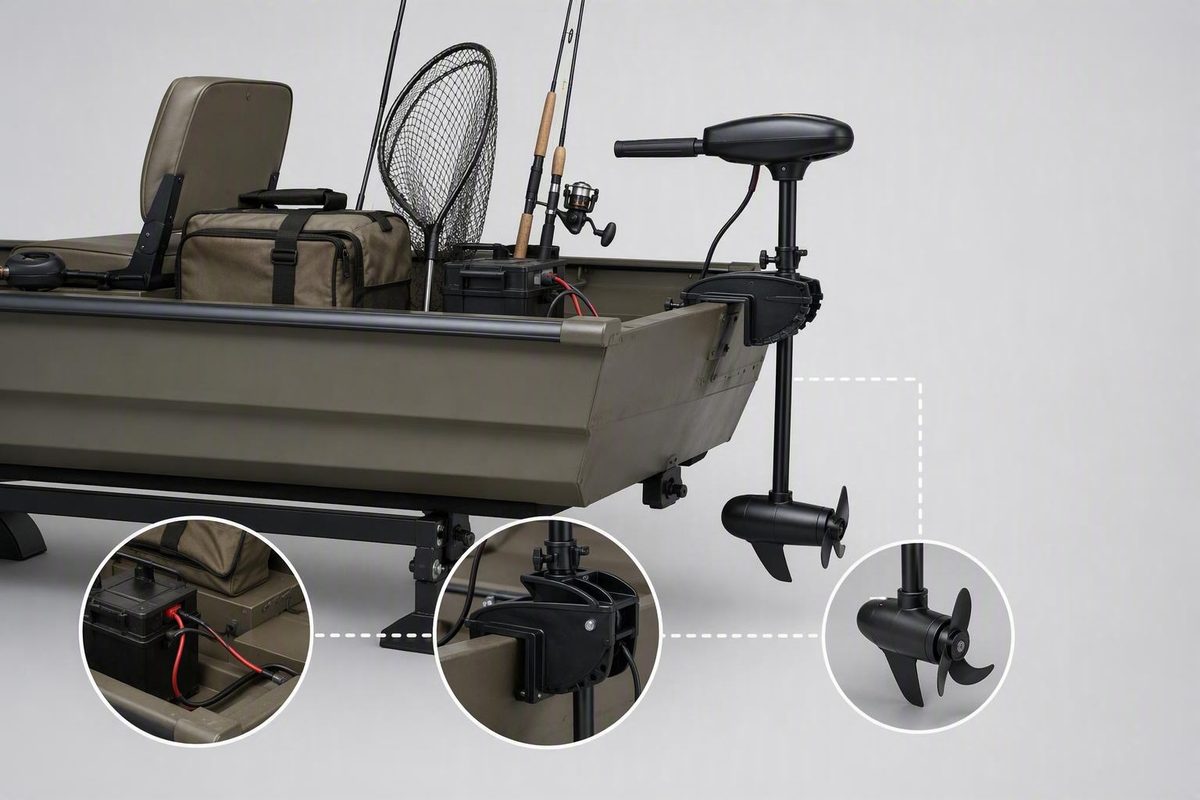
A transom mount places an electric trolling motor at the stern, where it pushes the boat and is commonly controlled by hand or tiller. It can work well for low-speed propulsion on a kayak, jon boat, dinghy, inflatable, or tender, but fit should be determined from fully loaded weight, wind and current exposure, transom-to-waterline distance, mounting geometry, and the manuals for the exact equipment. Boat length and apparent clamp fit are not enough.
What “transom mount” means
The transom is the stern mounting area of a boat. A transom-mounted trolling motor applies thrust from this rear position, pushing the hull rather than pulling it from the bow.
The phrase can describe either:
- A complete electric trolling motor designed to mount at the stern.
- A separate transom bracket that creates a suitable motor-clamping surface on a boat or kayak.
Many transom motors use screw clamps to grip a suitable transom directly. Other installations use bolt-on hardware or a removable bracket attached to a permanently installed base. The motor or bracket may therefore be removable even though part of the mounting system remains fixed to the boat.
This guide covers electric trolling motors and the hardware used to mount them. It is not a universal guide to gasoline outboards, electric outboards, transducers, boarding equipment, or every other stern-mounted accessory.
A flat area, matching bolt pattern, or clamp that opens far enough establishes only possible physical fit. It does not establish that the craft can carry the selected equipment at that position. Confirm structural suitability, permitted mounting locations, and applicable load limits through the craft manufacturer and the documentation for the motor and bracket. If those limits are not documented, appearance alone is not enough to approve the installation.
When a transom-mounted motor is the practical choice
A transom mount commonly suits small aluminum boats, jon boats, dinghies, tenders, inflatables, and square-back kayaks. Typical uses include protected-water trolling, quiet movement over short distances, low-speed maneuvering, and backup propulsion.
Most conventional models use hand or tiller steering. A direct clamp can make the motor straightforward to remove for transport or storage, while stern placement preserves bow-deck space. Those advantages depend on an accessible, approved transom. A separate bracket can make the installation more involved.
| Intended use or constraint | Transom mount fit | Main trade-off |
|---|---|---|
| Calm-water trolling | Often a good match | Straightforward low-speed control |
| Frequent motor removal | Potentially convenient | Battery and cables still require management |
| Limited bow space | Preserves the bow deck | Stern needs steering and tilt clearance |
| Precise structure fishing | Less compelling | More corrections may be needed |
| Regular wind or current | Assess cautiously | More thrust reserve and active steering may be needed |
Mount position changes handling. A bow motor pulls from the front, while a transom motor pushes from behind. Minn Kota says bow mounting generally provides better positioning because it is easier to pull the bow and move it sideways than to push and redirect the stern. That does not make either position universally superior; layout, operating conditions, steering method, installation feasibility, and the required level of control determine the better choice. Minn Kota explains this qualified control distinction in its selection guide.
Expect a stern-mounted motor to need more heading corrections when wind or current catches the bow. If the boat must repeatedly hold against current, follow tight contours, or work close to docks and structure, compare a bow mount before committing. For protected water, steady trolling, simple stern operation, or a boat without usable bow space, a transom mount may remain the practical option.
Size thrust and voltage from loaded weight
Start with the boat’s total operating weight, not its empty hull weight. Include:
- The boat or kayak
- The trolling motor and mounting hardware
- Propulsion batteries
- Passengers
- Fuel and another engine, if carried
- Anchors, fishing equipment, coolers, safety gear, and other cargo
Minn Kota suggests at least 2 pounds of thrust per 100 pounds of fully loaded boat weight under normal lake-fishing conditions. It presents that figure as a starting point rather than a universal formula and advises considering additional thrust where wind or current are major factors. Its general sizing table is reproduced below. See Minn Kota’s loaded-weight, thrust, voltage, and battery guidance.
| Fully loaded weight | Approximate boat length | Suggested thrust | Voltage |
|---|---|---|---|
| Up to 1,599 lb | About 14 ft | 30–40 lb | 12V |
| 1,600–2,599 lb | 16–17 ft | 40–55 lb | 12V |
| 2,600–3,599 lb | 17–18 ft | 70–80 lb | 24V |
| 3,600–4,599 lb | 18–19 ft | 80–90 lb | 24V |
This is one manufacturer’s general guidance for common boats. Loaded weight is the primary input; the listed lengths are secondary descriptions, not a substitute for calculating the complete operating load.
Minn Kota also states that its trolling-motor systems require one battery for every 12 volts: a 12V system normally uses one appropriately configured battery, a 24V system two, and a 36V system three. The selected motor’s manual still controls battery type, capacity, connections, charging arrangement, and circuit protection.
Worked example: A 14-foot boat that weighs no more than 1,599 pounds after adding passengers, battery, motor, fuel, and gear falls within the manufacturer’s 30–40-pound-thrust, 12V category. That does not automatically make the 30-pound option suitable. Regular exposure to substantial wind, river current, rough water, or adverse weather calls for reassessing the required reserve rather than defaulting to the bottom of the range.
Additional thrust may improve control under load or in difficult conditions, but the consequences for motor weight, voltage, battery configuration, space, and cost vary by model. Battery capacity is also a separate selection decision. Determine it from the exact motor’s current requirements, intended operating settings and duration, and the battery manufacturer’s usable-capacity and charging instructions.
Measure for the correct shaft length
Measure the boat in a representative operating condition:
- Load the craft with the motor, battery, passengers, and normal gear.
- Put it in the water where the measurement can be taken safely.
- Identify the exact surface on which the motor clamp or bracket will sit.
- Measure vertically from that mounting surface to the waterline.
- Compare the result with the shaft chart for the exact motor under consideration.
For Minn Kota transom-mount configurations, the manufacturer’s chart gives these starting points:
| Mounting surface to waterline | Suggested shaft length | Qualification |
|---|---|---|
| 0–10 in | 30 in | Transom-mount guidance |
| 10–16 in | 36 in | Transom-mount guidance |
| 16–22 in | 42 in | Transom-mount guidance |
| 22–28 in | 55 in | Specifically labeled RT Transom |
The 55-inch entry should not be generalized to every brand or model because Minn Kota labels it specifically for an RT Transom configuration. The company also advises adding 5 inches to the waterline measurement for rough-water fishing and recommends keeping the propeller tip—or, in related wording, the motor section—at least about 12 inches below the waterline. Apply the measurement and adjustment procedure stated in the exact motor manual. Minn Kota publishes the qualified shaft chart, rough-water allowance, and operating-depth guidance.
A shaft that is too short can allow the propeller to approach or break the surface as the stern moves in chop. The resulting ventilation reduces useful thrust and can increase noise. Excessive shaft length can create shallow-water, bottom, transport, or stowage-clearance problems.
Some retailer and shopping guides offer a general rule of adding 18–20 inches to the mounting-point measurement. Do not let a generic formula override the chart for the selected motor. Use the manufacturer’s stated measurement points, available shaft lengths, operating-depth requirement, and adjustment range.
Check the transom, bracket, and steering access
Before buying, verify the following against the documentation for the craft, motor, and bracket:
- The mounting surface shape and location are approved.
- Transom thickness falls within the motor clamp’s documented range.
- The craft manufacturer approves the installation position and load.
- The motor can turn fully in both directions.
- There is room to tilt, deploy, and adjust shaft depth.
- The propeller can clear the hull, rudder, trim tabs, and other fittings.
- The motor has adequate stowage and transport clearance.
- Clamps, bolts, nuts, and specified backing hardware remain accessible.
- The bracket is rated for the relevant motor type and documented load.
- Bracket height and motor-shaft range suit the loaded waterline.
There is no universal motor-weight, thrust, or structural-load limit for all transoms and aftermarket brackets. If the relevant documentation does not provide a limit or approve the proposed arrangement, do not infer suitability from the transom’s appearance, material thickness, bolt pattern, or another product’s rating.
A direct clamp-on motor and a removable-base bracket are different installations. A motor may clamp to a suitable existing transom without drilled holes, but an add-on bracket may require a permanent base, drilling, internal access, backing hardware, reinforcement, and sealed penetrations. For example, Birdsall describes a removable electric-motor bracket that bolts to a permanent plate installed on a flat transom area, showing why “removable motor” does not necessarily mean “drill-free boat.” Review the Birdsall bracket’s documented mounting arrangement.
Kayak brackets require equally specific checks. One listed Newport mount calls for a flat surface and a 3.75-by-4.75-inch bolt pattern and carries its own 3-horsepower rating. Those are product-specific specifications; they do not prove that a particular kayak is reinforced for the mount or that every motor below the headline rating is compatible. See the retailer’s Newport mount specifications.
For a kayak, sit in the normal operating position and check whether the tiller can be reached without unsafe twisting or weight shifting. A tiller extension or purpose-designed remote-steering arrangement may be needed. Also determine whether the motor can be raised and lowered from the seat; Newport’s kayak setup guidance notes that inaccessible stern mounts may require an appropriate extension or lift-cord arrangement. Review Newport’s kayak motor setup guidance.
Battery placement must be checked against the kayak’s capacity and the battery manufacturer’s instructions. Verify the required restraint and protection, maintain acceptable loaded trim, and route cables so they do not interfere with seating, pedals, rudder lines, drainage, or entry and exit. Do not purchase solely because the bracket holes align or the clamp appears wide enough.
Plan wiring, installation, and water-type compatibility
There is no responsible universal wiring recipe for every transom-mounted motor. Use the exact motor manual to determine conductor gauge, circuit-breaker or fuse size, voltage connections, battery type, connectors, terminal protection, and mounting procedure. Cable length, current draw, system voltage, and equipment design all affect those requirements.
Manufacturer resources provide separate diagrams for different system voltages, reinforcing that one configuration cannot simply be copied to another. Minn Kota’s installation hub covers battery type, conductor sizing, circuit protection, and diagrams for 12V, 24V, 36V, and 48V systems while directing owners to the applicable manual for installation steps. Use the manufacturer’s installation and wiring resources for the selected configuration.
Before launch, verify the craft’s capacity, motor and bracket ratings, battery restraint, loaded trim, cable routing, and steering and tilt clearances against the applicable manufacturer instructions. Recheck physical clearance with the boat afloat because its loaded waterline may differ from its position on a trailer or garage floor.
Freshwater and saltwater models are not interchangeable merely because they share a mounting shape. Minn Kota warns that using its freshwater motors in saltwater may substantially shorten motor life and void warranty coverage. For an appropriate Minn Kota saltwater motor, the company advises rinsing it with fresh water after use, storing it indoors, and not leaving it submerged while the boat is moored. Check Minn Kota’s water-type, warranty, and care guidance.
Use the pre-launch inspection specified by the equipment manufacturers and confirm that:
- Clamps or mounting fasteners are secured as documented.
- The bracket is fully engaged and locked.
- The propeller clears the hull and nearby hardware.
- Steering travels through its required range.
- Tilt and depth adjustments operate without binding.
- The specified electrical protection is installed.
- Connections and terminals are protected as required.
- The battery is restrained and loaded trim remains within craft limits.
- The lower motor section reaches the specified operating depth.
Choose in sequence: confirm that stern control suits the trip, calculate fully loaded weight, select thrust and voltage, measure the loaded transom-to-waterline distance, and verify every physical and electrical limit in the exact manuals. If structural capacity, clamp fit, bracket rating, steering access, or circuit protection cannot be confirmed, stop before installation and obtain guidance from the relevant craft or equipment manufacturer.
Will a higher-thrust transom-mounted motor make my boat faster?
Not necessarily. Higher thrust mainly provides more ability to move a loaded boat and resist wind or current. Top speed also depends on factors including hull characteristics, load, propeller pitch, and motor RPM. A larger motor may provide useful control reserve, but it does not guarantee a higher top speed.
Can every clamp-on transom motor be removed without drilling?
No. A motor that clamps directly to a suitable existing transom may be removable without drilling, but that does not apply to every boat or mounting system. An add-on transom bracket may require a permanently drilled and bolted base even when the bracket or motor can later be removed. Check the motor, bracket, and craft instructions for mounting, reinforcement, backing, and sealing requirements.