
How to Choose the Right Lewmar Setup for Your Boat and Bottom
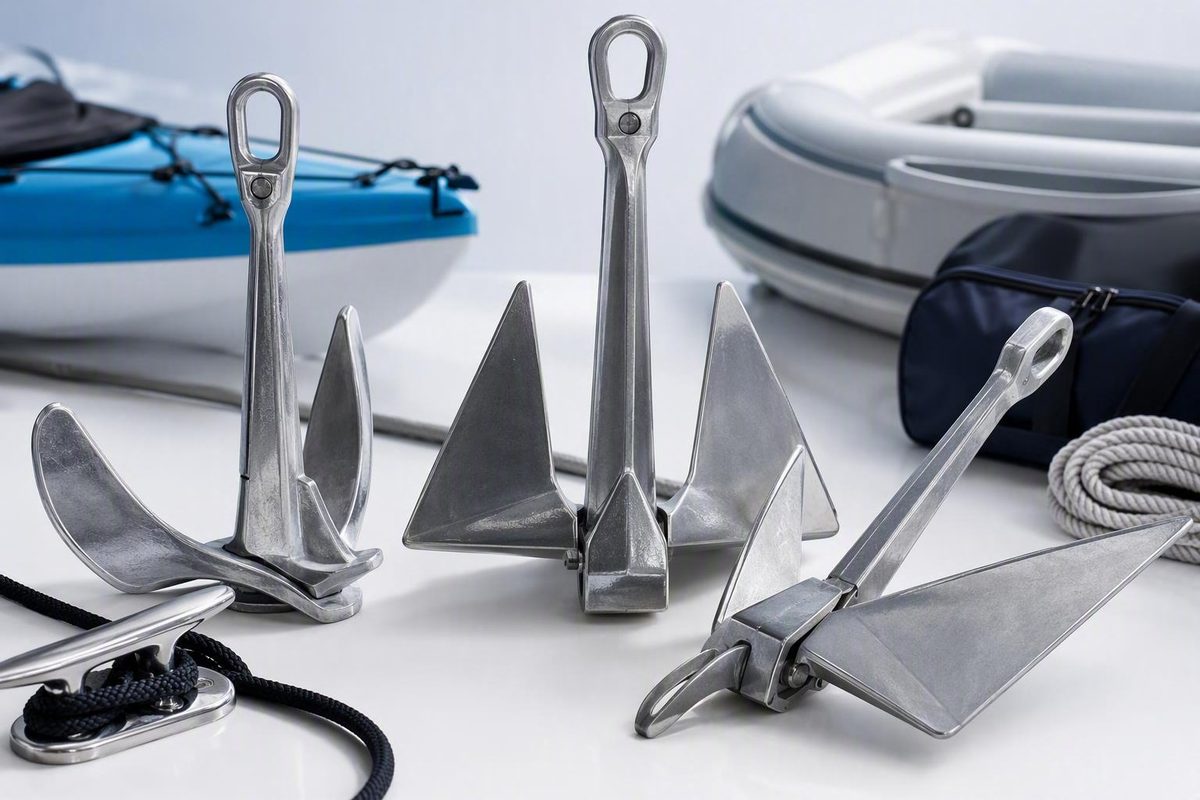
Choosing a Lewmar anchor starts with a distinction that product listings sometimes blur: conventional anchors and shallow-water pole systems do fundamentally different jobs.
A conventional anchor hangs from chain, rope, or a combination rode and develops resistance by engaging the seabed below the boat. Lewmar’s Axis and Vector systems instead lower a rigid spike from the boat to hold position in suitable shallow water. One is general ground tackle; the other is short-range positioning equipment.
Once that distinction is clear, match the relevant design to the boat’s loaded displacement and windage, expected bottoms and weather, storage or mounting constraints, rode and windlass, and complete installed cost. No available evidence establishes one Lewmar model as best for every boat or anchorage.
Research note: This guide compares manufacturer specifications, dated retailer listings, specialist guidance, and third-party editorial observations. It does not represent hands-on testing of the products discussed. Current Lewmar sizing and installation documentation should control the final purchase and installation.
Start Here: Two Very Different Kinds of Lewmar Anchor
Use this decision rule:
- Choose a conventional anchor if you need to anchor through a rode in variable depths, cruise between different seabeds, stay anchored overnight, or integrate the anchor with a bow roller and windlass.
- Investigate Axis or Vector if you mainly want to hold a suitable small boat in shallow water while fishing or stopping temporarily, and the transom, deck, motor, or jack plate can accept the mounting system.
These categories should not be ranked as interchangeable products. A shallow-water spike does not replace conventional ground tackle for deeper water. A conventional anchor, meanwhile, does not provide the same rapid, boat-mounted positioning experience in a shallow fishing area.
| Category | Representative models | Operating method | Typical role | Next question |
|---|---|---|---|---|
| Conventional fixed-shank or plow-style anchors | Delta, DTX, Epsilon | Anchor and rode engage the bottom; manual or windlass retrieval | Primary or secondary bow anchoring, subject to sizing and conditions | Which geometry, size, material, and rode fit the boat? |
| Conventional hinged plow | CQR | Hinged-shank anchor deployed on a rode | Traditional cruising installation or legacy replacement | Is its setting and resetting behavior acceptable for the expected bottoms? |
| Conventional claw | Claw | Bruce-style geometry deployed on a rode | General-purpose or secondary anchoring, subject to bottom and sizing | Does model-specific experience support it in the local seabed? |
| Conventional fluke | LFX, PGX | Flukes penetrate suitable bottom; LFX emphasizes portability | Sand-and-mud use, secondary use, or compact storage depending on model and size | Will it penetrate the expected bottom, and is it appropriate for the intended duty? |
| Electric shallow-water positioning | Axis | A 12-volt actuator lowers a rigid spike | Convenient shallow-water fishing and short stops | Does the boat meet the stated limits, and can it support the wiring and mount? |
| Manual shallow-water positioning | Vector | Manual strap-operated deployment of a rigid spike | Simple shallow-water positioning without an electrical connection | Is manual operation practical from the mounting position? |
The conventional families covered here are Delta, DTX, Epsilon, CQR, Claw, LFX, and PGX. Lewmar identifies Axis as its electric shallow-water system and Vector as the manual alternative; neither requires an external hydraulic system.
Lewmar’s wider catalog also includes anchor kits, rope and chain rodes, storage bags, locks, mounting brackets, chain stoppers, rollers, and related hardware. Its category listings therefore mix complete anchoring products with accessories, so catalog totals must not be interpreted as counts of distinct anchor designs. Lewmar’s anchoring catalog shows the wider product and accessory range.
The practical implication is important: decide which anchoring category you need before comparing prices. A manual shallow-water system is not simply a costly substitute for a compact fluke anchor. It uses a different mechanism, mounts differently, and is intended for a narrower operating depth and type of stop.
Lewmar Conventional Anchor Models Compared
Lewmar’s conventional range spans several geometries and materials. The comparison below reflects what the supplied manufacturer, retailer, specialist, and editorial material establishes—not a controlled head-to-head performance test.
Published family ranges require caution. Citimarine’s Delta listings extend from approximately 4 to 63 kilograms, while an Upffront retailer guide lists approximately 1–80 kilograms for Claw and 2–10 kilograms for LFX. These are family-level commercial listings rather than recommendations for a particular boat. Upffront provides the cited Claw and LFX ranges and design descriptions.
| Model | Geometry | Listed materials | Supported family range where available | Storage characteristics | Likely role | Important evidence limits |
|---|---|---|---|---|---|---|
| Delta | One-piece fixed shank with a plow or wing-like fluke and weighted toe | Galvanized and stainless steel | About 4–63 kg in retailer listings | Normally carried on a compatible bow roller; does not fold | Conventional bow anchor for sailboats and powerboats | Commercial documentation is extensive, but no supplied controlled test establishes universal superiority |
| DTX | Fixed-shank conventional family positioned alongside Delta | Stainless steel | Complete reliable range not established here | Intended for conventional bow storage, subject to roller fit | Premium stainless conventional setup | Material and market positioning are clearer than comparative performance |
| Epsilon | Concave fluke with ballast keel | Galvanized and stainless steel listings | Complete reliable range not established here | Compact conventional bow-anchor form, subject to roller fit | Newer conventional design for powerboats and sailboats | Favorable editorial experience exists, but controlled comparisons and complete specifications are absent |
| CQR | Hinged-shank articulated plow | Traditional metal construction in retailer listings | Model-specific sizing resources exist separately | Hinge affects movement and resting position at the bow; fit must be checked | Legacy cruising anchor or like-for-like replacement | Historically important, but setting and resetting behavior is disputed |
| Claw | Bruce-style claw | Galvanized and stainless steel | About 1–80 kg in one retailer guide | Bulky geometry may require careful roller and locker planning | Conventional or secondary option | Broad commercial bottom recommendations conflict with less favorable editorial observations |
| LFX | Lightweight fluke with adjustable angle; disassemblable | Aluminum | About 2–10 kg in one retailer guide | Can be broken down for storage | Portable sand-or-mud setup, potentially for secondary or stern use | Evidence is weak outside sand and mud and does not establish primary- or storm-anchor suitability |
| PGX | Traditional fluke-family geometry | Galvanized steel | Not established in the supplied evidence | Fluke geometry may store more readily than some plow or claw forms | Conventional fluke option | Available evidence establishes catalog presence, not detailed performance guidance |
Delta
Delta is the clearest conventional starting point because it is the best-documented traditional Lewmar family in the available material. That does not mean it is automatically the strongest choice for every boat, bottom, or use.
Its distinguishing features are a one-piece fixed shank and a weighted toe intended to encourage engagement. Lewmar calls Delta self-launching. Retailer descriptions also say it is balanced to fall from a suitable bow roller and is intended to work with remotely operated windlass installations. Those characteristics still depend on compatible roller geometry, sufficient pulpit clearance, and a clean retrieval path. Citimarine documents Delta’s construction, listed materials, family range, sizing examples, and bow-roller positioning.
DTX
DTX is best treated cautiously as a stainless-steel conventional family positioned commercially alongside Delta. The supplied evidence supports its material and premium price positioning more clearly than it supports a measurable performance advantage.
Bottom engagement, geometry, anchor size, rode, scope, deployment, and vessel load matter more than appearance alone.
Epsilon
Epsilon is a newer Lewmar design characterized in the supplied material by a concave fluke and ballast keel. It is relevant to buyers who want to compare a newer fixed-shank approach with Lewmar’s older plow and claw options.
The available evidence does not contain a complete model specification set or a controlled comparison across standardized bottoms. It is reasonable to shortlist Epsilon, but favorable descriptions should not be converted into a universal performance claim.
CQR
CQR’s defining feature is its hinged shank. Delta, by contrast, has a fixed shank. That mechanical distinction affects how the anchor articulates during deployment and when the direction of pull changes.
CQR has considerable historical importance, and traditional guidance still presents it as a proven cruising design. Peter Smith’s strongly critical commentary advocates newer anchor geometries and questions CQR’s consistency when setting in soft or hard bottoms, penetrating weed, and resetting after a change in pull direction. The source is argumentative rather than neutral, and its selected historical comparisons do not establish that every CQR deployment will fail. Its criticisms concern design behavior, not the workmanship of current Lewmar production. Peter Smith’s CQR discussion explains the articulated design and summarizes the author’s setting and resetting objections.
A buyer replacing an existing CQR should ask two separate questions: will the replacement fit the roller and handling system, and is retaining the hinged-plow design preferable to evaluating a newer geometry?
Claw
Lewmar’s Claw is a Bruce-style design sold in galvanized and stainless versions. Its appeal is straightforward geometry, broad commercial availability, and a wide range of listed sizes and prices.
The difficulty is conflicting guidance. Retailer and supplier articles often associate claw anchors with mud, sand, rock, and coral while identifying clay and heavy vegetation as weaknesses. Less favorable editorial observations suggest that claw designs may fail to bury fully except in very soft mud. A seabed label should therefore begin the research, not end it.
LFX
LFX is a lightweight aluminum fluke design with an adjustable angle. It can be disassembled, making it especially relevant where carrying weight, locker space, or portable storage matters.
Retailer guidance concentrates on sand and mud. That makes LFX worth investigating for small boats, day use, stern deployment, or a secondary setup in known bottoms. The supplied evidence does not establish it as a primary cruising or storm anchor, particularly where rock, coral, clay, weeds, or highly variable seabeds are expected.
PGX
PGX is a galvanized fluke family found in Lewmar-related retail catalogs. The evidence establishes its existence, material, and commercial position but does not provide enough model-specific information for confident bottom or duty recommendations.
Treat it as a candidate requiring review of the current product data sheet rather than assuming it behaves identically to every other traditional fluke anchor.
Match the Design to the Bottom—Without Overpromising
Bottom labels such as “good for sand” are useful filters, not guarantees. Even a label such as “mud” can describe anything from firm sediment to a soft surface layer over a harder substrate.
Relevant variables include:
- Exact bottom composition and surface debris
- Anchor weight and fluke area
- Loaded vessel displacement and windage
- Rode construction and chain weight
- Scope and water-depth calculation
- Deployment and setting technique
- Wind, waves, current, and surge
- Whether the direction of pull remains steady
- Ability to reset after a tide or wind shift
Mud and sand
LFX is primarily associated with mud and sand. Its low weight and disassemblable form can be advantageous aboard a small fishing boat or where an anchor must be carried to and from the vessel. Those characteristics do not remove the need for effective penetration.
An etrailer demonstration of the LE84GR package presents it as a sand-and-mud kit that can be disassembled and adjusted. That is useful retailer guidance, not a comparative seabed test. Evidence for LFX in rock, coral, dense grass, or clay remains weak.
Delta is also commonly presented as a broad-use fixed-shank option with better holding than many older plow designs. Some commercial guides attach numerical advantages to Delta, but the supplied evidence does not include a common test protocol that would justify repeating those figures as general fact.
Rock, coral, grass, and weed
Claw is frequently marketed for mud, sand, rock, and coral, with clay, grass, and weeds identified as weaker areas.
Practical Boat Owner presents a more critical view. Its author reports that claw anchors seldom dig in fully except in very soft mud, describes Delta as an improvement over many older plow designs, and reports favorable personal experience with Epsilon setting more easily than older plow or claw anchors. These are informed editorial observations, not findings from a controlled comparative test. Practical Boat Owner explains the design differences and the author’s observed setting behavior.
A broad claim that a design is “good in weed” says little about vegetation thickness, the underlying material, or whether the anchor will penetrate rather than skate over the surface.
The CQR dispute
Traditional advice often treats CQR as proven in mud or fine sand, reflecting its long use aboard cruising boats. Critics point to inconsistent initial setting, limited penetration in some hard or soft bottoms, and unreliable resetting after a direction change.
Both perspectives can exist because outcomes depend heavily on the test and use conditions. Long service history shows that CQR has been used successfully; it does not prove that it will match every newer alternative. Conversely, critical historical tests do not show that every CQR deployment will fail.
Resetting is its own criterion
Initial setting, peak holding, and resetting are different behaviors.
An anchor may set well under a steady pull but struggle after the vessel swings through a large angle. Another may release, rotate, and rebury. If you anchor in reversing tidal streams or places exposed to wind shifts, seek model-specific evidence about resetting rather than inferring it from a straight-line holding claim.
Conditional shortlist
A useful shortlist looks like this:
- Portable sand-or-mud setup: LFX deserves investigation when low carrying weight and disassembly matter. Confirm its size, intended duty, rode, and relevant manufacturer guidance.
- Conventional bow-roller setup: Delta is the best-documented place to begin, especially where self-launching behavior and windlass integration matter. Epsilon is also worth model-specific research.
- Legacy hinged-plow replacement: Compare the dimensions and behavior of a current CQR with fixed-shank alternatives rather than assuming a like-for-like replacement is mandatory.
- Mixed-bottom cruising: Investigate Delta and Epsilon in the required sizes, then compare model-specific evidence for setting and resetting. Weigh Claw’s broad commercial recommendations against the more critical editorial observations.
- Known soft-bottom day use: LFX, PGX, or another fluke design may be relevant if storage and deployment suit the boat, but avoid extrapolating beyond documented bottoms.
How to Size a Lewmar Anchor for the Actual Boat
Boat length is the initial lookup variable—not the final sizing decision.
Before opening a size chart, record:
- Overall boat length
- Loaded displacement, not merely dry or empty weight
- Hull type and normal operating load
- Cabin, canvas, rails, towers, and other sources of windage
- Expected current, waves, and weather
- Common seabeds
- Cruising exposure and distance from shelter
- Whether this is the primary, secondary, stern, or day anchor
- Rode type and available scope
- Existing bow roller, locker, and windlass constraints
Citimarine presents the following galvanized Delta recommendations. These are retailer-listed boat-length ranges, not complete engineering guidance:
| Galvanized Delta weight | Retailer-presented boat-length range |
|---|---|
| 9 lb | 10–20 ft |
| 14 lb | 20–30 ft |
| 22 lb | 27–40 ft |
| 35 lb | 32–45 ft |
The ranges overlap because length is only a proxy for the loads imposed on the anchor. They do not fully resolve displacement, windage, local bottom, rode, current, waves, or intended weather exposure.
Consider two boats of equal length. A low-profile open fishing boat used on a sheltered lake may impose less wind load than a tall-cabin cruiser. A heavy-displacement sailboat may create different loads again. Length alone cannot capture those differences.
Some third-party guides suggest considering a larger model for heavy-displacement boats or moving up when uncertain. That is a prompt to investigate, not a universal “always size up one” rule.
Use Lewmar’s current model-specific chart before purchase. The manufacturer’s anchoring page provides a direct DTX and Delta sizing resource, but the selected model’s current documentation and dimensional drawing should control.
Physical-fit checklist
A technically suitable anchor still has to fit the boat. Check:
- Shank dimensions: Can the shank enter and rest correctly in the bow roller?
- Fluke dimensions: Will the fluke clear the stem, hull, pulpit, platform, and fittings?
- Roller geometry: Can the anchor launch and retrieve without jamming?
- Pulpit clearance: Can it rotate into its final position without striking rails or navigation lights?
- Locker opening: Can the anchor or rode pass through every required opening?
- Locker volume: Is there room for the full rode without blocking drainage or retrieval?
- Retrieval path: Do chain, rope, splice, shackle, and any swivel pass cleanly from roller to gypsy or capstan?
- Securement: Is there a suitable stopper, cleat, lashing, or snubber so the windlass does not carry the static anchoring load?
- Manual handling: Can the crew launch or recover the setup if powered equipment fails?
Measure the actual boat rather than relying on nominal roller width. A template or published dimensional drawing is more useful than anchor weight alone.
Galvanized, Stainless, or Aluminum—and What Each Costs
Material affects purchase price, carrying weight, appearance, maintenance, and handling. It does not replace proper sizing or effective bottom penetration.
Galvanized steel
Galvanized steel is generally the lower-cost route when comparable anchor families are offered in both galvanized and stainless versions. Its zinc coating provides corrosion protection, but coating condition should be inspected over time, especially at the toe, shank, and contact points.
A lower price does not make galvanized steel inherently unsafe or short-lived.
Stainless steel
Stainless anchors are the polished, premium-priced option and are commonly marketed for saltwater corrosion resistance. They may appeal where appearance matters or where an owner wants to avoid the finish changes associated with worn galvanizing.
Do not assume stainless is always stronger, safer, or longer-lasting. Compare exact models and specifications rather than treating “stainless” and “galvanized” as complete performance descriptions.
Aluminum
Aluminum is useful where low carrying weight and portability matter. LFX applies that advantage to a fluke anchor that can be carried and disassembled more easily than many steel alternatives.
Its performance still depends on proper penetration. Low weight is beneficial only if the selected size, geometry, rode, and seabed allow the anchor to engage effectively.
Representative advertised prices
They are starting prices, often corresponding to the smallest size or least expensive configuration, and are not price guarantees. Lippert’s Lewmar catalog supports these starting-price examples.
| Model and material | Retailer | Advertised starting price |
|---|---|---|
| Galvanized Claw | Lippert | From $22.95 |
| LFX aluminum fluke | Lippert | From $99.95 |
| Galvanized Delta | Lippert | From $185.95 |
| DTX stainless | Lippert | From $672.95 |
| Epsilon stainless | Lippert | From $926.95 |
| Delta stainless | Lippert | From $1,374.95 |
These figures illustrate how sharply price changes with size and material; they do not establish comparative performance. West Marine lists the corresponding Lewmar product families and price ranges.
| Model and material | Retailer | Advertised range |
|---|---|---|
| Delta galvanized | West Marine | $162.99–$1,029.99 |
| LFX aluminum | West Marine | $137.99–$789.99 |
| DTX stainless | West Marine | $559.99–$2,589.99 |
Prices and availability can change with size, finish, color, configuration, location, stock, and date. Confirm the exact SKU immediately before ordering.
The anchor is not the whole bill
Budget for the complete installation, potentially including:
- Chain and rope
- Shackle and seizing method
- Swivel, if used
- Bow roller or roller modification
- Chain stopper, snubber, or other securement hardware
- Cleat and backing structure
- Storage bag or locker alterations
- Windlass, controls, breaker, wiring, and installation
- Shallow-water bracket and quick-release hardware
- Professional labor
- Shipping and taxes
In an etrailer product demonstration, the LE84GR LFX package includes an aluminum anchor, shackle, five feet of quarter-inch chain, and 125 feet of half-inch rope. The presenter describes the complete package as weighing approximately 14 pounds. These are presenter-reported package details, not independent measurements. Watch etrailer’s LE84GR LFX package demonstration.
A package price is more informative than an anchor-only price for a buyer starting from scratch. Conversely, an owner who already has a correctly matched rode may prefer an anchor sold separately.
Lewmar Axis vs Vector Shallow-Water Anchors
Axis and Vector are shallow-water positioning systems, not general rode-based anchors. Both lower a fiberglass spike from a boat-mounted mechanism, and neither requires an external hydraulic system.
Lewmar presents Axis as a 12-volt electric system with an IP68M actuator, keychain remote, fiberglass spike, and powder-coated aluminum construction. Its stated limit is a boat up to 26 feet or 4,500 pounds. Vector uses a manual tensioning strap and gas-spring-secured fiberglass spike, with a stated limit of up to 22 feet or 3,000 pounds. Lewmar provides the official feature lists and manufacturer-presented vessel limits.
| Feature | Axis | Vector |
|---|---|---|
| Operation | Electric deployment and retrieval | Manual deployment and retrieval |
| Power | 12-volt electrical connection | Human-powered; no electrical connection |
| Manufacturer-presented boat limit | Up to 26 ft or 4,500 lb | Up to 22 ft or 3,000 lb |
| Controls | Keychain remote | Manual tensioning strap |
| Listed construction | Powder-coated aluminum structure, fiberglass spike, IP68M actuator | Fiberglass spike secured by a gas spring; manual mechanism |
| Plumbing or wiring | No external hydraulic hoses or pumps; electrical connection required | No hoses, pumps, or wires |
| Approximate promotional weight | About 26 lb | About 22 lb |
| Lippert starting price reviewed August 29, 2026 | From $1,199 | From $525 |
| Best-fit buyer | Wants remote electric convenience and has a suitable 12-volt installation | Wants mechanical simplicity and no electrical connection |
The listed limits are manufacturer guidance, not promises for every boat below the threshold. Lewmar’s product page does not define the wind, current, wave, bottom, vessel-windage, or mounting assumptions behind them. A high-sided pontoon and a low-profile fishing boat of equal length can behave very differently.
A commercially affiliated promotional video attributes several additional figures to a person presented as a Lewmar representative: eight-foot spikes, an approximate weight of 22 pounds for Vector and 26 pounds for Axis, and an Axis current draw of approximately 3–5 amps. The video description contains affiliate links, so these figures should be treated as attributed promotional claims and checked against the current installation documentation. Watch the Axis and Vector promotional demonstration.
An eight-foot spike does not establish suitability for eight feet of water. The presenter recommends approximately seven feet or less, leaving part of the spike available to penetrate the bottom.
Choose Vector when:
- You want no electrical connection.
- Lower system complexity matters more than push-button deployment.
- Manual operation is practical from the mounting position.
- The loaded boat remains within Lewmar’s stated limit.
- The selected bracket and deployment path are compatible.
Choose Axis when:
- Remote electric deployment is the main reason for buying.
- The boat has an appropriate 12-volt electrical system.
- The electrical installation can follow the current Axis manual.
- The added purchase and installation cost is justified.
- The loaded boat and mounting arrangement satisfy Lewmar’s stated limits.
Neither model has a supported universal wind-speed rating in the supplied evidence. Do not assume either will hold in every combination of wind, current, waves, bottom, or boat orientation.
Shallow-Water Mounting and Installation Checklist
The mount is part of the positioning system. Buying Axis or Vector before inspecting the transom, motor movement, and trailer geometry risks choosing a bracket that cannot be installed as intended.
Lewmar describes the included mounting plate as suitable for a flat transom with interior access and no interference from the outboard or trim tabs. Optional arrangements include quick-release, motor-mount, pontoon-deck, and jack-plate brackets.
Installation decision tree
-
Is there a flat, suitable, unobstructed transom area with interior access? - If yes, investigate the included direct-transom mounting plate. - If no, move to the next question.
-
Must the anchor assembly be removed frequently? - If yes, investigate the optional quick-release dovetail bracket. - If no, a fixed arrangement may be suitable.
-
Does the boat already have a compatible jack plate? - If yes, assess the jack-plate bracket, clearances, and fastener arrangement. - If no, continue.
-
Is this a pontoon with an appropriate deck mounting area? - If yes, evaluate the pontoon-deck bracket and the support beneath the mounting position. - If no, continue.
-
Is avoiding holes in the hull or transom a priority? - Investigate jack-plate or motor-mount options, but do not assume “no drill” means a simple installation.
-
Would mounting between the outboard and transom solve the geometry problem? - Evaluate the motor-mount bracket with a qualified installer. Lewmar says this installation typically requires professional assistance.
Lewmar describes the optional quick-release bracket as a removable dovetail-style solution available in black or white. Its published dimensions are 8 by 6 by 1.5 inches, and it can be installed on the port or starboard side. The motor-mount bracket fits between the outboard and transom and is described as a no-drill arrangement. The jack-plate option may avoid hull drilling and motor removal, while the pontoon bracket mounts directly to the deck. Lewmar’s mounting guidance documents the bracket types, dimensions, and stated installation constraints.
“No drill” does not mean universally easy or safe. Before installation, verify:
- Whether the transom or deck can accept the loads specified in the current manual
- Backing and fastener access
- Outboard steering sweep
- Engine trim and tilt movement
- Trim-tab clearance
- Spike deployment path
- Required treatment of dissimilar metals
- Electrical cable routing for Axis
- Access for inspection and service
- Trailer bunks, guide posts, tie-downs, and launching clearance
Included hardware can vary by configuration. Distinguish the standard mounting plate from optional brackets, quick-release components, and model-specific hardware before comparing retailer prices.
Final pre-installation check
- [ ] Loaded vessel length and weight are within the manufacturer-presented limit.
- [ ] The mounting surface has been assessed against the current installation instructions.
- [ ] Interior fastener access is available where required.
- [ ] The spike can deploy without striking the hull, motor, propeller, tabs, or trailer.
- [ ] The outboard can steer, trim, and tilt through its required range.
- [ ] The assembly will not obstruct boarding or emergency access.
- [ ] The intended water depth leaves enough spike length for bottom penetration.
- [ ] Axis wiring and circuit protection will follow the current model manual.
- [ ] Included and optional components have been identified by exact SKU.
- [ ] A professional installer has been consulted where Lewmar’s guidance or the vessel structure calls for one.
Treat the Anchor, Rode, Locker, and Windlass as One System
Reliable anchoring depends on the entire ground-tackle system, not the anchor in isolation. A well-selected anchor can still be undermined by an incompatible bow roller, worn shackle, mismatched windlass gypsy, poor locker fall, or lack of a suitable load-transfer point.
The system may include:
- Anchor
- Chain
- Rope
- Rope-to-chain splice
- Shackles and seizing
- Swivel, if fitted
- Bow roller
- Chain stopper
- Snubber
- Cleat or another load-bearing point
- Anchor locker
- Windlass and controls
- Wiring and circuit protection
Windlass capacity
West Marine attributes to Lewmar a commonly cited selection method: total the working weight of the anchor, rode, shackles, and swivels, then multiply by four to estimate the minimum maximum-load capacity for many windlasses. Under its example, approximately 62 pounds of ground tackle produces a calculation of 62 × 4, or 248 pounds of rated pull. This is a selection cross-check, not a substitute for a model manual. West Marine explains the four-times method and 62-pound example.
A separate Jimmy Green specialist guide says the four-times multiplier applies to horizontal windlasses and vertical models through V5, while V6-and-larger vertical models use a two-times multiplier. It calls the calculation indicative only. Model-specific Lewmar documentation must control because maximum pull, working load, installation, and vessel characteristics differ. Jimmy Green documents the V5 and V6 multiplier distinction.
Match the gypsy to the exact chain
A windlass gypsy must match both chain diameter and chain type. Equal-diameter High Test, BBB, and Proof Coil chain can have different link dimensions, so nominal diameter alone does not establish compatibility.
Also verify rope diameter and construction if the gypsy handles rope-chain rode. The splice must pass cleanly through the retrieval path and should be inspected for wear.
Locker fall matters
A windlass retrieves the rode, but gravity normally moves it into the locker. Fall is the vertical distance between the top of the anchor locker and the top of the anchor rode when the entire rode is completely stored inside Lewmar Windlass Size Guide.
If there is too little clear space below the hawse pipe, the rode can mound up and obstruct retrieval. A large locker with poor geometry may work less effectively than a smaller locker with a clear, steep drop. Test the arrangement with the actual rode rather than judging only from empty locker volume.
A windlass is not the boat’s anchoring cleat
Use the windlass to retrieve slack rode and lift the ground tackle. It should not drag the boat toward a deeply buried anchor, break the anchor out by brute force, or carry the boat’s static anchoring load. Bring the boat toward the anchor while taking in slack, then use the boat—not the windlass motor—to assist with breakout at an appropriate angle. Once anchored, transfer the load to a suitable chain stopper, cleat, or snubber. West Marine’s windlass guide supports these retrieval and load-transfer precautions.
Powered windlasses also require dedicated electrical protection and correctly sized wiring. Cable size and breaker rating depend on the exact windlass, current, circuit length, voltage-drop allowance, and installation. Use the model’s wiring and breaker tables rather than a universal cable-size shortcut.
Complete purchase checklist
Before paying for any Lewmar anchor or shallow-water setup, verify:
- [ ] Conventional anchoring or shallow-water positioning is the correct category.
- [ ] Model and size account for loaded displacement, windage, duty, bottom, and exposure.
- [ ] Current manufacturer sizing documentation has been checked.
- [ ] Anchor or spike clears the hull, pulpit, motor, tabs, and trailer.
- [ ] Bow roller or shallow-water bracket fits the exact geometry.
- [ ] Rode type, diameter, length, and hardware suit the intended use.
- [ ] Chain type and dimensions match the windlass gypsy.
- [ ] Locker has adequate unobstructed fall.
- [ ] A stopper, cleat, or snubber will carry the static load.
- [ ] Wiring and circuit protection meet the current product manual.
- [ ] Included and optional components are separated in the quote.
- [ ] Installation labor and structural work are budgeted.
- [ ] Price and availability have been checked for the exact SKU.
- [ ] Current warranty terms, exclusions, and claim procedures have been read.
Frequently Asked Questions
Which Lewmar anchor is best for my boat?
There is no universally best Lewmar anchor. Start with the boat’s loaded displacement and windage, expected seabeds and weather, primary or secondary duty, rode, storage, and bow hardware.
Delta is the best-documented conventional starting point in the supplied material, especially for a bow-roller and windlass installation. Epsilon merits investigation as a newer concave-fluke design. LFX is notable where low weight, compact storage, and sand-or-mud use matter. CQR and Claw require a closer look at setting and resetting evidence because assessments of those older geometries conflict.
After creating a shortlist, use Lewmar’s current model-specific sizing guide and dimensional drawings. Do not choose solely from a boat-length label.
What is the difference between a Lewmar Delta and CQR anchor?
Delta is a one-piece fixed-shank anchor with a weighted toe. CQR is an articulated plow with a hinged shank.
Delta is marketed as self-launching and balanced for compatible bow rollers. CQR’s hinge allows the shank and plow body to articulate, but the design has attracted criticism for inconsistent setting and resetting in some bottoms. That criticism does not establish poor current manufacturing; it concerns geometry and observed behavior.
For an actual installation, compare size guidance, bottom suitability, roller fit, retrieval behavior, and reset performance rather than choosing on heritage alone.
Is the Lewmar Axis or Vector better for a shallow-water boat?
Vector is the simpler option if you want manual operation without wiring, pumps, or hoses. Axis is the convenience option if you want remote electric deployment and can support an appropriate 12-volt installation.
Lewmar presents Axis for boats up to 26 feet or 4,500 pounds and Vector for boats up to 22 feet or 3,000 pounds. Those manufacturer limits do not define performance under every combination of wind, current, waves, bottom, windage, and mounting geometry. Check both loaded boat weight and installation conditions rather than relying on length alone.
What does the Lewmar Delta anchor’s Lloyd’s status mean?
Lewmar describes Delta as Lloyd’s Registered, while retailer material describes it as the first fixed-shank anchor to receive Lloyd’s Register Type Approval. The supplied evidence does not explain the precise approval scope, covered models, test conditions, or significance for a particular recreational installation. Lewmar states the Delta’s Lloyd’s status without defining its full scope.
Treat the status as a product credential, not a guarantee that a Delta is correctly sized for your boat, will hold in every seabed, or can compensate for an unsuitable rode or installation.
Should a windlass hold the boat after the anchor is set?
No. A windlass is a retrieval device, not the point that should carry the boat’s static anchoring load.
After the anchor is set, transfer the load to a chain stopper, properly installed cleat, snubber, or another suitable bow load point. During retrieval, bring the boat toward the anchor while the windlass takes in slack. Do not use the windlass to drag the boat forward or forcibly break out a deeply buried anchor.
Final Decision Sequence
Do not start by choosing the highest-rated or most expensive Lewmar product.
First, decide between conventional rode-based anchoring and shallow-water positioning. Next, shortlist designs using loaded displacement, windage, likely bottoms, exposure, handling, and storage. Then verify physical fit and the complete rode, locker, or windlass system. Finally, check Lewmar’s current sizing guide, installation manual, warranty, included hardware, exact SKU, and dated price.
Delta is the clearest conventional starting point in the available documentation. LFX stands out for portable, sand-and-mud-oriented packages. Axis versus Vector comes down chiefly to electric convenience versus manual simplicity. None is established as right for every boat.