
Is This Fixed-Shank Plow the Right Anchor for Your Boat?
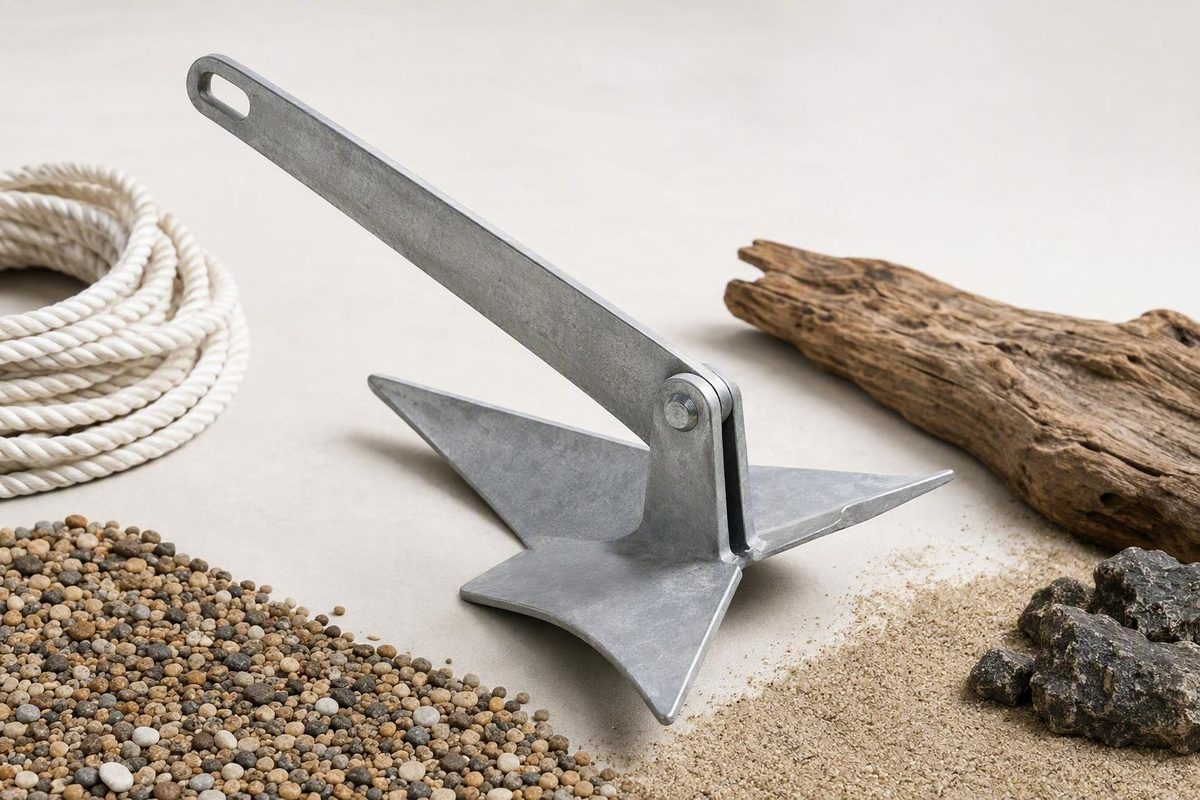
A Delta anchor can be a sensible primary anchor for a sailboat, powerboat, fishing boat, or pontoon—but neither its familiar shape nor a boat-length chart settles the decision.
The genuine Lewmar Delta is a rigid plow anchor designed around a weighted tip and bow-roller storage. Generic products advertised as “Delta,” “Delta-style,” “wing,” or “Wing/Delta” may look similar without sharing its materials, construction, approval, warranty, or sizing guidance. Even a genuine anchor must still suit the boat, seabed, rode, roller, weather, and intended use.
The practical verdict is conditional: a sound, conservatively sized Lewmar Delta remains credible, but it is not automatically the best anchor for every boat or bottom.
What a Delta anchor is—and why the name can be confusing
A Delta is generally classified as a rigid, non-hinged plow or wing-plow anchor. Its shank is fixed to the fluke, unlike the traditional CQR, whose shank pivots at a hinge.
“Delta” also operates in the marketplace as both a product name and an informal shape description. In this article:
- Lewmar Delta means the branded Lewmar product.
- Delta-style means a visually similar anchor whose manufacturer, construction, approval, or provenance differs or is unclear.
The branded model combines a shaped rigid shank, ballasted tip, low center of gravity, and self-righting geometry. Lewmar describes the galvanized version as a one-piece, high-grade galvanized-steel anchor and lists sail, power, fishing, and pontoon boats among its applications. Those design features are intended to support launching and setting; they do not remove the importance of installation, bottom conditions, scope, and technique. Lewmar documents the Delta’s construction, listed boat types, design features, and claimed setting behavior.
Broader boating guides commonly position this geometry as an all-around cruising anchor. Historical accounts differ slightly on timing. Practical Boat Owner describes the Delta as an early-1990s development intended to improve on the CQR. Its overview identifies the fixed shank as a defining difference from the older hinged plow.
A Rocna-affiliated history says Simpson-Lawrence developed the Delta in the 1980s for commercialization. That account comes from a direct competitor, but both histories place the design near the transition from traditional hinged plows to later fixed-shank anchors.
None of this makes a generic version inherently bad. It means its merits must be established independently. Retail catalogs sell Wing/Delta anchors from manufacturers other than Lewmar, sometimes in galvanized and stainless steel, and may group them with CQRs, rollers, swivels, and other anchoring equipment. A shared category label is not evidence of technical equivalence.
Before relying on a specification, identify the exact product it describes. Do not transfer Lewmar’s steel claims, weight guidance, Lloyd’s approval, or warranty to another anchor merely because its outline resembles a Delta. Conversely, do not assume every generic product is counterfeit or unsafe. Evaluate its maker, stated material, construction, weight, documentation, seller, and warranty on their own terms.
How the weighted-tip plow design is intended to launch and set
The intended sequence starts at the bow:
- The rigid shank travels along a compatible roller.
- As rode is paid out, the anchor leaves the roller and descends.
- On reaching the bottom, the weighted tip and low center of gravity help orient the fluke.
- As the boat moves away and a more horizontal load develops, the shaped tip is intended to penetrate.
- Progressive loading should drive the fluke farther into a receptive seabed.
Lewmar calls the Delta self-launching from “most” bow rollers and attributes rapid setting to its shank profile, ballasted tip, low center of gravity, and self-righting geometry. These are manufacturer claims—not proof that a particular roller will release the anchor cleanly or that a particular bottom will accept it.
It helps to separate four questions that product descriptions often blur:
- Did it launch? The anchor left the roller cleanly.
- Did it engage? The tip caught and the boat slowed.
- Did it set? Progressive load buried the fluke and the boat held in a verified position.
- Will it reset? After a substantial wind or tidal shift, the anchor remains buried or re-engages securely under the new load direction.
Success at one stage does not guarantee success at the next. A tip can catch weed, debris, or a rock and stop the boat briefly without the fluke developing a proper buried hold. An anchor that held under a steady pull may also behave differently after the vessel swings through a large angle.
“Self-launching” has a similarly limited meaning: with suitable roller geometry, the anchor may leave as rode is released. It does not mean every installation will work hands-free.
The rigid, non-folding shape can suit permanent bow-roller storage and a windlass-equipped installation. General plow-anchor guidance also credits the shape with relatively few projecting parts and less susceptibility to some forms of fouling than anchors with prominent stocks or flukes. The same geometry is bulky in a conventional locker and may require considerable clearance around the stem, pulpit, deck fittings, or bowsprit.
There are further trade-offs. General plow-and-scoop guidance often says these anchors can reset after a direction change, while competitor commentary questions the Delta’s behavior after a major reversal. Rocna’s discussion raises reset and fluke-area concerns, but it should be read as a commercially interested comparison rather than a neutral finding.
The supplied evidence includes no recent, neutral, controlled Delta-specific test across multiple seabeds. Reset performance should therefore be verified in actual use rather than assumed from geometry or marketing language.
Where a Delta may work—and where a false set is possible
No seabed label guarantees a result. “Sand” can mean fine compact sand, loose coarse grains, shell-strewn material, or a thin layer over rock. Mud ranges from firm, clay-like substrate to deep fluid silt. Scope, rode, loading, anchor condition, and setting technique remain consequential.
West Marine’s general anchor guidance places Delta-type plow or scoop anchors among options for sand, mud, vegetation, and rock, while warning that grass and rock carry a significant risk of false setting. It explains that rocky-bottom holding generally depends on snagging rather than burial. Its bottom guidance supports treating seabed labels as conditional rather than categorical.
| Bottom type | What the available sources suggest | Likely failure mode | Verification priority | Evidence confidence |
|---|---|---|---|---|
| Sand | Commonly cited as suitable | Failure to penetrate compacted, coarse, shell-heavy, or layered material; inadequate burial from poor scope | High: load progressively and confirm position | Moderate |
| Mud | Commercial sources claim suitability, but very soft mud is less certain | Shallow engagement, limited buried area, or continued plowing | Very high, particularly for overnight use | Low to moderate |
| Gravel | Lewmar includes it among claimed suitable bottoms | Tip skates, bites intermittently, or holds shallowly among coarse material | Very high | Low |
| Grass or weed | Some general guides list Delta-type plows as useful | Vegetation blocks penetration or creates a convincing snag without burial | Very high | Low and conflicting |
| Rock | Holding generally depends on snagging rather than burial | Temporary catch, sudden release after a swing, retrieval difficulty, or high hardware loads | Continuous vigilance | Moderate for the general mechanism; low for Delta-specific results |
Sand: This is one of the Delta’s most commonly cited applications, but performance still depends on the substrate. Fine, receptive sand may allow the plow to bury; coarse sand, shells, hard layers, or insufficient scope may prevent full engagement. Practical Boat Owner states more generally that mud and fine sand provide greater intrinsic holding than coarse sand, shells, or gravel, although that is not a Delta-specific controlled test.
Mud: Lewmar and other commercial guidance include mud among potential bottoms. That broad category should not be read as proof of performance in deep, very soft material. Sea Ray’s general plow-anchor guidance identifies soft bottoms as a potential weakness because of the design’s lower surface area, while the Rocna-affiliated comparison raises similar concerns about continued plowing. These are general or commercially interested assessments, not neutral Delta-only test results.
Gravel: Lewmar includes gravel among its claimed suitable bottoms, but coarse aggregate may provide less continuous material for burial than fine sand or firm mud. The important test is not whether the boat initially stops, but whether the anchor sustains a steadily increasing load.
Grass and weed: The evidence is mixed. Some general guides favor plow or scoop anchors in vegetation-covered bottoms because a pointed nose may penetrate and the geometry has relatively few protrusions to foul. Thick grass, root mats, or accumulated weed can nevertheless prevent the fluke from reaching the substrate. A tip hooked under vegetation may feel secure until the load rises or changes direction.
Rock: Burial is often impossible. The anchor instead catches a crack, ledge, boulder, or debris. Drop location, rode direction, connector strength, retrieval planning, and monitoring are especially important.
The tip may be hooked around a root, balanced against a rock, or caught on discarded gear. To distinguish a set from a snag:
- pay out the intended rode without dropping it in a pile over the anchor;
- allow the boat to move back gradually;
- increase load progressively rather than applying an immediate shock;
- use measured reverse power where appropriate for the boat, equipment, and surroundings;
- watch fixed visual transits or electronic position instead of relying only on feel;
- allow time for the system to settle;
- recheck after a meaningful wind, current, or tidal change;
- maintain an anchor watch or alarm appropriate to the consequences of dragging.
No bottom should be treated as categorically safe merely because a manufacturer or selection table includes it.
Delta anchor sizing: use the chart as a starting point, not a verdict
Boat length is an easy sorting variable, but it is not enough to size an anchor. Two boats of equal length can differ substantially in loaded displacement, freeboard, superstructure, hull count, and windage.
Consider all of the following:
- loaded displacement;
- windage and hull type;
- sailboat, powerboat, pontoon, or multihull configuration;
- expected wind, waves, and current;
- sheltered daytime stops versus exposed or overnight anchoring;
- seabed and likely tidal reversals;
- rode type, chain size, and available scope;
- windlass, roller, and manual-handling limits;
- current guidance for the exact anchor and chain.
Lewmar’s listed galvanized Delta options are 4 kg/9 lb, 6 kg/14 lb, 10 kg/22 lb, 16 kg/35 lb, 20 kg/44 lb, 25 kg/55 lb, 32 kg/70 lb, 40 kg/88 lb, 50 kg/110 lb, and 63 kg/140 lb. These are available product weights, not universal assignments to boats of a particular length.
The following is a retailer-reference table. Its overlaps and apparent anomalies are reproduced rather than silently corrected:
| Lewmar Delta weight | Listed chain | Powerboat length | Sailboat length |
|---|---|---|---|
| 9 lb | 1/4 in | 18–22 ft | 20–24 ft |
| 14 lb | 1/4 in | 24–30 ft | 26–31 ft |
| 22 lb | 5/16 in | 32–39 ft | 34–41 ft |
| 35 lb | 5/16 in | 42–50 ft | 44–52 ft |
| 44 lb | 3/8 in | 47–56 ft | 49–58 ft |
| 55 lb | 3/8 in | 52–62 ft | 54–64 ft |
| 70 lb | 3/8 in | 50–60 ft | 50–60 ft |
| 88 lb | 3/8 in | 63–75 ft | 64–75 ft |
Defender’s listing supplies those model, chain, and vessel-length pairings. It also lists the 110 lb/50 kg and 140 lb/63 kg models with 12 mm or 1/2-inch chain, but the supplied excerpt provides no boat-length recommendations for those two models. Check the retailer table against current Lewmar and chain-manufacturer guidance before selecting equipment.
The overlap between the 55 lb and 70 lb rows is not a typographical correction for the reader to make. It is a reminder that this is retail guidance and may reflect assumptions not explained in the excerpt.
Chain diameter should not be selected in isolation. Grade, working-load limit, connector ratings, gypsy compatibility, corrosion condition, and expected vessel loads also matter. Every component in the load path must be suitable for the intended system.
A high-windage cabin boat or pontoon can impose more load than a low-profile boat of the same length. A multihull may present substantial windage and require a suitable bridle. Exposed anchorages, heavy weather, overnight stays, and leaving the vessel unattended increase the consequences of undersizing or a poor installation.
Use a chart to identify candidates, not to certify one. Before making a safety-critical selection, consult current anchor and chain manufacturers or a qualified marine specialist familiar with the vessel, installation, and cruising area.
The rest of the anchoring system matters as much as the anchor
A Delta is one component in a load path that includes:
- the anchor;
- chain;
- rope or all-chain rode;
- rated shackles, swivels, or other connectors;
- a snubber or multihull bridle where applicable;
- bow roller and retention hardware;
- windlass, gypsy, clutch, and deck structure;
- cleats or other load-bearing attachment points;
- a position reference, alarm, and monitoring routine.
Chain protects rope near the seabed from abrasion, and its weight can help keep the initial pull on the anchor closer to horizontal in moderate conditions.
Scope is deployed rode length divided by the vertical distance from the bow chock to the bottom. That vertical distance includes water depth plus the bow’s height above the water—not water depth alone. West Marine gives at least one boat length of chain as general guidance for a combination rode, but also emphasizes displacement, windage, conditions, and manufacturer recommendations.
Sea Ray mentions 7:1 as general scope guidance. That figure should not be treated as a universal prescription: its own broader guidance says anchor choice and setup depend on boat size, bottom, conditions, storage, and handling. Sea Ray’s anchor guide provides the 7:1 figure as general guidance rather than a guarantee for every situation.
The appropriate setup changes with:
- depth and bow height;
- waves and current;
- expected wind;
- chain weight and rode elasticity;
- available swing room;
- neighboring boats and fixed hazards;
- local restrictions;
- the vessel’s windage and load response.
A practical deployment routine is:
- Inspect before use. Check the anchor connection, shackles or swivel, seizing, chain, rope, snubber or bridle, windlass, and bitter end.
- Choose the drop point. Account for depth, tide, expected scope, swing circle, hazards, and nearby boats.
- Stop the boat. Avoid dropping while carrying excessive forward speed.
- Lower rather than throw the anchor. Keep crew clear of moving rode, the windlass, pinch points, and the bight of the line.
- Move astern slowly. Pay out rode in a controlled way so it extends over the bottom instead of piling on the anchor.
- Increase load progressively. Give the fluke time to penetrate.
- Verify the set. Check visual transits, electronic position, rode behavior, and reverse-power response where appropriate.
- Secure the working load correctly. Follow the equipment manufacturers’ instructions and use the intended attachment point, snubber, or bridle rather than assuming the windlass should carry continuous anchoring loads.
- Monitor. Establish an appropriate alarm or watch and reassess after conditions or load direction change.
Dragging is not automatically an indictment of the anchor model. Causes can include poor bottom match, inadequate scope, undersizing, fouling, a false set, weak or failed hardware, abrupt directional change, or deployment technique.
After retrieval, inspect the anchor and connecting hardware for deformation, shank misalignment, damaged galvanizing, corrosion, questionable welds, and loose or distorted connectors. The supplied evidence does not establish a universal replacement threshold. Questionable damage warrants assessment by the manufacturer or a competent marine professional.
Where local bottoms vary—or where losing the primary anchor would have serious consequences—a second anchor of a different style can provide redundancy and cover conditions the primary handles less well.
Bow-roller fit, materials, and the real installed cost
“Fits a bow roller” is not a complete specification. Before buying, make a full-scale template if necessary and check:
- shank width against the roller channel and cheeks;
- whether the shank can travel through its full launch and retrieval path;
- fluke-tip clearance from the hull, stem, platform, and fittings;
- release angle when the anchor is unweighted;
- roller diameter and side clearance;
- whether the anchor rotates and seats consistently during retrieval;
- chain alignment with the roller and windlass gypsy;
- clearance over the deck and into any chain locker;
- interference with pulpits, furlers, lights, cleats, or trailer hardware;
- access for manual assistance without placing hands in pinch points;
- positive primary and secondary methods of securing the anchor underway.
Lewmar says the Delta can self-launch from most bow rollers. “Most” is not a compatibility promise for an individual boat. Measure before purchase and test the completed installation under controlled conditions before relying on it.
Without an appropriate roller or bowsprit, the non-folding Delta can be awkward to carry. It may not fit a locker designed around a flat fluke anchor, while deck storage requires adequate clearance and secure retention.
Galvanized steel is Lewmar’s mainstream listed construction. The company also advertises a premium Duplex/high-tensile stainless-steel version.
A polished finish alone is not proof of strength, fabrication quality, or provenance.
Retail prices are particularly easy to misuse. On August 26, 2026, Defender displayed $126.99 to $6,420.99 across Lewmar options. The retailer’s range spans different sizes and material options and must be rechecked before publication or purchase.
On the same date, a separate stainless retailer displayed generic or differently branded Delta listings from $49.99 to $879.99. Those figures cover different weights and configurations and are not a direct comparison with the Lewmar range. The category page illustrates how broadly the Delta name is used across stainless products not established as Lewmar anchors.
Price ranges may also reflect availability, included shackles, material, finish, weight, or temporary listing conditions. Recheck the exact model immediately before purchase.
Calculate installed cost rather than anchor price alone:
- anchor;
- correctly sized and graded chain;
- rope rode if used;
- rated connectors and seizing;
- snubber or bridle;
- roller or bowsprit changes;
- windlass or gypsy compatibility;
- deck reinforcement if required;
- shipping and handling;
- inspection, recoating, and other maintenance.
A polished generic stainless Delta-style anchor should not be assumed to carry Lewmar’s steel specification, approvals, sizing guidance, or warranty.
Delta versus CQR, Rocna-style, and fluke anchors
Anchor comparisons are more useful when they expose trade-offs than when they announce a universal winner.
| Design | Geometry and moving parts | Typical stowage | Claimed setting behavior | Bottom specialization | Bulk | Evidence quality here |
|---|---|---|---|---|---|---|
| Lewmar Delta | Fixed-shank plow; no hinge | Bow roller | Weighted tip intended to orient and penetrate quickly | Broad-use claims; additional caution in very soft mud, weed, and rock | Heavy and non-folding | Manufacturer claims and editorial guidance; no recent neutral multi-bottom test supplied |
| CQR | Hinged plow shank | Usually bow roller | Traditional articulating-plow behavior | General cruising use; results vary with bottom and technique | Heavy and awkward in lockers | Editorial comparisons with limited quantitative evidence |
| Rocna-style scoop or roll-bar | Concave scoop, commonly with a roll bar; geometry varies by maker | Bow roller, subject to roll-bar clearance | Commonly promoted for rapid orientation, setting, and holding | Broad-use claims, including difficult bottoms | Bulky; roll bar may complicate fit | Competitor claims, editorial preference, and anecdotes; incomplete neutral data supplied |
| Fluke or Danforth-style | Broad pivoting flukes | Often flat in a locker or bracket | Can develop substantial buried area in receptive substrate | Commonly selected for suitable sand or mud | Light and easy to stow, but projecting parts can foul | Strong general specialization rationale; not a universal primary choice |
The Delta’s defining contrast with the CQR is its fixed rather than hinged shank. Editorial sources often present the Delta as a later improvement on traditional plow anchors and credit it with a proportionately larger fluke area. The supplied material does not include current quantitative evidence establishing universal superiority.
Newer scoop and roll-bar anchors are favored by some editors and owners for setting and holding. That preference is relevant but not decisive. Manufacturer comparisons carry commercial interests, while forum reports are anecdotes shaped by boat, bottom, anchor size, rode, weather, and technique.
One Rocna-affiliated page relays averages from 2006 West Marine testing: 4,800 lbf for a 32 lb Rocna and 3,250 lbf for a 35 lb Delta. The source does not provide the complete protocol or raw data needed to assess representativeness, and it is a direct competitor presenting a dated comparison in its own marketing context. Those figures do not establish a universal performance ratio.
Owner reports are mixed. Several contributors in a cruising forum preferred newer anchors after reporting Delta setting or holding difficulties. The same discussion acknowledges successful long-distance Delta use and repeatedly raises sizing, chain, fittings, snubbers, and technique. The forum thread is useful for identifying practical questions, but it cannot establish typical failure rates.
A fluke-style anchor can complement rather than replace a plow. In receptive sand or mud, broad flukes may offer useful alternative behavior, and the anchor may stow more easily as a spare. In weed, rock, or hard substrate, it brings different limitations. Carrying different geometries gives the crew options when one design does not suit the bottom.
There is not enough consistent, current, neutral evidence here to rank Delta, Rocna, Epsilon, Kobra, Knox, Channel, Danforth, or every variant across multiple seabeds and equivalent sizes. Instead, ask:
- What bottoms dominate locally?
- How often will the boat anchor overnight?
- Are 90- or 180-degree tidal reversals common?
- How exposed are the anchorages?
- Which designs fit the existing roller and deck?
- Can the crew safely handle the required weight?
- What is the complete installed budget?
- Is the current anchor genuine, correctly sized, undamaged, and proven on this boat?
- Is confidence in the rode and setting routine as high as confidence in the anchor?
Approvals, warranty, and the final buy-or-keep checklist
Lewmar says the Delta has Lloyd’s Register General Approval of an Anchor Design as a High-Holding Power anchor and carries Type Approval. It also says optional Lloyd’s test certification is available for individual anchors. The supplied material does not fully explain how General Approval, Type Approval, HHP classification, and optional individual certification relate, so those terms should not be treated as interchangeable. Lewmar’s product page states the approval, classification, certification, and manufacturer-warranty claims.
Warranty wording also deserves care. Lewmar describes lifetime coverage for manufacturing quality while excluding damage caused by bending or deformation. Defender summarizes the product as carrying a lifetime guarantee against breakage. These statements are not equivalent to coverage for corrosion, cosmetic damage, every deformation, poor installation, or dissatisfaction.
Before purchase, obtain the current written warranty for the exact model and confirm:
- who issues and administers it;
- whether the seller is an authorized channel;
- what proof of purchase is required;
- how corrosion is treated;
- how bending and deformation are treated;
- whether commercial use or installation conditions affect coverage;
- who pays inspection, removal, or shipping costs.
When comparing a genuine Lewmar Delta with a Delta-style product, check:
- maker and model markings;
- seller identity and authorization;
- documented material or steel specification;
- stated weight rather than approximate dimensions alone;
- traceable provenance;
- approval documentation tied to that product;
- warranty issuer and full exclusions;
- shank, fluke, tip, joint, and weld construction;
- connector, chain, windlass, and roller compatibility.
Then choose among three practical outcomes.
Keep it if the existing anchor is sound, correctly sized for the loaded vessel and expected conditions, fits the roller, suits the normal bottoms, and has repeatedly developed verified sets.
Improve the system if the anchor is credible but the weak point is worn rode, questionable connectors, poor chain lead, inadequate snubbing, awkward retention, insufficient scope, or inconsistent technique. Fixing those faults may add more security than changing the anchor alone.
Replace it or add another design if provenance is unknown, sizing is doubtful, damage is present, roller fit is poor, local seabeds expose a recurring weakness, or the crew cannot develop confidence in verified sets. A complementary second anchor may be preferable to discarding a serviceable Delta.
The Delta remains a credible fixed-shank plow—not an automatic best choice and not an obsolete failure. Its suitability depends on whether the exact anchor is genuine and sound, conservatively sized for the vessel and conditions, compatible with the roller and rode, appropriate for the bottoms encountered, and deployed and checked correctly.
No article or boat-length chart can certify an anchor for a particular vessel. For high-consequence choices, use current manufacturer documentation and advice from a qualified marine specialist who can assess the complete installation.
Delta anchor FAQs
Is a Delta anchor good for sand and mud?
It can be. Sand and mud are commonly cited as suitable Delta bottoms, but performance varies with compaction, shell content, mud consistency, scope, loading, and anchor size.
Very soft mud deserves particular caution because a plow may engage shallowly or continue moving. In either bottom, load the anchor progressively, verify position under an appropriate load, and continue monitoring.
How do I choose the right Delta anchor size for my boat?
Start with the current chart for the exact Lewmar model, then assess loaded displacement, windage, hull type, local bottom, expected weather, exposure, overnight use, rode, and handling limits. Do not choose by length alone.
Confirm chain grade and diameter, connector ratings, windlass compatibility, bow-roller fit, and the snubber or bridle arrangement. High-windage boats, multihulls, and exposed cruising warrant conservative manufacturer or professional review.
Will a Delta anchor self-launch from any bow roller?
No. Lewmar claims self-launching from most bow rollers, not all of them. Shank width, release angle, roller diameter, side clearance, tip-to-hull clearance, windlass alignment, and retention hardware can all prevent clean movement.
Measure before buying and test launching and retrieval under controlled conditions. Self-launching does not remove the need to manage pinch points, crew position, or secure retention underway.
What is the difference between a genuine Lewmar Delta and a Delta-style anchor?
A genuine Lewmar Delta is the branded product associated with Lewmar’s documented construction, size range, approval statements, and warranty terms. A Delta-style or Wing/Delta anchor is a similar fixed-shank plow made or sold under another identity—or one whose provenance is unclear.
A generic product may be serviceable, but appearance does not establish equivalent steel, fabrication, weight distribution, testing, approval, sizing, or warranty. Verify its maker, markings, material, construction, documentation, and seller.
Is a Delta anchor better than a CQR or Rocna-style anchor?
There is no universal answer. Compared with a CQR, the Delta removes the hinged shank and represents a later development of the plow concept. Newer scoop or roll-bar anchors are often favored for rapid setting and holding, but much of the supplied comparative evidence comes from competitors, editorial judgment, or owner anecdotes rather than a current neutral multi-bottom test.
Choose according to local seabeds, tidal reversals, exposure, roller fit, storage, handling, budget, and the complete anchoring system. A correctly sized, proven Delta may be preferable to an ill-fitting alternative; another design may be worth considering when the Delta repeatedly fails to set in local conditions or no longer covers the boat’s intended use.