
How Long the kLite 750 Battery Lasts on a Kayak
Compare kLite 750 battery life at 19 W, 133 W, 500 W and 750 W, calculate a mixed kayak trip, and size the nominal battery energy required.
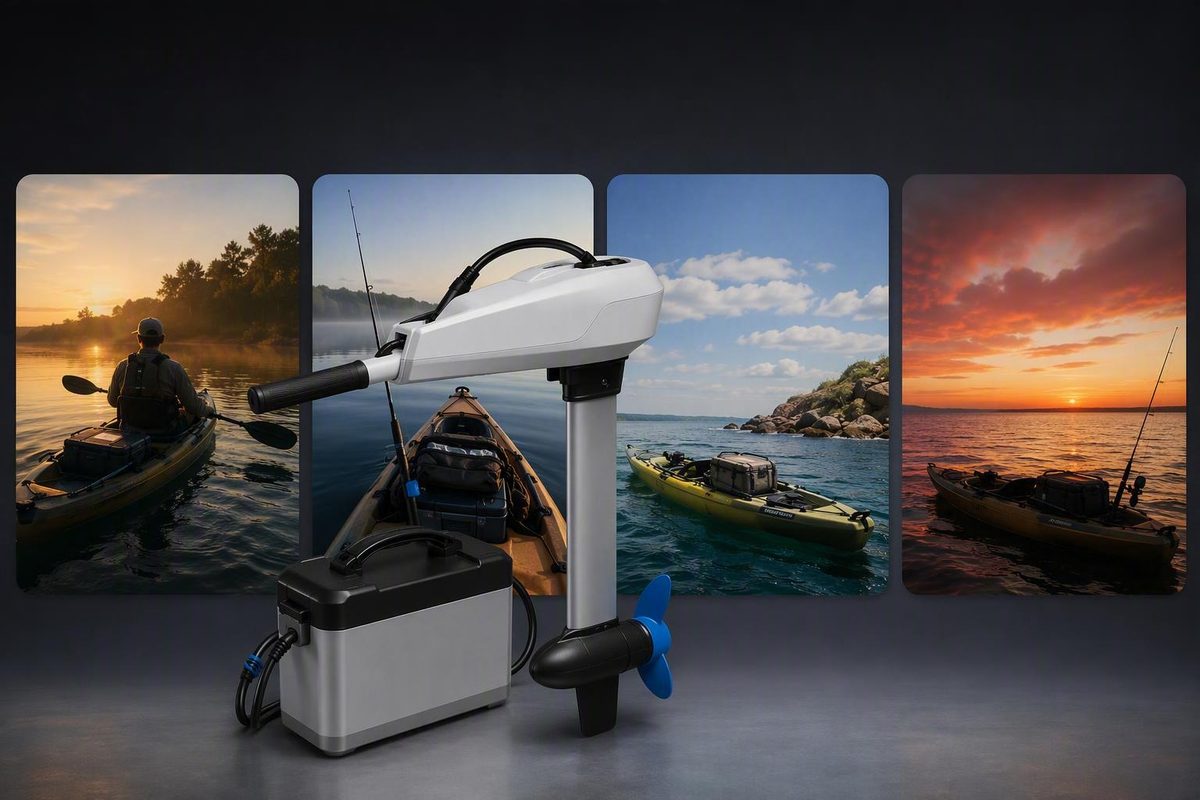
The ePropulsion kLite 750 runs about 2 hours 48 minutes at 133 W, 48 minutes at continuous 500 W, or nearly 20 hours at an exceptionally low 19 W on its integrated battery. Its published 750 W row shows 15 minutes, but Boost is a temporary feature rather than a continuous cruising mode. For a typical fishing day, 2 hours 48 minutes is the useful manufacturer benchmark—not an all-conditions guarantee.
The motor has a built-in 378 Wh, 25.2 V lithium-ion battery and weighs 14.3 lb with the battery. ePropulsion produced the runtime figures on a Crescent Kayaks LiteTackle II without a solar charger or range extender. They are manufacturer results, not independent testing by this publication. The test configuration appears on the official kLite 750 product page.
Enter your planned minutes in each mode; the calculator totals motor time, distance, energy demand, and equivalent nominal battery size.
Minutes are motor-on time. Distances use the speeds from ePropulsion’s Crescent LiteTackle II test; energy totals are nominal planning estimates.
No Boost time is selected. If added, its watt-hours are only an energy comparison: the published 750 W row does not prove continuous Boost runtime.
| Mode | Minutes | Test Speed | Est. Distance | Nominal Energy |
|---|---|---|---|---|
| Positioning, 19 W | 0 | 2 mph | 0 mi | 0 Wh |
| Fish, 133 W | 120 | 4 mph | 8 mi | 266 Wh |
| Go, 500 W | 15 | 5.5 mph | 1.4 mi | 125 Wh |
| Boost demand, 750 W | 0 | 6 mph | 0 mi | 0 Wh |
Distance estimates do not adjust for hull, load, wind, current, waves, installation, temperature, acceleration, or time with the motor off.
| Power | Speed | Integrated 378 Wh | Published Range | With 691 Wh Extension |
|---|---|---|---|---|
| 19 W | 2 mph | 19 hr 54 min | 40 mi | 56 hr |
| 133 W | 4 mph | 2 hr 48 min | 11 mi | 8 hr |
| 500 W | 5.5 mph | 48 min | 4 mi | 2 hr |
| 750 W entry | 6 mph | 15 min | 1.5 mi | 1 hr 24 min |
The extension combines 378 Wh and 691 Wh for 1,069 Wh nominal. It recharges the integrated battery at up to 100 W rather than directly driving the motor.
Source: ePropulsion manufacturer testing on a Crescent Kayaks LiteTackle II without solar or a range extender; extended figures are manufacturer data reproduced by retailers. Calculated mixed-mode values are estimates, and unknown values are shown as —.
Published Run Time Ranges From 15 Minutes To Nearly 20 Hours
Runtime, speed, and range must remain attached to the power setting that produced them.
| Power | Speed | Integrated Runtime | Range |
|---|---|---|---|
| 19 W | 2 mph | 19 hr 54 min | 40 miles |
| 133 W | 4 mph | 2 hr 48 min | 11 miles |
| 500 W | 5.5 mph | 48 min | 4 miles |
| 750 W entry | 6 mph | 15 min | 1.5 miles |
The 19-hour-54-minute result represents extremely gentle movement at 19 W. It is relevant to slow positioning, not ordinary powered travel.
The 133 W row is the strongest planning reference for efficient fishing and moderate transit. It produced about 4 mph, 2 hours 48 minutes of runtime, and 11 miles of total range in the Crescent test.
Continuous 500 W operation increased speed to approximately 5.5 mph but reduced endurance to 48 minutes and range to 4 miles. Moving from 133 W to 500 W therefore added about 1.5 mph while cutting published runtime by two hours.
The 750 W row added only another 0.5 mph while showing much shorter endurance. Do not combine its 6 mph speed with the 2-hour-48-minute runtime from the 133 W row; that would create a result the test never produced.
The 2.8-Hour Claim Applies To One Fish Mode Test
The advertised 2.8-plus-hour figure corresponds to approximately 2 hours 48 minutes at 133 W, about 4 mph, and roughly 11 miles on the Crescent LiteTackle II. It does not describe every outing conducted in Fish Mode.
Fish Mode covers low-power operation rather than one fixed output. Gentle positioning, intermittent propulsion, and steady movement near the upper end of the mode consume energy at different rates. An angler who drifts, anchors, paddles, or switches the motor off may spend much longer than 2.8 hours on the water without accumulating that much motor-on time.
A heavier or less efficient kayak may need more than 133 W to hold the test speed. Wind, current, waves, load, installation, propeller depth, battery temperature, and repeated acceleration can also change the result. The evidence does not provide a defensible universal deduction for those factors, so an automatic adjustment such as 20% would imply unsupported precision.
The listed 11 miles is total test range, not a safe one-way distance. Dividing it in half would leave no allowance for fishing movements, detours, worsening conditions, or a return leg requiring more power than the outbound leg.
Go Mode Is Continuous, While 750 W Boost Is Temporary
Go Mode is the continuous 500 W setting. Its published integrated-battery benchmark is 48 minutes, 5.5 mph, and 4 miles. This is the appropriate row for sustained high-power travel.
The 750 W function is described as Sport, Sport Burst, or Boost. ePropulsion’s launch announcement distinguishes continuous 500 W Go Mode from the 750 W Sport Burst. Third-party launch coverage reports that one activation lasts no more than 60 seconds (Marine Industry News).
The manufacturer’s Crescent table nevertheless contains a 15-minute 750 W entry. The supplied documentation does not explain its test method or reconcile that energy-endurance figure with the per-activation limit. It therefore is not evidence of 15 uninterrupted minutes in Sport Mode or a guaranteed number of one-minute boosts.
Peak output also requires the integrated battery to remain above 50% charge and within its permitted operating-temperature range. The operating restrictions and Crescent figures are reproduced by a kLite retailer.
Sport is best treated as temporary additional thrust. Because it may become unavailable as charge falls, it should not be the planned cruise setting for reaching or returning from a distant fishing area.
A Mixed Fishing Day Can Outlast The Fixed-Power Tests
Fixed-power tests measure continuous motor operation. A fishing day often combines a moderate transit, slow shoreline movement, brief corrections, drifting, anchoring, paddling, and periods with the motor off. Its elapsed duration can therefore exceed the published runtime at any one setting.
The calculator estimates the energy required by a chosen mode mix using each published wattage. Required nominal energy equals the sum of watts multiplied by minutes and divided by 60. Distance is estimated separately from the speed in each matching Crescent row.
Those calculations are planning estimates, not a new performance test. The 500 W row’s rounded 48-minute result, for example, does not align perfectly with a simple division of 378 Wh by 500 W. The unusual 750 W row also cannot be modeled as ordinary continuous operation.
Across the published results, higher wattage produces greater speed but much shorter endurance. The practical strategy is to use the lowest output that still produces adequate progress. Lower power is not automatically better in a strong adverse current, however: the motor can consume energy for longer while making little progress over the bottom.
The 691 Wh Extension Raises Stated Energy To 1,069 Wh
The cited extended configuration pairs the 378 Wh integrated battery with a 691 Wh third-party battery, producing 1,069 Wh of stated nominal combined energy. The external 12 V battery does not directly power the motor. The optional kit recharges the integrated battery at up to 100 W.
The manufacturer’s extended figures, reproduced in a retailer first look, are:
| Power | Integrated Only | Extended Setup |
|---|---|---|
| 19 W | 19 hr 54 min | 56 hr |
| 133 W | 2 hr 48 min | 8 hr |
| 500 W | 48 min | 2 hr |
| 750 W entry | 15 min | 1 hr 24 min |
At 133 W, the extended result rises from 2 hours 48 minutes to 8 hours. At 500 W, it rises from 48 minutes to 2 hours. These remain ePropulsion figures tied to the Crescent test rather than independent retailer results.
The 1-hour-24-minute 750 W entry does not establish uninterrupted Boost operation. It has the same unresolved relationship with the temporary activation restriction as the integrated battery’s 15-minute row.
Adding 378 Wh and 691 Wh correctly states the batteries’ nominal ratings, but it does not establish that every watt-hour reaches the propeller. Charging and conversion losses are not quantified in the supplied evidence. The documentation also does not clearly establish whether propulsion and active range-extension charging can occur simultaneously.
A retailer-reported mixed-use outing lasted approximately 12 hours without exhausting the extended setup. That was not a controlled fixed-power test. Long periods spent stopped, drifting, fishing, or moving slowly can make elapsed time much greater than continuous motor runtime.
Battery Comparisons Are Defensible In Watt-Hours, Not Runtime Alone
The kLite’s integrated battery can be compared with a trolling-motor battery by nominal watt-hours, but nominal capacity alone does not prove equal on-water endurance.
A mixed plan requiring 300 Wh has a nominal energy equivalent of 300 Wh in another battery system. Converting that figure to amp-hours requires the comparison battery’s voltage: amp-hours equal watt-hours divided by volts. The calculator leaves that voltage to the reader rather than assuming a system voltage.
Actual equivalence also depends on usable discharge, battery management, controller and motor efficiency, wiring losses, and how the motor’s thrust translates into speed on the kayak. The supplied evidence gives no lead-acid discharge allowance, comparable trolling-motor efficiency, battery weight, or lithium-versus-lead-acid runtime test. A claim that a particular lead-acid or lithium battery would match the kLite mile for mile would therefore be unsupported.
The kLite’s advantage is that its 378 Wh lithium-ion battery is integrated into the 14.3 lb motor package. A separate trolling-motor arrangement may offer different battery capacities or replacement options, but this evidence does not provide enough data for a reliable weight, price, or complete-system endurance comparison.
For a typical efficient outing, the decision rests on whether the 133 W benchmark leaves enough route margin. Anglers expecting sustained 500 W travel should plan around 48 minutes with the integrated battery or the published 2-hour result with the 691 Wh extension—not the 2.8-hour Fish Mode headline.
Hull, Load, And Conditions Determine Useful Range
The test kayak was a Crescent LiteTackle II. Another hull can travel faster or slower at the same displayed power, changing both useful range and the amount of throttle required.
Total paddler and gear load, wind, current, waves, propeller depth, installation, temperature, and acceleration pattern all affect the comparison. An outward tailwind or favorable current can also become a headwind or adverse current on the return.
Monitor battery state against actual GPS progress early in the trip. If consumption is higher than expected, reducing power or shortening the route early preserves more options than waiting for the final part of the charge.
Independent production-unit runtime evidence remains limited following the motor’s July 2026 launch and August arrival at US dealers. Several retailers reproduce the manufacturer’s data, but repeating the same table does not independently validate it.
A useful personal benchmark records starting and ending charge, displayed power, motor-on time, GPS distance, speed over the bottom, load, wind, and current. After several comparable outings, those records will be more relevant to a particular kayak than the headline figure.
Charging Takes About Four Hours From Empty
The standard charger is listed as taking approximately four hours to recharge the integrated battery from empty. Charging duration and motor runtime are separate constraints: discharging at continuous 500 W can take 48 minutes in the published test, followed by several hours of shore charging.
Plan with the matching power row, the entire return route, and a reserve appropriate to the consequences of running short. The sources do not specify a manufacturer-recommended reserve percentage, so no single percentage can be presented as authoritative.
Carry an accessible paddle, wear an appropriate life jacket, and identify alternate landing points. The published final minute or mile should not become the margin for getting home.
The Practical Buying Threshold Is 133 W Versus 500 W
The integrated battery best suits shorter efficient outings where the 2-hour-48-minute, 133 W result leaves a comfortable return margin. It is less suitable for a route that requires prolonged operation near 500 W, where the benchmark falls to 48 minutes.
The 691 Wh extension materially changes that calculation, raising the published results to 8 hours at 133 W and 2 hours at 500 W. It adds installation and compatibility considerations and still does not make the test figures guaranteed endurance.
Treat the 750 W setting as a brief, conditional feature. For a fishing kayak’s ordinary travel plan, 133 W and 500 W are the two rows that matter most.