
Choose an Anchor Roller by Fit, Clearance and Mounting Support
Match an anchor roller to your anchor, rode and bow layout, then check mounting support, windlass alignment and secure stowage.
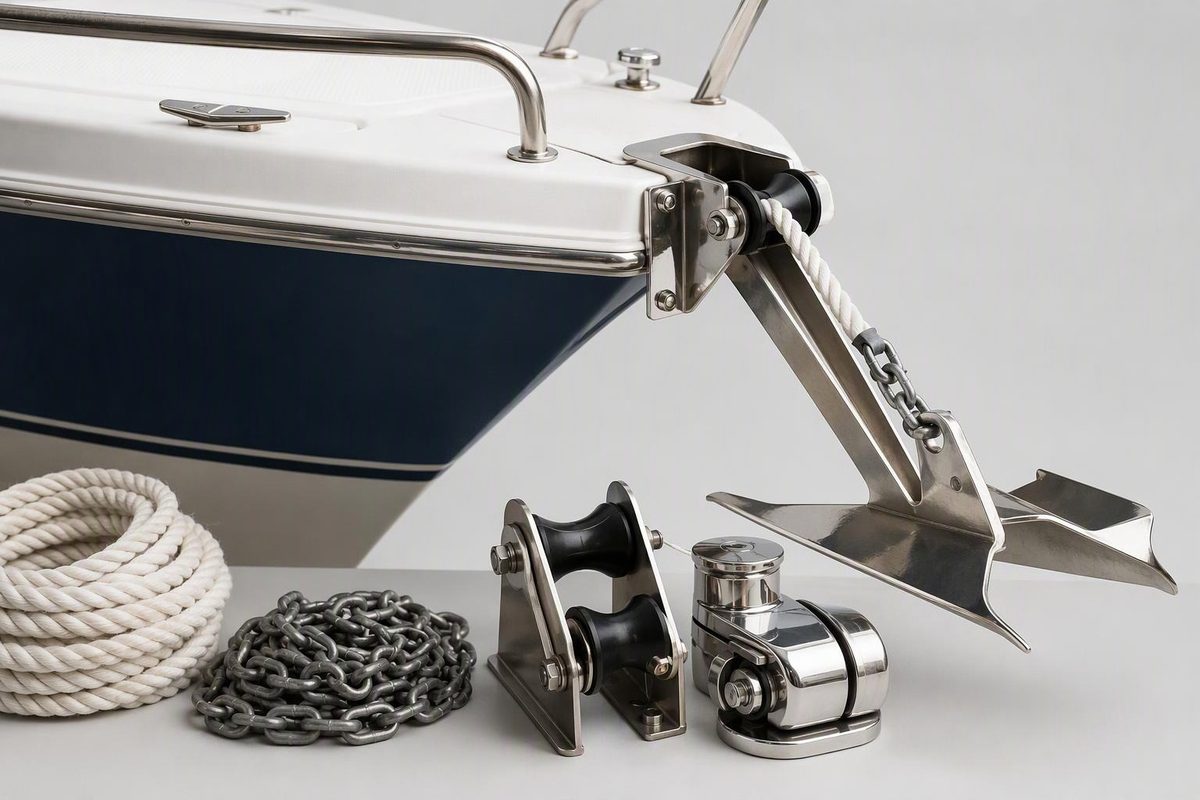
An anchor roller guides the anchor rope or chain over the bow during lowering and retrieval. Some assemblies also cradle the recovered anchor for storage. It can make hand-hauling easier and keep the anchor and rode from dragging across the boat’s finish—but only when the anchor, roller and bow layout fit together. West Marine’s guide explains both functions.
Choose by anchor geometry, hull clearance and mounting support, not boat length alone. A weight-range label is a starting point, not proof that your anchor will seat correctly.
Check the complete anchor-and-roller fit
Before ordering, identify the exact anchor model and size, rope diameter, chain size, and any shackle or swivel that must pass through the assembly. Then compare the manufacturer’s compatibility information and dimensional drawing with your bow.
Check these points with the actual anchor or a correctly scaled manufacturer template:
- Shank fit: The channel must accommodate the shank without binding, and support it in the intended stowed position.
- Hull clearance: The flukes, plow or claw must clear the bow both when seated and while coming aboard. A roll bar may also conflict with rails or other fittings.
- Rode passage: Rope, alternating chain links and connectors must pass without snagging on the side plates or retaining hardware.
- Launch and recovery: If you want self-launching, confirm that the seated anchor will tip out under control rather than needing a shove over the bow.
- Restraint: There must be a workable way to secure the anchor against movement and accidental deployment.
“Universal” does not mean every anchor will fit. West Marine advises checking the roller manufacturer’s compatibility guidance. Rocna likewise explains that roller diameter, side-plate geometry and fore-and-aft restraint affect how its anchors launch, return and sit securely; those recommendations are specific to Rocna designs, not universal dimensions. See its bow-roller design guidance.
If you are replacing only the rolling wheel, rather than the whole bracket, measure the axle diameter, available width, outside diameter and groove profile. Prefer the assembly manufacturer’s replacement part where available: matching the axle hole alone does not establish a correct fit.
Plan the mounting before drilling
Dry-fit the roller with the anchor, then check access beneath every proposed fastener and confirm that drilling will not damage concealed equipment or wiring. Include clearance for the bow gate, navigation lights, trolling motor and trailer bow stop—not just the anchor itself. Isolate power to any winch or windlass before installation work, as required by its manual.
For a windlass installation, the roller also needs to deliver the rode at the angle and height specified in the windlass manual. For example, Lewmar’s V700 manual calls for the rode to lead ideally horizontally to the top of the gypsy—the wheel that handles the rode—along its centerline. Moving the roller sideways simply to clear another fitting may create an unsuitable lead.
Do not improvise the structural attachment. Confirm the deck or beam arrangement, required reinforcement, fasteners and sealing method with the boat and hardware manufacturers. A roller’s appearance says little about whether the structure beneath it can carry the loads.
Pontoon installations can be especially model-specific. The Lewmar Venta installation manual gives separate decking and aluminum-beam mounting instructions and discusses when a mounting plate is needed; installation of its optional mounting-plate accessory is not covered. It also restricts that system to the Lewmar 14-pound galvanized Delta and 14-pound stainless-steel Epsilon anchors. Its dimensions and compatibility rules should not be transferred to an unrelated winch or roller. If mounting strength remains uncertain, stop and consult the boat manufacturer or a qualified marine installer.
Secure the anchor independently
A roller is a guide and, in some designs, a cradle. It is not automatically an anchor lock.
Use the anchor and roller manufacturers’ approved restraint arrangement. Do not rely solely on a windlass to keep the stored anchor aboard. Lewmar’s V700 safety instructions require independent securing against accidental release and specify a separate strong point for the rode while anchored.
Keep hands, clothing and hair clear during powered operation. If retrieval starts binding, stop rather than using more motor force to overcome poor fit. Before each outing, with winch or windlass power isolated, check that the wheel turns freely, the axle is retained, the bracket and fasteners are sound, and the anchor restraint works. Follow the equipment manual’s maintenance schedule as well.
Does a kayak need one?
For a kayak, start with line handling and release access rather than adding a boat-sized bow cradle. Compact roller-and-lock products serve a different job: Scotty’s 276 Anchor Lock, for example, is described for small vessels used in still, calm water and accepts line up to half an inch in diameter. That is not an endorsement for anchoring in strong current.
Before choosing kayak hardware, work through the anchor, trolley, storage and immediate-release setup. A smoother-running roller does not replace a release you can operate from your seat.