
What Is a Boat Transom?
Learn where a boat’s transom is, how it differs from the stern, why it supports motors, and what to check before adding a motor or buying used.
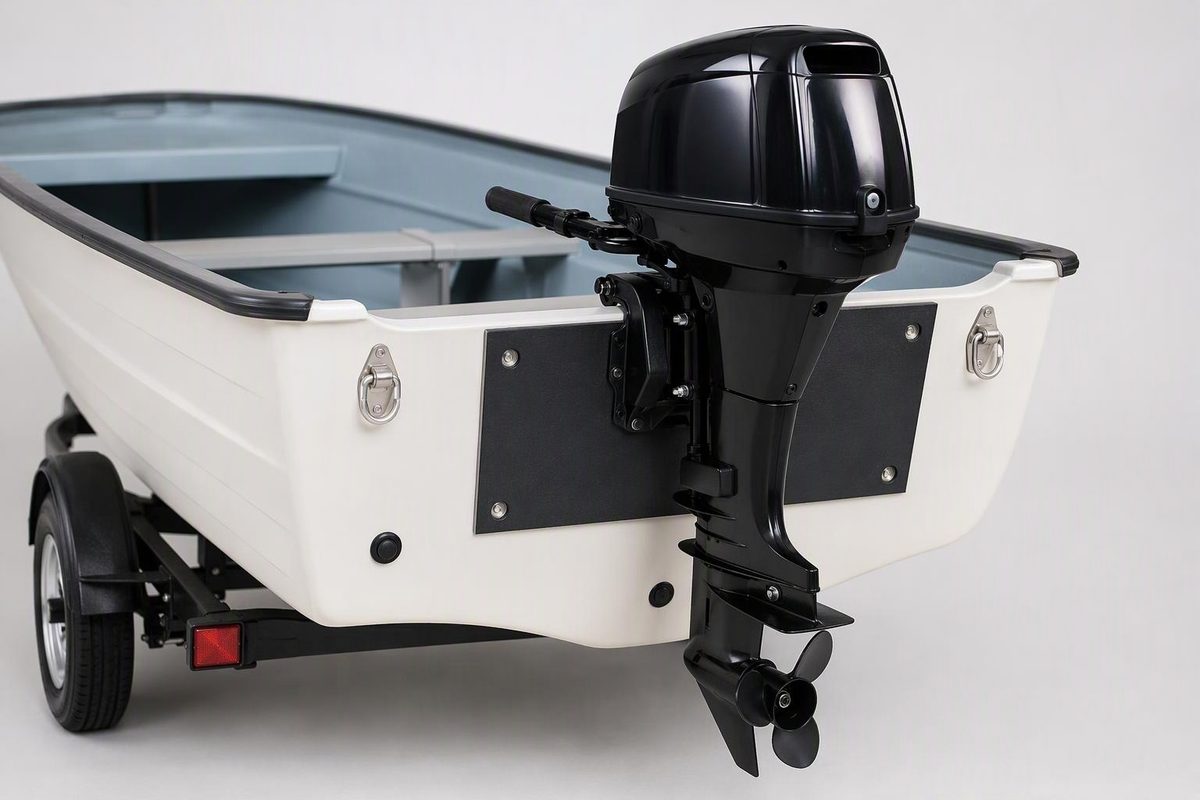
A boat transom is the panel or wall across the back of the hull, where the hull’s sides meet at the stern. On a small outboard-powered boat, it is usually the surface the motor clamps or bolts onto. It is often flat, but can be slightly curved or sloped rather than perfectly vertical. Sea Tow explains its location and structural role.
Transom vs. stern: what’s the difference?
The stern is the boat’s rear end as a whole. The transom is a particular part of that rear end—the crosswise panel closing the hull. The bow is the front, and the hull is the boat’s body. These distinctions follow BOATERexam’s boat terminology guide.
To identify the transom on a typical jon boat or dinghy, look at the boat from behind. Find the broad rear panel joining its two sides. If an outboard is fitted directly to the boat, its mounting bracket will sit against that panel.
What does the transom do?
The transom is more than a convenient place to hang a motor. It:
- Closes the back of the hull, helping keep water outside the boat.
- Stiffens the stern, working with the boat’s other structural members.
- Supports propulsion loads on outboard boats, carrying both the motor’s weight and the forces it applies while running.
- Provides attachment points for equipment such as swim ladders and platforms, where the structure is designed to support them.
A transom can also have a notch or cutout for an outboard; it does not have to be a full-height wall all the way across. These functions and shapes are described in Sea Tow’s transom guide.
What does “transom mount” mean?
A transom-mount motor attaches at the transom rather than at the bow. But a transom motor mount can also mean an added bracket that gives a motor somewhere to attach.
That distinction matters for kayaks. For example, Newport’s kayak transom mount is a separate bracket intended for kayaks with a suitable flat mounting surface. The product name does not mean that any kayak stern can safely take a motor. Confirm compatibility with the kayak, bracket and motor manufacturers before drilling or fitting hardware.
For motor selection, see our guides to transom-mount trolling motors and long- versus short-shaft outboards. Knowing the part’s name is only the start: mounting strength, clearance and shaft fit still matter.
What should you check on a used boat?
Look for cracks around motor mounts, moisture around fasteners, loose hardware and visible deformation. On a cored fiberglass transom, the outer skin can conceal damage underneath. WEST SYSTEM describes how transom loads and cracks can allow moisture into the core, leading to serious structural damage.
Treat those signs as reasons for a qualified inspection—not as proof that the boat needs only fresh sealant. WEST SYSTEM also notes that sealant may temporarily stop leakage around loose hardware without restoring its holding strength. If the transom visibly flexes or the mounting bracket shifts against it, postpone powered use until the structure and mounting have been assessed.