
Choose a Kayak Launch You Can Land at Again
Check legal access, the carry, footing, water conditions, boat traffic and your return landing before choosing a kayak launch site.
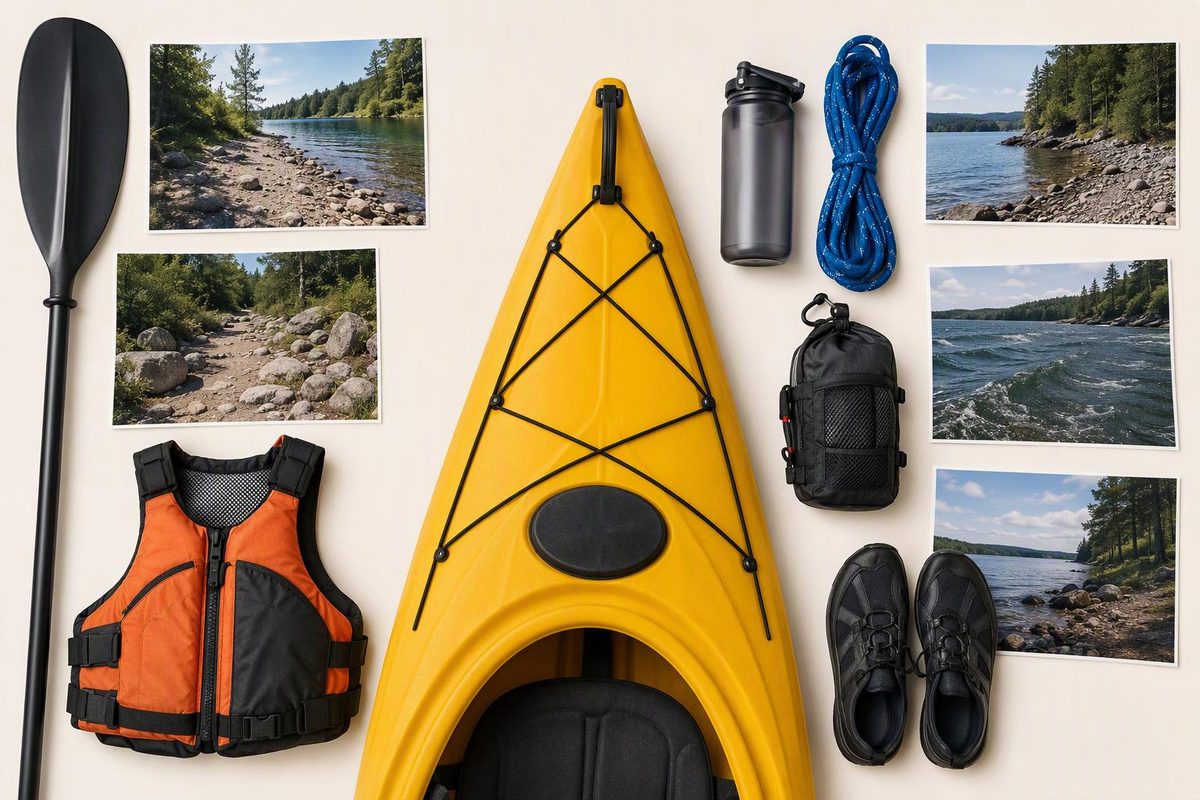
Choose a launch where you can legally reach the water, carry your kayak without losing control, get aboard on stable footing, and land again under the conditions expected when you return. For a beginner, favor a gently sloping, firm shoreline on sheltered water with little boat traffic—not simply the nearest ramp.
Assess the site in two stages: check access and conditions before leaving home, then walk the launch without the kayak before unloading.
1. Confirm access, not just a map pin
Use the launch operator’s current information: a park authority, municipality, marina or landowner. Check:
- Whether kayak launching is permitted and which entry point to use.
- Opening hours, gates, parking rules, fees and any required permits or inspections.
- Closures, water-quality advisories and restrictions on nearby landing areas.
- Whether docks or launch aids will actually be available.
A launch directory helps with the shortlist, but facilities can be seasonal. For example, New York DEC’s launch information lists launch types, directions and parking capacity, and advises contacting its regional offices for current dock installation and removal schedules.
Do not assume a roadside gap, private dock or inviting beach is an authorized access point. If permission is unclear, ask the operator or choose another site.
2. Walk the whole carry and inspect the footing
Follow the route from the unloading area to the water. Can you carry your actual boat around tight turns, down steps and back uphill? A manageable empty-kayak carry may require separate trips for gear. Plan around the least mobile paddler and whoever must handle the heaviest lift.
At the entry point, look for:
- Stable footing: firm ground rather than deep mud, loose stones, slippery surfaces or an eroding bank.
- A manageable slope: somewhere you can stop and set the kayak down without it sliding away.
- Usable water depth: enough to float the loaded boat without forcing you across sharp rocks or into an abrupt drop-off.
- Space to board and exit: without balancing precariously or obstructing other users.
The National Park Service and River Management Society’s Prepare to Launch! guidance identifies gradual slopes with stable surfaces as desirable and steep, unstable banks as poor launch locations.
A low dock or assisted kayak launch may solve a transfer problem, but check that its equipment suits your boat and abilities. A dock is not automatically easier than a beach: assess the height difference and how you will get back out.
3. Check where the water will take you immediately
Watch the entry area before committing. Could you pause afloat to settle yourself, or would current, breaking waves or wakes immediately demand boat-control skills?
For a straightforward recreational outing, prefer sheltered water with room to maneuver, away from heavy traffic, dams and weirs. These are also key location criteria in Prepare to Launch!.
On rivers, check current flow information, closures and downstream hazards along your planned route—not just the quiet patch beside the bank. For example, Olympic National Park’s boating guidance directs paddlers to check river flows and conditions and warns of log jams on several rivers. On shared ramps, prepare away from the active lane and avoid launching among reversing trailers or maneuvering powerboats.
Shelter at the shoreline does not establish that the route beyond it is suitable. Use the separate wind-checking guide to assess forecast wind, gusts and exposure through your return time.
4. Assess the landing for your return time
Ask how the same site could look several hours later. Tidal changes can turn a channel into a mudflat or expose rocks, as the NPS/River Management Society guidance explains. Check local tide predictions, river levels or reservoir information as applicable—not just the water depth you see now. Make sure access gates will still be open when you return.
Identify another permitted, reachable takeout before departure. Paddling.com’s location guidance recommends alternative takeouts so deteriorating conditions do not force a return to the original launch. For a downstream trip, confirm the takeout and transport arrangements before putting in.
5. Make the decision before boarding
Choose another site—or postpone—if access is uncertain, footing is unreliable, boarding requires skills you do not have, or there is no credible return landing. Do not let an easy parking space outweigh a difficult shoreline.
Wear your life jacket, paddle with a companion and share your route and expected return time—precautions also recommended in Paddling.com’s guidance. A suitable launch removes an avoidable difficulty; it does not replace preparation for the water beyond it.