
Find a Boston Whaler Stencil Number—and Don’t Confuse It With the HIN
Learn where Boston Whaler stencil numbers are located, what they identify, how to date an early hull, and when to use the 12-character HIN instead.
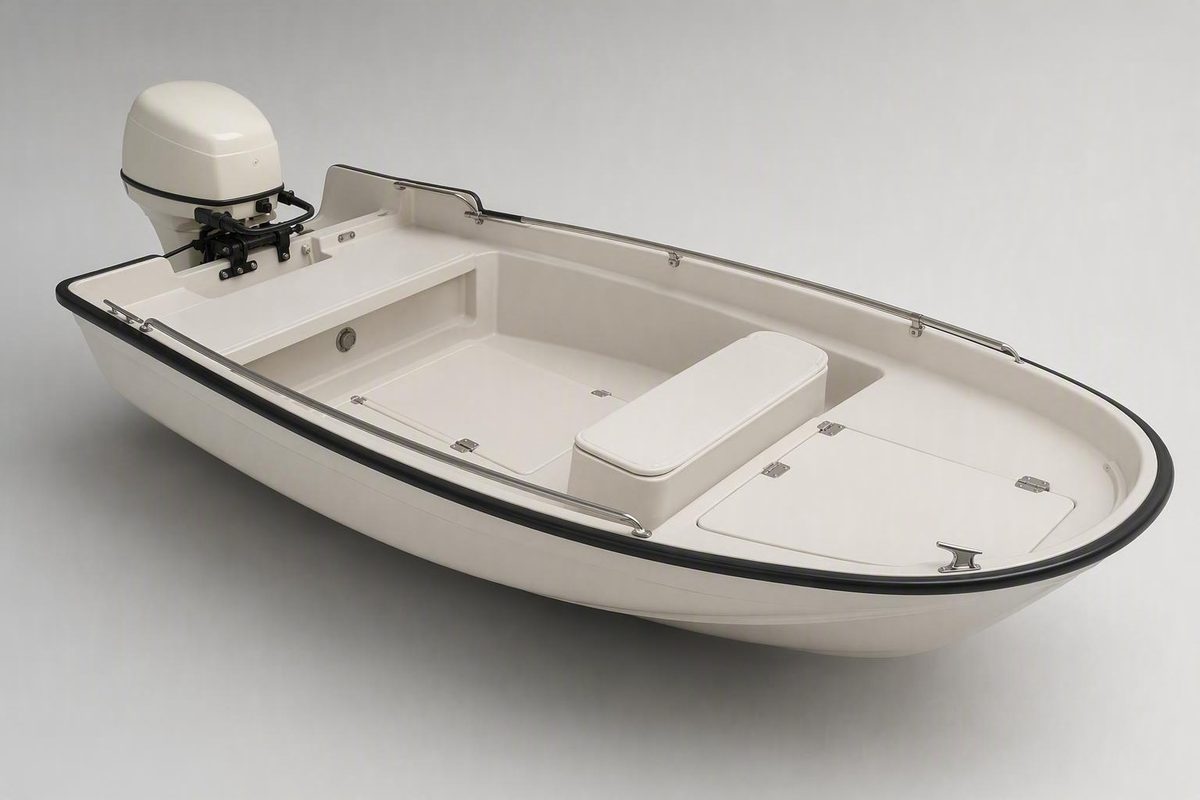
A Boston Whaler stencil number is the factory identifier molded into the gelcoat of the hull’s interior. It is not simply paint, and it is not necessarily the boat’s federally standardized Hull Identification Number (HIN). On a pre-November 1972 Whaler, however, the stencil may be the only original number associated with the boat. (continuousWave)
Where to look
Search the interior in good light before sanding or applying paint:
- Small classic hulls: Check the inboard face of the transom, centered in the splashwell and roughly 3–5 inches below the transom top.
- Larger hulls: Look inside the forward lockers, especially a starboard locker or the center anchor locker.
- Color: Most stencil numbers are black. Early boats with blue interiors commonly have white numbers.
The location varies by model. A previous refinish may have covered the number; aggressive sanding or new gelcoat may have removed it. If you find the stencil during restoration, photograph it, transcribe it and mask it off before surface preparation. The number was molded into the outer gelcoat and can sometimes survive beneath later paint. (continuousWave)
Stencil number vs. HIN
These numbers answer different questions:
| Identifier | Typical appearance and location | What it tells you |
|---|---|---|
| Stencil number | Contrasting characters molded into the cockpit liner | Identifies the molded hull-and-liner assembly |
| HIN | A 12-character number on the starboard exterior of the transom on federally regulated boats | Identifies the completed boat and encodes manufacturer, serial and date information |
A stencil does not reliably identify the finished model. Boston Whaler applied it before adding consoles, seats and other equipment, so consecutive hulls from the same mold could be completed as different models. Hardware and layout therefore matter when distinguishing, for example, a bare Standard hull from a factory-finished Sport or Montauk. (continuousWave)
For boats built on or after November 1, 1972, look first for a 12-character HIN. The current federal format uses characters 1–3 for the manufacturer code, 4–8 for the serial number, 9–10 for the month and year of manufacture or certification, and 11–12 for the model year. The primary HIN belongs on the starboard outboard side of the transom near its top; a duplicate must be in an unexposed location. (33 CFR Part 181, Subpart C)
Older post-1972 Whalers can use earlier HIN date formats, so do not apply the current month-code scheme blindly to every vintage tag.
Dating an early hull from its stencil
The most useful published sequences cover the original 13-foot and 16/17-foot families. Match the complete stencil—including any letter prefix—to the correct hull family, then treat the result as a production-year range rather than proof of the finished model.
Selected 13-foot ranges include:
| Stencil range | Approximate year |
|---|---|
| 100–4499 | 1958–1961 |
| 8500–11300 | 1963 |
| 17501–21200 | 1966 |
| 28501–2A2400 | 1969 |
| 2A2401–2A5600 | 1970 |
| 2A5601–2A7800 | 1971 |
| 2A7801–2B000 | 1972 |
| 2B001–2B2700 | 1973 |
The complete 13-foot sequence is available in the continuousWave 13-foot reference.
Selected original 16-foot ranges include:
| Stencil range | Approximate year |
|---|---|
| 3000–3999 | 1961–1962 |
| 30000–31499 | 1962–1963 |
| 34400–35800 | 1966 |
| 39751–3A1300 | 1969 |
| 3A1301–3A4100 | 1970 |
| 3A4101–3A5200 | 1971 |
| 3A5201–3A6700 | 1972 |
The 16/17-foot reference explicitly cautions that its stencil sequence does not encode the model.
A practical identification sequence
- Record both numbers separately. Photograph the interior stencil and the exterior HIN or old metal tag. Do not combine characters from the two.
- Measure the hull. Length, beam, transom configuration and molded interior shape help select the correct hull family.
- Use the HIN for a post-1972 boat. It is the standardized identifier for title, registration and date decoding; use the stencil as supporting evidence.
- Use stencil ranges cautiously on an early boat. They can narrow the molding date, but original furniture, console arrangement, rails and period documents are needed to establish the model.
- Resolve paperwork conflicts before buying or restoring. Compare the physical identifiers with the title and registration. Do not alter or recreate a HIN yourself; federal rules prohibit unauthorized removal or alteration of a required number. (33 CFR Part 181, Subpart C) Contact the relevant state boating-registration authority about a missing or conflicting identifier.
Boston Whaler’s current registration page says its system cannot provide boat details or documentation for models older than 1997. For an older hull, preserve the physical identifiers and assemble the stencil range, HIN, dimensions, photographs and ownership papers rather than assuming the factory can issue a full build record. (Boston Whaler)