
Solve Anchor-Retrieval Problems Without Adding an Avoidable Weak Point
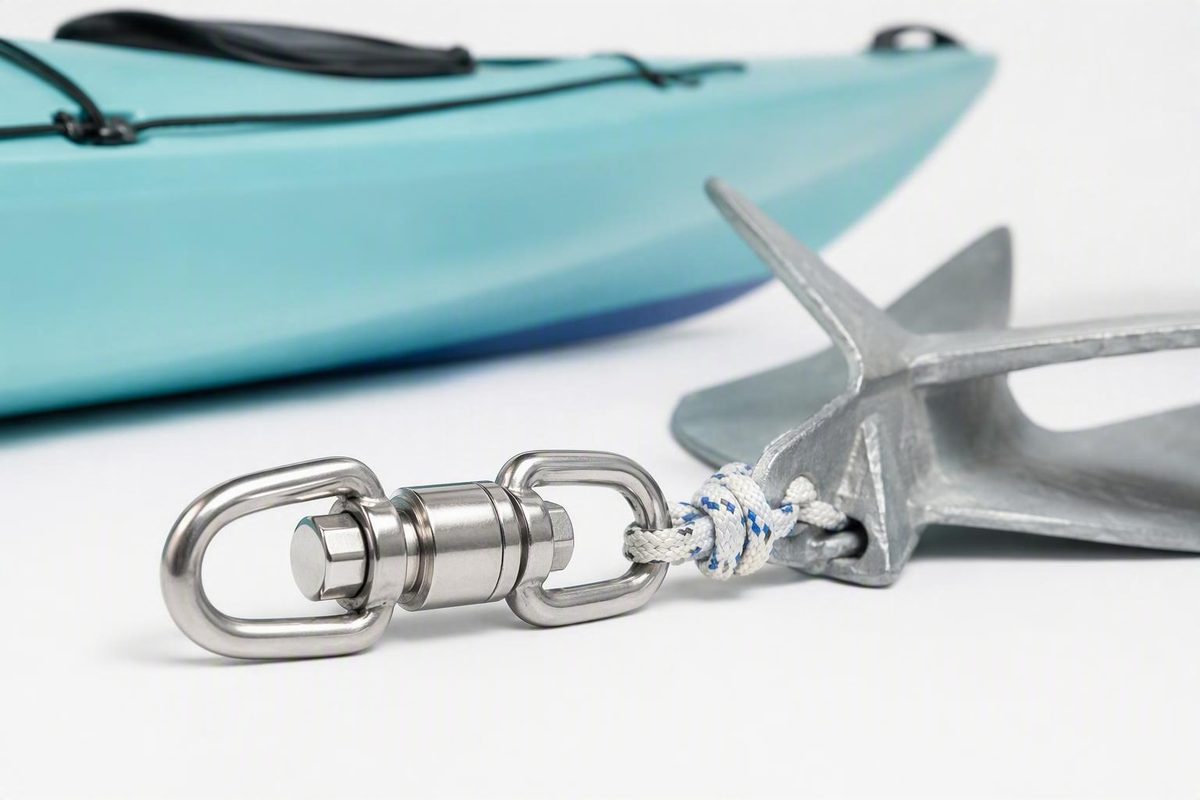
An anchor swivel is not a default upgrade for every rode. It is an additional connector intended to permit rotation, and it should earn its place by correcting a specific, recurring problem.
If your anchor retrieves in the correct orientation, the chain does not accumulate troublesome twist or skip on the gypsy, and the complete assembly passes over the bow roller cleanly, a properly sized, load-rated bow shackle is usually the simpler connection. If retrieval is unreliable, diagnose the geometry before buying a swivel. The cause may be the anchor, roller, windlass approach, chain, or stowage arrangement rather than a lack of rotation.
When a swivel is justified, select it as part of the complete anchor-to-chain system. Chain grade and link dimensions, connector ratings, side-loading exposure, articulation, pin fit, roller clearance, fastener retention, and inspection access all matter. The instructions for the exact model and size—not generic advice for a similar-looking product—control its installation.
The short answer: most anchor rodes do not automatically need a swivel
You do not need an anchor swivel merely because you have an all-chain or rope-chain rode. Start with what the system actually does during deployment, retrieval, and stowage.
If the anchor arrives upright, the chain enters the gypsy cleanly, and the connector crosses the roller without snagging or violently righting itself, there is no demonstrated problem for a swivel to solve. Rocna likewise says that a quality load-rated shackle is sufficient for most systems that retrieve cleanly, while identifying circumstances in which a swivel may help. Rocna’s swivel-or-shackle guidance
A bow shackle is the baseline because it is comparatively simple. It has a body and pin but no rotating joint. Depending on its design, a swivel can add forks, pins, threads, locking screws, rotating bearing surfaces, welds, or enclosed components. Those features provide articulation, but they also create more interfaces that must remain secure, undamaged, and free to move.
That does not make every swivel unsafe. It means the extra component needs a reason to be there.
Investigate further when you repeatedly encounter one or more of these symptoms:
- The boat consistently swings in one direction and visible twist accumulates.
- The anchor or rode hydro-rotates during deployment or retrieval.
- The chain bunches or skips on the windlass gypsy.
- The anchor repeatedly reaches the roller sideways or upside down.
- The anchor rights itself abruptly at the roller.
- The swivel, shackle, or chain binds against narrow roller cheeks or a retaining bar.
- The connector does not follow the windlass approach cleanly.
- Retrieval routinely requires someone at the bow to correct orientation, making operation particularly difficult when sailing alone.
A minor twist that disappears when the chain hangs freely is different from twist that causes skipping, bunching, unreliable self-stowage, or repeated manual intervention. Focus on the operational consequence, not simply whether the chain has rotated.
Compact decision tree
- Is there a recurring retrieval or rotation symptom? - No: retain the simpler, properly sized rated connection. - Yes: continue to step 2.
- Does inspection reveal a roller, gypsy, chain, anchor-geometry, or alignment problem? - Yes: correct that problem and retest before adding hardware. - No or unresolved: continue to step 3.
- Would a compatible swivel directly address the observed rotation or orientation problem? - No: do not add one merely because swivels are common. - Possibly: verify ratings, fit, geometry, clearance, retention, and current instructions.
- Does the assembled connection bind, side-load, snag, or rely on an unexplained rating? - Yes: stop and resolve the incompatibility. - No: install and inspect it according to the exact manufacturer’s instructions.
This is a diagnostic framework, not a universal rule against swivels. Two boats using the same anchor and chain can behave differently because their bow rollers, windlass locations, gypsies, anchor lockers, and retrieval angles differ.
What a swivel can—and cannot—do in an anchor rode
An anchor swivel is a rotating connector installed within the connection between the anchor and rode. A conventional unit may connect an anchor to chain, while some products are also designed for chain-to-line placement.
A swivel is proposed to provide two distinct benefits:
- Relieving accumulated rotational twist. The rotating joint can allow one part of the rode to turn relative to another.
- Improving retrieval orientation. Some designs may help an inverted or sideways anchor rotate into a position that follows the bow roller.
These benefits should not be conflated. A swivel might help the anchor turn at the roller without eliminating all twist in the chain. Conversely, it may permit some twist relief without reliably making an anchor enter a particular roller upright.
Self-alignment is conditional. The swivel must be free to rotate under the loads and angles actually present. The anchor must have geometry that permits it to turn, and the roller must provide enough room. A connector trapped against a roller cheek, retaining bar, shank, or hard stop cannot provide the same movement it demonstrates while hanging freely.
Owner reports are mixed. Some boaters say a swivel helps when wind or tide repeatedly turns the boat or when an inverted anchor needs to orient at the roller. Others report continued rode twist with a swivel installed. These accounts identify possible symptoms but are not controlled comparisons and cannot predict performance on another boat. Examples of differing owner experiences
A swivel does not:
- Increase the anchor’s holding power.
- Correct poor scope, setting, or anchoring technique.
- Compensate for undersized or damaged chain.
- Make incompatible shackles or pins suitable.
- Guarantee that the anchor will self-stow.
- Guarantee that chain twist will disappear.
- Guarantee protection against anchor loss.
Before attributing an inverted anchor to chain twist, watch the complete retrieval sequence. Determine where the orientation changes:
- Does the anchor approach correctly and flip at the roller?
- Does it rotate while suspended below the bow?
- Is a broad shackle or swivel catching a roller cheek?
- Does the windlass pull from one side?
- Does the chain jump before or after the connector reaches the roller?
These observations separate a rotation problem from a retrieval-path problem. A swivel can permit rotation; it cannot redesign a narrow roller, move an offset windlass, change the anchor’s shape, or create clearance where none exists.
Swivel versus bow shackle: compare the whole connection, not one feature
The meaningful comparison is not “swivel versus no swivel” in isolation. It is one complete connection layout versus another.
| Consideration | Load-rated bow shackle | Anchor swivel |
|---|---|---|
| Primary purpose | Simple anchor-to-chain connection | Allows rotation and may assist retrieval orientation |
| Mechanical complexity | Low | Higher; may include joints, forks, pins, threads, screws, welds, or enclosed parts |
| Moving parts | None in normal service | One or more rotating or articulating interfaces |
| Articulation | Limited by shackle shape, anchor opening, and chain | Potentially greater, but design- and installation-dependent |
| Inspection | Usually straightforward when exposed | Varies; enclosed designs may conceal components |
| Maintenance | Pin retention and condition checks | Retention, threads, rotating surfaces, locking elements, and condition checks |
| Potential concerns | Pin loosening, deformation, wear, corrosion, poor fit | The same concerns plus binding, restricted rotation, fork distortion, and concealed damage |
| Retrieval benefit | Limited to its shape and available articulation | May relieve twist or help orient an anchor |
| Best use case | A rode that already deploys and retrieves correctly | A compatible system with a recurring rotation or alignment problem |
The shackle’s advantage is simplicity. If the retrieval system works correctly, adding a rotating mechanism does not improve the anchoring result; it increases the component count.
The swivel has a narrower advantage: controlled rotation. That can be useful where twist contributes to gypsy problems or where an anchor repeatedly arrives inverted. The benefit depends on hardware that remains correctly assembled, undamaged, free to articulate, and compatible with the surrounding chain and anchor.
Do not assume every shackle is stronger than every swivel. Suitability depends on documented ratings, material, dimensions, loading direction, design, manufacturing quality, condition, and installation. An unrated shackle of unknown origin is not a sound baseline merely because it is simple.
Likewise, a large breaking-strength number on a swivel does not prove system compatibility. The chain-side pin may pass through a nominal chain size but bear poorly on its link. The anchor-side fork may bind when angled. The swivel may be too wide for the roller or too long for the windlass approach. Its load terminology may also differ from that used for the chain.
Before choosing either connection, check:
- Documented working rating and the manufacturer’s definition of that rating.
- Exact chain diameter, grade, and link dimensions.
- Fit at the chain-side pin and intended bearing surface.
- Fit through the anchor opening or required shackle.
- Articulation in straight, sideways, and inverted positions.
- Exposure to lateral or off-axis loading.
- Pin, screw, or thread-retention method.
- Access for inspection and disassembly.
- Clearance through the bow roller and retaining hardware.
- Compatibility with the windlass, gypsy approach, hawsepipe, and locker.
- Availability of current instructions for the precise model and size.
A swivel should solve an observed problem. A streamlined appearance, marketplace popularity, or the fact that neighboring boats use one is not enough.
Why side loading and connection geometry matter
A connector is axially loaded when the pull follows its intended straight load path. Imagine a line running from the chain through the swivel to the anchor. When the components align with that line and move freely, the swivel is closer to a straight pull.
Off-axis loading occurs when the pull is angled across the connector. A conventional swivel attached directly to an anchor can be forced against the edge of the anchor’s attachment opening. Instead of rotating or pivoting freely, its fork or body may act as a lever against the shank.
A straight-pull rating does not establish equivalent performance under side loading. Nor does it establish performance under shock, repeated load cycles, wear, fatigue, loosening, or corrosion.
Reported swivel problems have included distorted forks, failed clevis or threaded fasteners, corrosion in a concealed welded part, and a suspected welded-part failure. The available examples do not establish how common such failures are, but they illustrate why geometry and inspectability matter. Practical Sailor’s discussion of swivel geometry and reported failures
Direct-to-anchor attachment is therefore not a universal installation method. Some products require a bow shackle; some conventional inline swivels may be separated from the anchor by a short chain leader; specialized integrated or anchor-straightening designs may use a different arrangement.
A short leader is intended to let a conventional swivel align more nearly with the chain pull instead of binding directly against the anchor. The extra links add planes of articulation. They also make the assembly longer and bulkier, which may prevent it from passing through a particular roller or windlass path.
Do not assume that five links—or any other fixed number—is universally correct. One retailer’s illustrated arrangement uses five links but expressly treats anchor-straightening swivels differently. The correct layout must come from the exact product instructions and must fit the boat’s retrieval path. Absolute Marine’s illustrated connection advice
Treat these four configurations separately:
1. Conventional swivel directly on anchor — caution example

CHAIN ---- [SWIVEL] ---- ANCHOR SHANK
\__ may bind against the attachment opening
2. Manufacturer-approved shackle connection

CHAIN ---- [SWIVEL] ---- (BOW SHACKLE) ---- ANCHOR
                         arrangement and orientation per manual
3. Short chain leader, where expressly approved

MAIN CHAIN ---- [INLINE SWIVEL] ---- SHORT CHAIN ---- SHACKLE ---- ANCHOR
                                     length must suit the instructions
                                     and retrieval path
4. Integrated-shackle or specialized design

CHAIN ---- [SPECIALIZED SWIVEL / INTEGRATED SHACKLE] ---- ANCHOR
            install only according to that product's manual
These are conceptual diagrams, not installation drawings. Conventional inline, integrated-shackle, ball-and-socket, universal-joint, and anchor-straightening connectors may manage articulation differently. Advice for one type should not be transferred to another without confirmation.
Before accepting a layout, move the safely unloaded assembly through realistic positions. Pull it straight, move the anchor sideways, invert it, and reproduce the approach to the roller. A position that locks the swivel against the shank, forces a fork apart, levers a pin across an edge, or traps a chain link indicates an incompatible arrangement.
How to read working-load, proof-load, and breaking-strength figures
Connector listings use inconsistent terminology. The largest number is not automatically the number permitted in service.
For comparison purposes:
- A proof load is a specified test level. It is not automatically either the working limit or breaking point.
Do not treat these labels as interchangeable:
- kg or kgf
- pounds
- B.S.
- B.L.
- UBS
- working load or WLL
- maximum working load or MWL
- proof-tested
- breaking or ultimate load
Units matter as well. Even where a product page uses familiar shorthand, the buyer still needs to determine what the figure represents and under what loading conditions it applies.
Wichard’s 2977W page separates its figures, listing a 3,500 kg maximum working load and a 9,500 kg breaking load. Its compatibility labeling is less clear: the heading and summary refer to a 1/2- to 5/8-inch range, while the detailed information identifies 1/2- and 9/16-inch chain. That discrepancy should be resolved before purchase. Wichard’s specifications for model 2977W
Mantus demonstrates why chain grade matters. Its selection table assigns different S1, S2, or S3 models to some chains of the same diameter depending on whether they are Grade 30, 40, or 70. For example, it assigns S1 to 8 mm Grade 30 or Grade 40 chain but S2 to 8 mm Grade 70 chain. The page states that working load is one-fifth of “UBS,” but it does not define that abbreviation; the term should not be expanded or reinterpreted without clarification. Mantus’s chain-grade-dependent selection table
Other specification problems require the same restraint:
- Sea-Dog publishes values labeled “B.S.” but does not define the abbreviation or state a working-load limit in the supplied product information. Sea-Dog’s listed swivel specifications
- Kong lists four kgf figures without identifying them as working, proof, or breaking loads. Its 16–20 mm option is shown at 2,000 kgf, below the 5,000 kgf and 9,500 kgf figures displayed for two smaller options, and the page does not explain the anomaly. Kong’s listed sizes and kgf figures
- A marketplace listing may state both working and breaking figures without supplying the test method, certification, loading direction, or applicable standard.
Assess the swivel, shackles, leader chain, pins, and adjoining main chain as one load path.
The available evidence does not support a universal safety factor for every anchor swivel. Use documented ratings appropriate to the exact chain and system. When terminology, testing, loading direction, or compatibility remains unclear, obtain written clarification from the manufacturer or advice from a qualified marine rigger rather than converting a breaking figure into a self-selected working limit.
A system-level compatibility checklist before buying
Begin with the chain, not the swivel catalog.
Record the chain’s measured diameter, link length, internal width, external width, grade, manufacturer if known, and documented working and breaking specifications. Do not identify grade from appearance alone. If the chain’s origin and specification cannot be established, treat that as an unresolved system-level uncertainty.
Nominal diameter does not describe every link dimension.
Chain-side checks
- Does the specified pin pass through the link without forcing?
- Is there adequate articulation without obviously excessive play?
- Does the link bear on the surface intended by the manufacturer?
- Can the pin seat fully and engage its specified retention system?
- Does the link jam against the swivel body when pulled at an angle?
- Is the selected model approved for the chain’s grade, not merely its diameter?
Anchor-side checks
Measure the anchor’s attachment opening, including width, thickness, and edge geometry. If the manufacturer requires a bow shackle, verify that the shackle body and pin fit the prescribed sides of the connection. Do not assume that reversing a shackle is harmless; orientation can change articulation and bearing.
Check whether the connection can move through the angles created as the boat swings. Make sure the pin can be secured by the prescribed method and remains accessible for inspection.
Rating checks
Create a row for every component:
- Main chain.
- Chain-side swivel pin.
- Swivel body and rotating joint.
- Anchor-side pin or integrated shackle.
- Any separate bow shackle.
- Any approved leader chain and its connecting hardware.
Record the exact terminology attached to every figure. A blank or undefined field is an unresolved question, not permission to infer a safe value.
Articulation checks
With the proposed assembly safely unloaded, move it through:
- A straight pull.
- A pull to either side.
- An inverted anchor position.
- A sideways approach to the roller.
- The transition onto the roller.
- The final stowed position.
Watch for metal-to-metal hard stops, fork spreading, pin levering, trapped chain links, restricted rotation, and fasteners that become inaccessible.
Retrieval-path checks
Measure more than the roller’s central groove:
- Roller width, diameter, and profile.
- Distance between roller cheeks.
- Retaining bars, bail arms, pins, and latches.
- Windlass location and chain approach angle.
- Gypsy clearance.
- Deck openings and hawsepipe dimensions.
- Anchor-locker entrance and fall.
- Space for the swivel in the fully stowed position.
- Contact between fasteners and hard stops.
A structurally plausible swivel can still be unsuitable if it catches a retaining bar or cannot enter the locker. A leader may improve articulation near the anchor while creating a new problem at the roller or windlass.
Instruction checks
Obtain the current manual for the exact model and size. Confirm:
- Approved connection layout.
- Permitted chain sizes and grades.
- Required pin orientation.
- Torque, if specified.
- Required thread treatment.
- Retention or locking method.
- Whether a separate shackle or leader is required.
- Prohibited arrangements.
- Inspection and disassembly procedure.
- Replacement criteria.
Integrated-shackle, inline, ball-and-socket, and anchor-straightening products are not automatically interchangeable.
Pre-purchase worksheet
| Field | Your system |
|---|---|
| Chain nominal diameter | |
| Measured link diameter | |
| Link internal length and width | |
| Chain grade | |
| Chain manufacturer and model | |
| Chain working-load terminology and figure | |
| Chain breaking-load terminology and figure | |
| Anchor make and model | |
| Anchor attachment-opening dimensions | |
| Proposed swivel model and size | |
| Swivel working-load terminology and figure | |
| Other stated or breaking-load figure | |
| Chain-side pin diameter and usable length | |
| Anchor-side pin or shackle dimensions | |
| Separate shackle rating and dimensions | |
| Leader-chain specification, if approved | |
| Bow-roller width and cheek clearance | |
| Retaining-bar clearance | |
| Windlass and gypsy model | |
| Hawsepipe or locker-opening clearance | |
| Approved connection layout | |
| Fastener-retention method | |
| Current manual obtained | Yes / No |
| Unresolved terminology or fit questions |
Do not buy until questions affecting load, fit, retention, or geometry have been answered.
Specification examples—and why they do not create a best-swivel ranking
The table below demonstrates how differently manufacturers and sellers present anchor-swivel information. It is an audit exercise, not a shortlist. The figures cannot be ranked directly because the sizes, definitions, geometries, tests, and installation methods are not standardized in the supplied information.
Prices have been omitted because they change and do not establish suitability.
| Model | Material | Stated chain fit | Explicit working load | Breaking or other figure | Design and pin instructions | Unresolved issue |
|---|---|---|---|---|---|---|
| Kong Swivel Anchor Connector | AISI 316 stainless steel | 6–8, 8–12, 12–14, and 16–20 mm options | Not stated | 2,500, 5,000, 9,500, and 2,000 kgf respectively | Rotating anchor connector; product page links to a manual | Type of kgf figure is unspecified; the lower figure for the largest option is unexplained |
| Mantus S1/S2/S3 | 316L stainless body; duplex stainless pin | Selection varies by chain diameter and Grade 30, 40, or 70 | Stated as one-fifth of “UBS” | No separately defined breaking figure in the supplied page text | Integrated-shackle concept; oblong chain-side pin | UBS is undefined; superiority and elimination-of-side-loading statements are manufacturer claims |
| Wichard 2977W | 316L stainless steel | Detailed information identifies 1/2 and 9/16 inch; broader labeling says 1/2–5/8 inch | 3,500 kg maximum working load | 9,500 kg breaking load | Swiveling anchor-to-chain connector | Conflicting chain-size labeling requires clarification |
| Sea-Dog 182608, 182612, and 182614 | Investment-cast AISI 316 stainless steel | 1/4–5/16, 5/16–1/2, and 1/2–5/8 inch respectively | Not stated | 5,500, 17,000, and 21,500 lb B.S. respectively | Double locking pins; 4 mm wrench for the first two models and 5 mm for the third; Blue Loctite or anti-seize specified on pin threads | B.S. is undefined |
| Better Boat, smaller listed version | Seller describes 316 stainless steel | 1/4–5/16 inch | Seller states 1,900 lb | Seller states 4,500 lb breaking load | Marketplace-listed swivel; detailed installation and testing information not supplied | Seller-provided figures lack supplied test methods or certification; exact variant identity should be confirmed |
Manufacturer statements such as “strongest,” “safest,” “self-aligning,” “reduced wear,” or “prevents twisting” describe intended benefits or marketing positions. They do not independently prove field performance across different anchors, rollers, loading angles, or maintenance conditions.
Nor can the products be ranked by the largest displayed number. Wichard separates working and breaking loads; Sea-Dog’s “B.S.” is undefined; Kong does not identify the type of its kgf figures; and Mantus uses an undefined abbreviation when relating working load to UBS. Those values are not directly comparable.
The correct product—if a swivel is needed—is the one whose documented ratings, dimensions, connection layout, and instructions match the complete system.
Installation, pin security, and inspection checklist
Use the current instructions for the exact design, model, and size. Do not transfer a shackle arrangement, thread treatment, torque, or chain-leader recommendation from a visually similar product.
Before assembly
- Confirm that the swivel addresses an identified problem.
- Verify the approved layout: direct specialized connection, separate bow shackle, two shackles, short leader, integrated shackle, or another arrangement.
- Confirm every component’s size, fit, and documented rating.
- Clean and inspect the chain end, anchor opening, swivel, shackles, pins, and accessible threads.
- Do not install components already showing deformation, material wear, damaged threads, suspect welds, or corrosion of concern.
- Confirm that the assembly can be dismantled as directed for future inspection.
Use only the specified retention method
Different products use different retention systems. A conventional shackle may use seizing where its design and instructions permit. A swivel may instead rely on locking pins, set screws, specified thread treatment, mechanical retainers, or another proprietary arrangement.
Threadlocker and anti-seize are not interchangeable generic remedies. Use only the treatment specified for the exact product. Sea-Dog, for example, instructs users to coat the pin threads on its listed swivels with Blue Loctite or anti-seize to prevent galling and specifies model-dependent wrench sizes. Those instructions apply to those products, not automatically to other swivels.
If the manual is missing or contradictory, obtain clarification from the manufacturer rather than improvising a retention method.
After assembly
Before relying on the rode, move each joint by hand while the system is safely unloaded. Reproduce straight, sideways, and inverted positions, followed by the actual approach over the roller and into the stowed position.
Confirm that:
- Pins are fully engaged.
- Locking elements are installed as specified.
- Threads are not cross-threaded.
- The swivel rotates without obvious roughness or seizure.
- Forks remain aligned during articulation.
- Chain links do not jam in the connector.
- The swivel does not lever against the anchor shank.
- Fasteners do not strike the roller, retaining bar, windlass, or deck.
- The connection remains accessible for inspection.
- The stowed anchor is secured by its intended restraint rather than by unintended loading against the swivel.
Rocna’s current guidance distinguishes between its own shackle-based installation and arrangements for third-party inline swivels, and it recommends seasonal inspection with replacement of parts showing wear, deformation, or corrosion. Rocna’s installation and inspection guidance
Routine checks
Inspect the connection as part of the boat’s regular ground-tackle checks and whenever retrieval behavior changes. Look for:
- Pin engagement and retention.
- Loose screws, pins, or shackles.
- Fork misalignment or spreading.
- Visible cracks or deformation.
- Bent or worn pins.
- Damaged threads.
- Wear at chain and pin bearing surfaces.
- Rough, stiff, or restricted rotation.
- Contact damage from the roller or windlass.
- Corrosion, discoloration, or pitting.
- A changed stowed position that could indicate movement or wear.
Thorough periodic inspection
Remove or disassemble the connector only as directed so normally hidden areas can be examined. Pay attention to fork roots, pin holes, bearing surfaces, threads, welds, crevices, locking elements, and any change in fit between chain, swivel, shackle, and anchor.
Enclosed designs may conceal corrosion, welds, or other damage. A clean exterior is not proof that every internal component is sound. Reported failures involving concealed parts are one reason inspectability should be considered during selection. Practical Sailor’s inspection and failure discussion
Remove from service hardware showing deformation, significant wear, damaged threads, failed retention, weld defects, corrosion of concern, or impaired movement. If the significance of a mark, pit, or change in fit is uncertain, do not rely on the component until the manufacturer or a qualified marine professional has assessed it.
There is no evidence-based universal service life for every anchor swivel. Saltwater exposure, anchoring frequency, load history, shock events, storage, materials, and design differ. Base replacement decisions on current manufacturer guidance, inspection findings, operating environment, and known loading—not an arbitrary number of seasons.
Conclusion
Use a conservative sequence: diagnose the retrieval problem, keep the simpler rated-shackle connection if the system already works, and add a swivel only when its specific benefit justifies the extra component.
If a swivel is warranted, choose and install it as part of the complete load path—not by brand reputation, appearance, price, or headline breaking strength. Verify chain grade, link and pin fit, documented ratings, articulation, side-load geometry, roller and windlass clearance, fastener retention, and inspectability against the current instructions for the exact model.
Any unexplained rating, incompatible geometry, binding, looseness, deformation, damaged thread, suspect weld, corrosion of concern, or impaired rotation is a reason to stop and resolve the issue before relying on the rode.
Frequently asked questions
Does an anchor swivel completely stop chain twist?
No. A swivel permits relative rotation, but it does not guarantee that every turn will pass through the joint. Load, friction, chain bunching, roller contact, and the swivel’s position can all affect whether it rotates.
In some systems, improved anchor orientation at the bow roller may be a more realistic benefit than complete elimination of twist.
Should an anchor swivel be stronger than the anchor chain?
The complete connection should have documented ratings appropriate to the chain and intended system, but “stronger than the chain” is too vague to be a selection rule. It may compare a swivel’s breaking figure with a chain’s working limit or combine figures derived from different test methods and loading directions.
Compare equivalent rating terms where possible and include every shackle, pin, and leader. Do not infer a safe working load from an undefined B.S., kgf, UBS, or breaking figure.
Can I attach a conventional swivel directly to the anchor?
Not as a universal practice. A conventional swivel can bind against the anchor attachment point and experience off-axis loading when the rode pulls sideways. Some manufacturers require a separate bow shackle, leader, or another arrangement to preserve articulation.
Follow the exact swivel manufacturer’s instructions. A direct connection may be intentional for a specialized integrated or anchor-straightening design while being unsuitable for a conventional inline swivel.
How many chain links should go between an anchor and swivel?
There is no universal number. A short leader may help a conventional swivel align with the pull, but its length and connections must be approved for that product and must fit the boat’s roller, windlass approach, and stowage path.
Use the current manual for the exact model rather than copying a fixed link count from another boat.
Is stainless steel automatically the best material for an anchor swivel?
No. Stainless steel is used in several current swivels, including products described as 316, 316L, or duplex stainless. The material name alone does not establish rating, construction quality, resistance to galling or corrosion, fatigue performance, weld quality, or suitability under side loading.
Practical Sailor has expressed a preference for inspectable, load-rated components and cautioned against unrated bargain stainless swivels, but that is an editorial position rather than proof that every stainless design is unsuitable. The practical choice depends on documented ratings, material specification, construction, geometry, compatible adjoining hardware, inspectability, maintenance requirements, and operating environment.