
What Makes a Sea-Doo Switch Bury Its Bow
See how bow loading, planing transitions and jet braking combine on the Sea-Doo Switch, plus what two remedies mean when comparing pontoons.
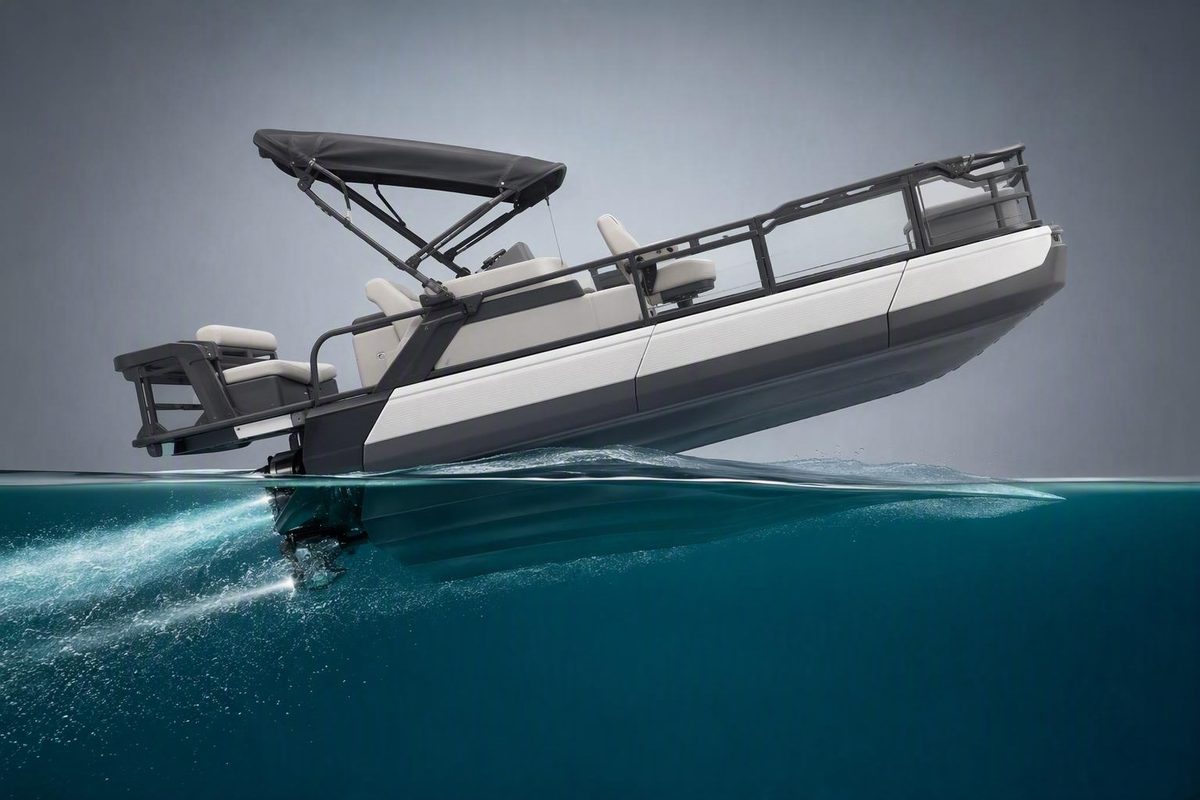
The Sea-Doo Switch can flip forward when bow-heavy trim combines with a sharp speed or planing transition; at least two remediation rounds have now addressed the same failure mode, so operator error alone is not an adequate explanation. The first remedy altered the pontoon system, while a second reported system uses sensors to take over throttle as a forward flip develops. Neither changes the basic fact that the Switch’s unusual hull, loading and jet-control architecture can put its bow into the water under the wrong combination of forces. BRP documents the front-overload capsize risk, and the June 2026 report describes the newer throttle intervention.
That verdict needs limits. The available evidence does not establish one mechanical sequence behind every reported rollover, and it does not show that ordinary throttle or braking will flip a properly loaded Switch. It does establish bow overloading as a recognized capsize hazard, identifies planing transitions and sudden speed changes as critical conditions, and shows that BRP has pursued more than one technical mitigation.
The Beginner-Friendly Consensus Is Partly Right
The usual case for the Switch is straightforward. It has no exposed propeller, uses familiar PWC-style handlebar controls and can bank through turns rather than remaining as flat as a conventional pontoon. For a buyer who already understands Sea-Doo controls, it may feel more approachable than an outboard pontoon with a wheel and combined shift-throttle lever.
That description is not false. The Switch has a large central hull with smaller, shallower outer hull sections, allowing more PWC-like leaning than the broad, relatively flat response buyers expect from traditional pontoons. A third-party review documents both the raised outer sections and the banking behavior. GearJunkie’s Switch review shows the hull and handling arrangement.
The mistake is treating easy controls as proof of conventional-pontoon stability. The Switch is not simply a traditional pontoon with a jet in place of an outboard. Its central hull, outer buoyancy sections, modular deck, jet propulsion and iBR braking system create a different response to load placement and changing speed.
The consensus is also right that operator inputs matter. Abrupt braking, turning while slowing and poor passenger placement can contribute to a capsize sequence. But an input is not the same thing as a complete cause. If a vessel’s geometry and running attitude make one loading-and-speed combination unusually consequential, blaming the final lever movement alone leaves out the system in which that movement occurred.
Bow Weight Starts the Forward-Flip Sequence
Total capacity and load distribution answer different questions. A Switch can remain below its rated passenger or weight limit while carrying too much weight at the bow or on one side.
Forward passengers, coolers, anchors, batteries and other dense cargo move the combined center of gravity toward the bow. That lowers the front before any throttle or brake input occurs. Several adults seated forward can materially alter trim even when the permitted passenger count has not been exceeded.
Speed then changes how the hull is supported. A boat that looks acceptably level on plane can settle differently as it approaches or leaves planing speed. If its bow is already low, that transition reduces the margin before the forward deck or hull sections meet the water.
Jet thrust and iBR braking affect this running attitude, but the supplied evidence does not prove that hard acceleration alone causes every forward flip. The stronger documented warning concerns sudden speed changes, strong deceleration and instability while approaching or coming off plane. Hawaii’s boating agency, summarizing U.S. Coast Guard Safety Alert 18-25, advised operators to watch for nose-diving around those transitions and avoid sudden changes in speed or direction at non-planing speeds. The government summary lists the Coast Guard recommendations.
A representative sequence is:
- Passengers or cargo establish bow-heavy trim.
- The boat accelerates, slows sharply or crosses the planing threshold.
- Occupants or unsecured cargo shift as the running attitude changes.
- The bow settles into a wake, chop or its own disturbed water.
- A turn or wave adds lateral or vertical force.
- The immersed bow resists forward movement and becomes a pivot.
- Water comes aboard, or the stern continues rotating over the buried bow.
A momentary bow dip is not automatically a capsize. A nose-dive means substantial bow immersion, potentially with water over the forward deck. A pitchpole is the extreme outcome in which the buried bow acts as a pivot while the stern rotates forward. A side capsize may begin with roll rather than pitch, and a photograph of an overturned boat cannot by itself reveal the first movement.
Choose the hull, load position and throttle behavior that match how you would use the boat; the result identifies whether your inputs match the documented Switch pattern.
This is a condition-matching tool, not a probability calculator. It compares your intended setup with the loading and speed-transition pattern described in the safety guidance and reporting.
What The Switch Pattern Adds
Bow loading interacts with a central hull, shallower outer sections, jet thrust and iBR braking. The reported throttle takeover can react to a developing event but cannot redistribute weight.
What This Result Does Not Mean
It does not predict a capsize or declare a traditional pontoon safe under poor loading. No universal speed, brake input, bow angle or probability is available in the supplied evidence.
All 18 Input Combinations
The selected default row is highlighted by its matching labels. JavaScript adds filtering when you change an input.
| Boat | Load | Throttle | Pattern Result |
|---|---|---|---|
| Traditional pontoon | Even/aft | Progressive | No Switch match General operating guidance still applies. |
| Traditional pontoon | Even/aft | Hard acceleration | No Switch match Different hull and propulsion arrangement. |
| Traditional pontoon | Even/aft | Abrupt slowing | General caution Strong deceleration can still move occupants and cargo. |
| Traditional pontoon | Mixed | Progressive | No Switch match Check side-to-side and fore-aft balance. |
| Traditional pontoon | Mixed | Hard acceleration | General caution Secure cargo and keep passengers seated. |
| Traditional pontoon | Mixed | Abrupt slowing | General caution Deceleration and uneven loading can combine. |
| Traditional pontoon | Bow-heavy | Progressive | Loading concern Being below capacity does not ensure proper trim. |
| Traditional pontoon | Bow-heavy | Hard acceleration | Loading concern Not the complete documented Switch pattern. |
| Traditional pontoon | Bow-heavy | Abrupt slowing | Heightened general caution Move weight away from the bow and slow progressively. |
| Jet-drive modular | Even/aft | Progressive | Lower pattern match No condition alone guarantees safety. |
| Jet-drive modular | Even/aft | Hard acceleration | Partial match Architecture and speed change match; bow loading does not. |
| Jet-drive modular | Even/aft | Abrupt slowing | Transition caution Watch the bow while approaching or coming off plane. |
| Jet-drive modular | Mixed | Progressive | Lower pattern match Confirm the bow is not carrying disproportionate weight. |
| Jet-drive modular | Mixed | Hard acceleration | Partial match Keep passengers seated and cargo secured. |
| Jet-drive modular | Mixed | Abrupt slowing | Transition caution A turn, wake or passenger movement can add another force. |
| Jet-drive modular | Bow-heavy | Progressive | Recognized loading hazard BRP warns that front overloading can cause nose-diving and capsizing. |
| Jet-drive modular | Bow-heavy | Hard acceleration | Switch pattern matched Concern zone; evidence is stronger for abrupt slowing than acceleration alone. |
| Jet-drive modular | Bow-heavy | Abrupt slowing | Strongest documented match Bow load, deceleration and a planing transition can stack the hazard. |
“Lower match” does not mean safe. Weather, waves, turns, passenger movement, retained water, damage and vessel configuration can add forces not represented by these three inputs.
Sources: BRP front-overload recall and safety guidance; U.S. Coast Guard Safety Alert 18-25 summary; June 27, 2026 throttle-intervention reporting. No numerical capsize probability or universal threshold is available.
Braking Can Trigger the Geometry Without Being the Root Cause
The Switch’s Intelligent Brake and Reverse system uses the left lever for both deceleration and reverse. Greater lever input produces stronger braking. If the lever remains applied as the boat nears a stop, reverse can engage. Sea-Doo advises progressive brake application and warning passengers before a quick stop. The official helm guide explains the progressive braking and reverse controls.
During strong deceleration, passengers and unsecured objects retain forward momentum. At the same time, the hull loses the dynamic support associated with its running attitude. A bow-heavy boat can therefore settle farther forward just as people or cargo move in the same direction.
A turn, wake or chop can compound that change. Turning while slowing adds lateral force and uneven hull loading. A following wake can reach the stern while the bow is already settling. Head seas can put the lowered bow into the next wave before it recovers.
This is why neither extreme explanation is adequate. “The operator hit the brake” omits the load and hull response. “The brake always flips the boat” is also unsupported. The evidence does not identify a universal speed, brake position, passenger arrangement or bow angle at which a Switch will overturn.
Marine reporting has collected accounts involving forward loading, rapid slowing, turns, wakes, retained water and passenger movement. It has also documented disagreement over whether design characteristics or operator technique mattered more. Those reports identify a recurring pattern, not a completed reconstruction of every event. Marine Industry News summarizes the incidents and competing interpretations.
Two Remedies Do Not Equal a Geometry Fix
The safety history is more useful to a buyer than arguments over whether one incident was caused by one lever input.
| Development | What It Establishes |
|---|---|
| February 2025 recall | BRP recognized a front-overload capsize risk. |
| March 2025 remedy reporting | No-cost pontoon-system changes were intended to help keep the bow elevated. |
| October 2025 safety alert summary | Operators were warned about bow weight and planing transitions. |
| June 2026 intervention report | A sensor-driven system was reported to take over throttle when a forward flip appeared imminent. |
The first reported remedy addressed the pontoon system. The newer intervention reportedly watches for a developing event and changes throttle without waiting for the operator. That may interrupt a dangerous sequence, but it is a compensating control rather than evidence that loading and hull behavior have ceased to matter.
Publicly accessible material supplied for the June 2026 system does not establish which models receive it, whether it is available on every affected boat, whether the operator can override it or how it performs in controlled and real-world testing. Buyers should not assume a boat has the system without vessel-specific documentation.
The same limitation applies to the earlier work. The available evidence here does not establish every covered model year, length or configuration. Recall eligibility and completion should be checked by hull identification number through current BRP records or an authorized dealer.
A disputed theory concerns water in the segmented outer hull areas. Published reporting says water can enter those areas at rest and drain through rear openings while the boat is underway or out of the water. Owners and writers have proposed that retained water could move forward during deceleration and add bow weight.
That mechanism remains unproven as a universal cause. The supplied evidence contains no verified outer-hull water capacity, measured drainage rate, controlled center-of-gravity data or completed accident reconstruction establishing shifting water as the cause of a particular capsize. Reporting on the earlier alteration describes the theory and remedy while leaving causation unresolved. The Outdoor Wire summarizes BRP’s compliance position and the reported alteration.
The Lawsuits Raise the Stakes but Do Not Decide Causation
A wrongful-death lawsuit concerning the 2024 Flagstaff Lake, Maine capsize, in which three people died, was refiled or expanded on August 25–26, 2026, naming BRP and the dealer. Maine and marine-industry outlets reported the filing. NEWS CENTER Maine is among the Maine sources covering the dispute.
A separate suit over an earlier Switch incident had reached the expert-selection stage for an April 2026 trial, according to independent boating coverage. That indicates the controversy predates the Flagstaff Lake deaths and continued after the first remediation round. Loose Cannon has followed the Switch litigation and remedies.
Lawsuit allegations are not technical findings or final judgments. They cannot establish that every Switch has the same defect, and manufacturer compliance statements cannot establish the sequence of a specific accident. The proper buyer takeaway is narrower: the forward-capsize concern is recurrent, has prompted official safety action and remains serious enough to produce additional technical intervention and litigation.
What the Throttle Takeover Can and Cannot Do
If the reported sensor-driven system recognizes a developing nose-dive early enough, changing throttle may reduce one force in the sequence or help restore a safer running attitude. That is potentially valuable because a developing pitch event can leave little time for an inexperienced operator to diagnose load, speed and wave interaction.
It cannot redistribute passengers, secure a sliding cooler, remove retained water, change an approaching wake or repair damage. It also cannot make a bow-heavy load appropriate. No available source provides a universal intervention threshold or guarantees recovery after the bow is already deeply immersed.
The system therefore should be evaluated as a backup layer, not as permission to load the forward deck like a conventional entertainment platform. The default operating controls remain load distribution, progressive speed changes and attention to the boat’s attitude around planing transitions.
BRP’s safety guidance says to distribute passengers and cargo from front to back and side to side, prevent passengers from gathering at the bow and move people aft if nose-diving develops. Its safety video also calls for gradual braking. Sea-Doo’s Switch safety video demonstrates the loading and nose-dive response.
Buyer Due Diligence Is Different From Routine Boat Shopping
A buyer cross-shopping a Switch against a traditional pontoon should compare behavior, not just seating layout and propulsion exposure. The conventional pontoon does not share the Switch’s complete hull-and-control arrangement, so familiarity with one does not establish how the other will react when heavily loaded forward.
Before buying a particular Switch, obtain its hull identification number and ask an authorized dealer to document whether every applicable recall or service action has been completed. Ask specifically whether the reported throttle-takeover system applies to that vessel and request the relevant model-specific documentation. If no public figure or applicability list is available, treat it as unknown rather than assuming the newest remedy is installed.
On a test ride, keep the load within the operator guide and appropriately distributed. Observe the bow during progressive acceleration and deceleration without trying to reproduce a dangerous condition. A severe or repeated nose-dive during ordinary operation with appropriate loading is a reason to stop operating and seek authorized inspection, not a handling trait to test more aggressively.
If the bow begins riding unusually low, alert passengers, keep them seated and reduce throttle progressively. Avoid adding a sharp turn or abrupt braking input unless that is necessary to prevent a more immediate collision. Stop in safe water, then move passengers away from the bow when movement can be made safely.
Do not resume ordinary operation after substantial water comes aboard, a warning remains active, controls behave unpredictably, water appears not to drain as expected or the boat has struck something or capsized. Appropriate life jackets remain essential even though they cannot prevent the initial nose-dive.
“Flip Forward” Can Also Describe the Control
Some searches refer to the handlebar controls rather than a hull rollover. The Switch starts in neutral, and the display identifies forward, neutral or reverse.
Tapping the right throttle lever selects forward. Tapping the left lever returns the boat to neutral. Pulling and holding the left lever selects reverse, but releasing it returns the Switch to neutral, not forward. The left lever also supplies progressively stronger braking before reverse engages near a stop.
If the displayed mode or boat movement does not follow that documented sequence, stop using the vessel and consult its model-specific operator guide or an authorized Sea-Doo dealer. That behavior calls for vessel-specific diagnosis rather than speculation about a sensor, lever or software fault.