
Why Standing and Shifting Weight Can Put a Boater in the Water
Standing up is the expected quiz answer: it raises the center of gravity and shifts weight, making balance harder to maintain, especially in a small boat.
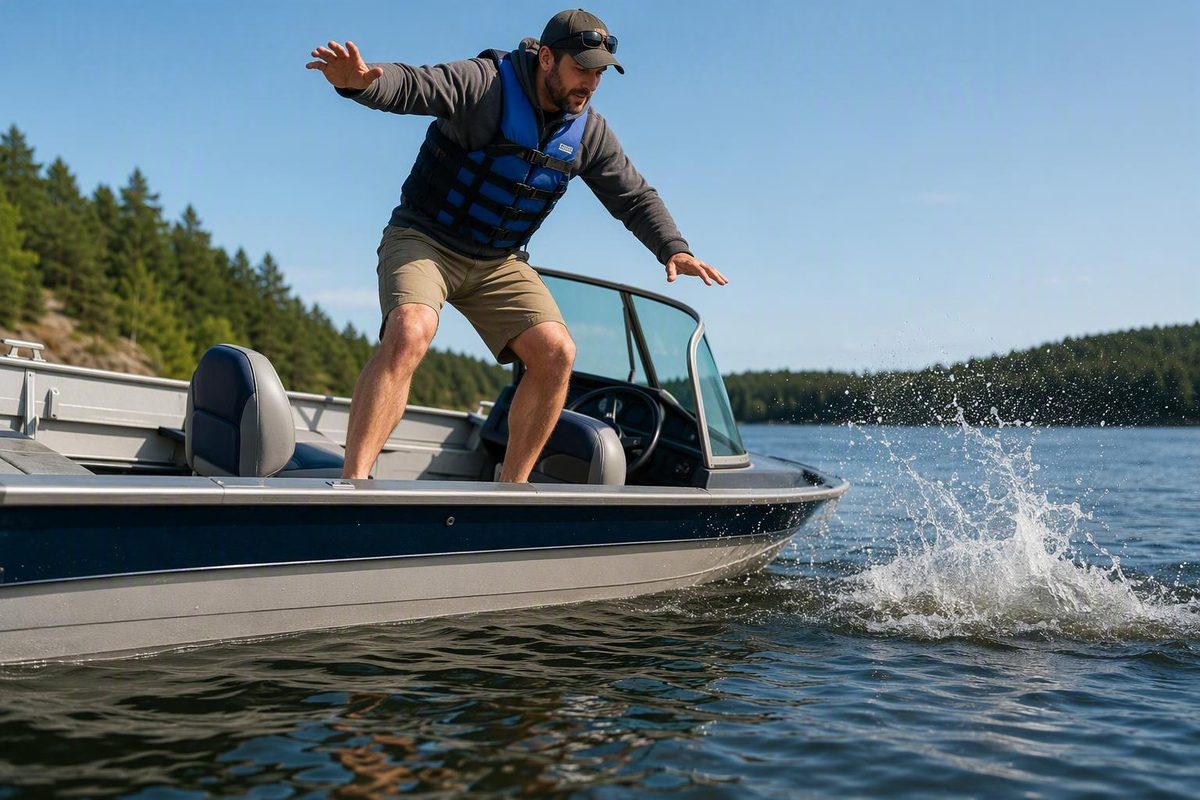
The short answer: standing up in the boat
Among the usual multiple-choice options, standing up in a boat is most likely to cause someone to fall overboard. Standing creates a greater change in balance and weight distribution than properly balancing people and gear, and it makes it harder to recover when the boat moves beneath you.
That is the expected answer to a familiar quiz formulation, not a statistically proven leading cause across every vessel and incident. A Quizlet example of the multiple-choice question selects standing from choices that also include balancing people and gear, sitting on a pedestal chair while anchored, and fishing. The study platform does not provide accident statistics, so its answer should be understood only in the context of those choices.
A useful way to interpret the answer is to separate the immediate event from its contributing behavior:
- Immediate mechanism: The person loses balance.
- Contributing behavior: The person stands, leans, changes seats, or shifts position.
- Possible trigger: The boat meets a wake or wave, turns, accelerates, or moves unexpectedly.
- Result: The person cannot recover and falls overboard.
Real incidents may involve several hazards at once, including poor footing, rough water, unsafe seating, impairment, or uneven loading. The supplied evidence does not rank one factor as the universal leading cause across small recreational boats, larger powerboats, sailboats, canoes, kayaks, and commercial vessels.
For a boating-course student, the practical takeaway is simple: stay seated—or at least low and centered—whenever practical.
Why standing makes a small boat less stable
Standing raises the body’s center of gravity. It may also move a substantial portion of the boat’s total weight upward or toward one side. Both changes can make it harder for the passenger to stay balanced as the hull moves.
The basic incident sequence is straightforward:
- A passenger stands or begins changing position.
- Their body weight moves upward or across the boat.
- The boat encounters a wave, wake, turn, or other motion.
- The passenger loses balance.
- The passenger goes overboard.
Boat Tests 101 describes standing or shifting position as changing or raising the center of gravity, allowing a wave, wake, or sudden turn to cause a fall. Its guidance on capsizing and falls overboard also identifies overloading, uneven weight distribution, and rough water as related stability hazards, although it does not rank them by frequency.
Consider a passenger who stands to change seats just as the boat crosses another vessel’s wake. The wake may be the final trigger, but the upright, shifting posture created the vulnerability.
Several descriptions of the incident can therefore be true at once:
- Standing was the risky behavior.
- The raised or shifted weight reduced the passenger’s stability.
- The wake triggered the boat’s sudden movement.
- Loss of balance was the immediate mechanism.
The same reasoning applies when someone leans out to reach a line, steps toward one side to retrieve gear, or turns abruptly while fishing. Upright movement does not guarantee a fall; it reduces the room for error if the boat moves unexpectedly.
No single explanation captures the stability characteristics of every vessel. The general principle remains useful, however: avoid moving body weight high or far from the center unless the task requires it, and use safety practices appropriate to the particular craft.
Other factors that contribute to falling overboard
Standing is the familiar quiz answer, but actual falls often involve interacting conditions. Those contributing factors fall into four broad groups: behavior, boat stability, environmental conditions, and personal impairment. These are prevention-oriented hazards, not a statistical ranking of causes.
Behavior
Movements and positions that can reduce a person’s ability to remain aboard include:
- Standing unnecessarily
- Changing seats suddenly
- Leaning over the side
- Reaching beyond a stable position
- Moving without secure contact
- Becoming distracted while moving
- Sitting or riding in an area not intended for passengers
- Turning or stepping without anticipating the boat’s motion
A movement does not have to be dramatic. A passenger may rise slowly but then twist, reach, or take an awkward step. If the boat turns or meets a wake at that moment, a minor balance error can become an overboard fall.
Fishing is not inherently safe or unsafe in every situation. The balance risk depends on what the angler does. Standing in unsettled water, leaning to land a fish, reaching for equipment, stepping around clutter, or reacting suddenly to line tension can reduce stability. A seated, centered angler with a clear working area is in a different position from someone stretching over the gunwale on a wet deck.
Boat stability and loading
Loading changes how a small boat responds to passenger movement. Relevant hazards include:
- Too many people or too much gear
- Passengers concentrated on one side
- Heavy equipment placed high in the boat
- Several people moving simultaneously
- Heavy or unsecured items shifting during a turn
- Failure to observe the boat’s stated capacity
Even weight distribution cannot make a fall impossible, but it helps preserve the boat’s available stability. An uneven or excessively high load leaves less room for error when someone stands or moves.
Overloading, falling overboard, and capsizing are not identical events. An overloaded boat may remain upright while a passenger falls, while a severe weight shift may contribute to the entire boat tipping. Loading is therefore best described as a contributing stability factor rather than proof that every overboard incident was a capsize.
Environmental conditions
A boat is rarely motionless. Conditions that can trigger or worsen a loss of balance include:
- Waves and wakes
- Rough or choppy water
- Sharp turns
- Sudden acceleration or deceleration
- Strong wind or bad weather
- Wet or slippery surfaces
- Loose equipment and deck clutter
Wind, waves, and vessel motion may demand attention at the same moment someone is trying to move. A passenger who can change seats comfortably in flat water may struggle when the boat is pitching, rolling, or turning.
Poor footing may result from several hazards acting together. Water can make a surface slippery, while bags, tackle, lines, or other loose equipment can obstruct safe places to step. The passenger must then divide attention between maintaining balance and finding a secure foothold.
Personal impairment
A person’s ability to recognize danger or recover balance may be affected by:
- Alcohol or drug use
- Fatigue
- Distraction
- Poor judgment
- Limited strength or mobility
- Health-related balance difficulties
- Inexperience with how a boat moves
Alcohol and drugs can compound problems with coordination, judgment, and reaction. Fatigue, distraction, slippery surfaces, rough conditions, and failure to maintain secure contact can have similar effects. A broader seamanship overview of overboard risks presents these as interacting hazards rather than proving that any one factor always predominates.
The central lesson is that modest risks can combine. A distracted passenger standing on a wet deck while the boat approaches a wake faces several hazards at once: an elevated posture, poor footing, reduced attention, and sudden vessel motion. Together, they may leave little time or stable support from which to recover.
High-risk positions and movements to avoid
The simplest way to reduce exposure is to avoid positions from which an ordinary boat movement could easily send someone over the side.
Passengers should not stand without a reason, lean outside the boat, or make sudden position changes. In a small boat, keep your shoulders between the gunwales—the upper sides of the boat—so more of your body mass remains within the hull.
Avoid riding on:
- The bow
- A gunwale
- A seatback
- The edge of the cockpit
- A cooler or storage compartment not designed as a seat
- Any other surface not intended for passenger seating
Such positions may lack back support, secure footing, or a reliable handhold. They may also place a passenger close to the edge, where a wake or turn requires only a small additional movement to cause a fall.
The Ohio Department of Natural Resources’ fall-prevention guidance advises passengers not to stand or lean out from a small boat and not to sit on the gunwale, bow, seatbacks, or other areas not designed for seating. It also advises against using pedestal seats while underway above idle speed.
Standing while urinating over the side deserves specific mention. The person is upright, close to the edge, and may lack secure contact with the boat. The BoatUS Foundation identifies this as one of the most common crew-overboard scenarios leading to drowning and recommends using the boat’s toilet instead. That wording does not prove it is the leading cause of all overboard incidents, but it does identify a preventable high-risk situation in the Foundation’s crew-overboard prevention guidance.
Fishing, handling an anchor, docking, taking photographs, and retrieving gear require the same posture-based assessment:
- Can the task be completed while seated?
- Can the object be brought closer first?
- Is there a firm handhold?
- Can the operator slow the boat before the person moves?
- Is a wake, wave, or turn approaching?
- Will the movement put the person’s shoulders outside the gunwales?
- Is someone else moving at the same time?
The activity’s name matters less than the movement it requires. Standing, leaning, reaching, and reacting suddenly from an insecure position create the balance concern.
How to prevent a fall in a small boat
Fall prevention is a group of habits rather than a single action. The goal is to keep people stable and reduce the effect of unexpected boat movement. Boat Ed recommends remaining centered with a low center of gravity, keeping shoulders between the gunwales, avoiding movement when possible, maintaining three points of contact when movement is necessary, and balancing people and gear without overloading the boat in its guide to preventing falls from small boats.
1. Stay seated or low
Remain seated whenever practical, especially while the boat is underway or crossing unsettled water. If standing is necessary, establish secure footing and contact before rising, avoid sudden movement, and sit down again when the task is complete.
“Stay low” does not mean moving into an awkward crouch while the boat is underway. It means avoiding unnecessary upright movement and keeping body weight closer to the boat’s floor and center.
2. Remain centered
Keep your body near the boat’s centerline when possible. In a small boat, keep your shoulders between the gunwales instead of extending your upper body over the side.
If something is beyond safe reach, bring it closer or reposition before reaching for it. Do not shift weight farther outward than your footing and handholds can support.
3. Use three points of contact
When movement is necessary, maintain two hands and one foot, or two feet and one hand, in contact with the boat. Each point of contact must be secure. A hand resting on a loose bag or a foot placed on sliding gear does not provide reliable support.
Three points of contact give the body more than one way to resist an unexpected roll, turn, or wake. Use firm grab rails, stanchions, stable seating, or other supports intended for that purpose.
4. Board toward the middle
When entering a small boat, step toward the middle rather than onto an outer edge. Where practical, have one person board at a time and allow that passenger to settle before the next person moves.
The BoatUS Foundation advises boarding small boats one person at a time, stepping into the middle, and keeping weight low and centered.
5. Move one person at a time
Communicate before moving:
- State where you need to go.
- Ask others to remain seated.
- Wait for calmer water or reduced speed when possible.
- Watch for approaching wakes.
- Let one person finish moving before another begins.
This is especially useful in canoes, dinghies, small fishing boats, and other craft where passenger movement is immediately noticeable.
6. Distribute passengers and gear evenly
Do not concentrate passengers or heavy equipment on one side. Keep heavier items low, and secure gear so it cannot slide during a turn or while crossing a wake.
Loading decisions should account for:
- The combined weight of passengers
- Fuel, batteries, coolers, and equipment
- Where people and equipment will be positioned
- Whether gear can shift
- Expected wind and water conditions
- The boat’s stated capacity
Never exceed the boat’s capacity. A capacity figure does not make careless distribution safe, nor does it eliminate the need to account for conditions and room to move securely.
7. Maintain solid footing and clear surfaces
Keep standing and walking areas free of loose lines, tackle, bags, clothing, and other trip hazards. Address spills or standing water when it is safe to do so, and use footwear suitable for the boat and conditions.
On larger boats, use the rails, lifelines, grab handles, or handholds intended for support. Do not assume that loose fittings, unsecured furniture, or decorative trim can bear a person’s weight.
8. Anticipate wakes, turns, and bad conditions
Prepare for vessel movement before it happens. Passengers should stop moving, sit down, and establish secure contact when approaching a wake, turn, or rough patch of water.
Operators can reduce exposure by slowing when passenger movement would be unsafe and avoiding abrupt maneuvers. If rough water or bad weather makes ordinary movement difficult, delaying, shortening, or reconsidering the outing may be safer.
These practices reduce instability and improve a person’s ability to recover from unexpected motion. They do not guarantee that a fall cannot happen.
Fall prevention and survival are not the same thing
Stable seating, low and centered positioning, secure contact, balanced loading, and controlled movement help prevent a person from entering the water. A life jacket has a different primary purpose: it provides flotation after entry.
It can help once the person is in the water, where an overboard victim may face panic, injury from the fall, cold-water exposure, hypothermia, or drowning.
Wear the life jacket rather than merely storing it aboard. If the boat continues moving or drifts away, equipment left aboard may be out of reach. BOATERexam emphasizes wearing flotation in advance in its guidance on preparing for a fall overboard or capsize.
Before departure, show passengers:
- Where throwable flotation is stored
- Where recovery lines or other rescue equipment are kept
- How to access and use that equipment
- Which seating positions and handholds are appropriate
- How to alert the operator if someone goes overboard
An operator who drives from a standing position should maintain solid footing and brace against an appropriate support. On boats equipped for one, the BoatUS Foundation also recommends wearing the engine cut-off lanyard so the engine stops if the operator goes overboard.
Think of preparation as two separate layers:
- Prevent the fall: Stay low, centered, secure, and properly seated; distribute the load evenly; and control movement.
- Improve survival and recovery: Wear a life jacket, keep flotation accessible, brief passengers, and understand the person-overboard procedure.
Both layers matter because no balance precaution eliminates every possibility of a fall.
What to do immediately if someone falls overboard
If someone goes overboard, respond quickly but methodically. The priorities are to keep the person visible and afloat, return under control, and avoid creating a collision, propeller, stability, or second-person-overboard hazard.
Use this sequence:
- Alert everyone. Shout “Person overboard” or “Man overboard” and identify the side from which the person fell.
- Reduce speed or stop as conditions require. Avoid unnecessarily increasing the distance from the person while retaining control of the boat.
- Throw flotation. Get a life ring, throwable cushion, life jacket, or other suitable flotation aid to the person.
- Maintain continuous visual contact. If other passengers are available, assign one person to point at and watch the victim continuously.
- Return carefully. Approach slowly and avoid striking the person.
- Stop the engine before recovery. Shut it down before attempting to bring the person aboard.
- Recover the person while preserving balance. Keep other passengers positioned so the recovery does not overload one side of a small boat.
Ohio’s person-overboard instructions call for immediately reducing speed, throwing flotation, approaching carefully, stopping the engine, and recovering the person while keeping the boat’s weight balanced.
Do not impulsively jump into the water and create a second victim. Prioritize flotation, continuous observation, communication, and controlled boat handling. If an in-water rescue is genuinely required, the circumstances, equipment, and rescuer’s capabilities must be considered.
Once the person is alongside, avoid having everyone rush to the same side. The recovery itself can create a dangerous weight shift in a small boat. Keep unnecessary passengers seated and use the vessel’s intended recovery or reboarding method when one is available.
Practice person-overboard drills before an emergency. Passengers should know who alerts the operator, who watches and points, where flotation is stored, and how the equipment works. The BoatUS Foundation recommends briefing passengers before departure and practicing crew-overboard maneuvers and throwable-flotation use.
Frequently asked questions about falling overboard
Is standing up always the leading cause of falling overboard?
No. Standing is the expected answer to the familiar multiple-choice question because it raises the person’s center of gravity, shifts weight, and makes balance harder to maintain.
That does not establish standing as the statistically leading cause across every vessel or incident. A real fall may involve leaning, poor footing, a wake, rough weather, unsafe seating, impairment, fatigue, distraction, or uneven loading. Often several factors interact.
What does maintaining three points of contact mean on a boat?
It means keeping two hands and one foot, or two feet and one hand, securely in contact with the boat. For example, a passenger might keep both feet planted while holding a firm grab rail with one hand.
All contact points must be reliable. A hand on loose equipment or a foot on a sliding object does not provide secure support. Ohio’s boating-safety guidance uses the same definition and recommends three points of contact whenever movement cannot be avoided.
Where should passengers avoid sitting in a small boat?
Passengers should avoid sitting on the bow, gunwale, seatbacks, coolers, storage compartments, or other surfaces not designed as seats. Elevated or edge positions may provide poor support and place the passenger close to the water.
Use designated seating and remain low and centered. Pedestal seats should not be treated like ordinary low seating while underway; Ohio specifically advises against using them above idle speed.
Can alcohol increase the risk of falling overboard?
Yes. Alcohol can impair coordination, judgment, and reaction, making it harder to recognize an unsafe position or recover when the boat moves. The risk can be compounded by fatigue, distraction, rough water, poor footing, or movement near the edge.
Alcohol is a contributing factor, not a proven universal leading cause. The supplied evidence does not adequately rank it against standing, unsafe seating, environmental conditions, or other hazards.
What is the first thing to do when someone falls overboard?
Immediately alert the operator and everyone aboard by shouting “Person overboard” or “Man overboard.” Identify the side from which the person fell.
The operator should reduce speed or stop as appropriate. If another passenger is available, that person should point at the victim and maintain uninterrupted visual contact while flotation is thrown and the operator returns under control.
The rule to remember
Standing up is the expected quiz answer because raising the center of gravity and shifting weight make loss of balance more likely, especially in a small boat. Turn that answer into a practical rule: stay low, centered, and seated when possible; when movement is necessary, maintain three secure points of contact.
Balance passengers and gear, avoid unsafe seating and unnecessary leaning, and anticipate wakes and turns to help prevent the fall. At the same time, wear a life jacket and know the person-overboard response, because prevention and survival are separate layers of boating safety—and no precaution removes all risk.