
Choose an Anchor Pole That Reaches and Releases Safely
Compare manual and powered anchor poles, calculate vertical reach, check bottom suitability and storage fit, and plan a release you can use from your seat.
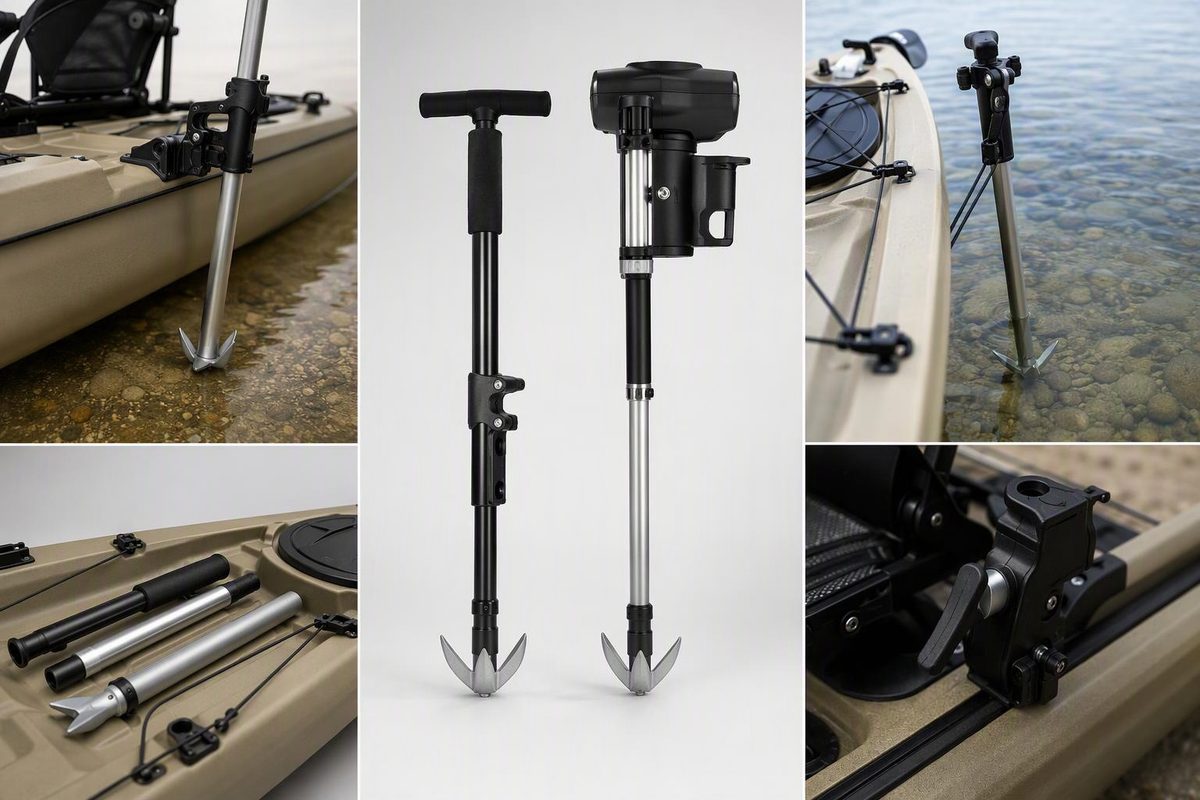
A shallow water anchor pole, also called a stake-out pole, is a useful choice for repeated kayak or small-boat fishing stops in sheltered shallows with penetrable sand or mud. Start with a manual pole for a kayak unless frequent deployment justifies a powered unit’s mounting, electrical and transport requirements. Choose by bottom suitability and usable reach—not advertised length alone. It is not a replacement for every anchoring situation. Louisiana Sportsman explains the setup and its limits.
Enter your water depth and length allowances to check the minimum vertical reach.
Vertical Pole Reach Check
Illustrative example: 5 + 1 + 1 = 7 ft.
Vertical reach only—not a holding guarantee. An angled pole needs more length.
Source: the article’s illustrative 5 + 1 + 1-foot calculation, not a manufacturer depth rating. Without JavaScript, the example remains visible; edits do not recalculate.
Bottom Suitability Comes Before Pole Length
A manual pole needs a bottom its tip can penetrate. Sand or mud is the usual application; exposed rock is not a dependable place to stake out. Very soft sediment also needs a holding test rather than an assumption that reaching the bottom is enough. Kayak Angler’s stake-out guide recommends finding soft bottom and testing the hold before tying off.
An 8-foot pole does not mean an 8-foot anchoring depth. Some length must enter the bottom, and some must remain above the water for handling or attachment. Angling the pole reduces its vertical reach further.
Minimum vertical pole length equals water depth plus bottom penetration plus the length needed above the surface.
For example, 5 feet of water, 1 foot of bottom penetration and 1 foot above the surface account for 7 feet of a vertical pole. This is an illustrative reach calculation, not a recommended penetration depth or guarantee of holding. Required penetration varies with sediment and load; the calculator cannot establish that allowance for your bottom.
Measure the deepest water where you actually plan to stop, including a rising tide where relevant. If your fishing spots are routinely deeper, consider a conventional anchor and suitable rode rather than carrying an increasingly awkward pole—but only where conditions permit safe anchoring. Our kayak anchor guide compares those options by depth, bottom and flow.
Manual Poles Simplify Setup; Powered Units Add Installation Requirements
| Option | Best Fit | Main Check |
|---|---|---|
| One-piece manual pole | Sheltered shallows; no battery | Full-length kayak and vehicle storage |
| Two-piece manual pole | Limited transport or storage space | Assembled length, joint security and packed fit |
| Powered spike driver | Frequent stops; less reaching | Loaded boat weight, mount, power and release |
Two manufacturer-listed manual examples show the storage trade-offs. These specifications were checked in October 2026:
- YakAttack ParkNPole 7′8″: a manual stake-out/push pole with a fiberglass body and nylon tip and foot. Its listed shaft diameter is 0.845 inches. Check holder fit and where the full length will sit without obstructing your paddle stroke or re-entry. YakAttack specifications.
- YakAttack ParkNPole Link: an 8-foot, two-piece pole listed at 1.8 pounds, with an optional extension bringing total length to 12 feet. Its useful distinction is easier transport—not proof that it can securely anchor in water as deep as its assembled length. YakAttack specifications.
For powered operation, Power-Pole recommends its Micro for boats up to 1,500 pounds total, including people, motor and gear. It uses 12-volt power and accommodates a ¾-inch spike; the spike and optional battery pack are sold separately. Its listed driver weight is 7.5 pounds without the clamp, so account for the complete installation, not just the pole. A kayak-oriented unit should not be assumed suitable for a heavier pontoon. Power-Pole Micro specifications.
Rig the Pole for a Release From Your Seat
A manual kayak setup needs secure travel storage, a suitable tether and a release that actually separates the kayak from the pole.
- Secure the pole for travel. Use compatible holders or deck restraints, keeping the pointed end and shaft clear of your normal movements.
- Stake beside the kayak. As a conservative default, do not push the pole through a scupper hole. Kayak Angler’s guide warns that this can damage the plastic or leave the pole stuck.
- Position the tether for alignment. An anchor trolley can move the attachment toward the bow or stern without requiring you to reach those ends. Keep the kayak aligned with the prevailing load rather than held broadside to it, and keep loose line out of your feet and cockpit.
- Test the hold and release in calm water. Use a release you can operate from the seat under load; do not rely on untying a tight knot in an emergency. Check that the tether can clear the trolley or attachment when released. Opening a cleat is not enough if another part remains trapped.
- Retrieve before moving. If the pole is stuck, do not lean far over the side or use it as a boarding handle. Release the tether rather than risk a capsize trying to recover it.
Cornish Kayak Angler’s anchoring guide explains alignment, trolley use and quick-release arrangements.
A trolley changes the attachment position, not the safety of the water. YakGear warns against deploying a trolley-mounted anchor in swift-moving water, even with a quick release. Wear your life jacket and avoid staking out in strong current or breaking waves. YakGear safety guidance.
The Micro Is Not Primary or Unattended Anchorage
For a powered Micro, follow its specific mounting, calibration and kayak quick-release instructions. Its manual explicitly says not to use it as primary anchorage or leave the boat unattended while held solely by it. High wind or rough seas may cause it to release holding pressure to protect the transom. Micro installation and owner’s guide.
If the bottom will not accept the pole—or conditions make fixing the kayak in place unsafe—move to a more suitable stopping spot rather than forcing the setup.