
A Practical Guide to Slowing Drift and Holding the Bow to Weather
Its submerged canopy creates drag against the surrounding water, but current can carry the boat and canopy together. Drogues and drift socks serve different jobs.
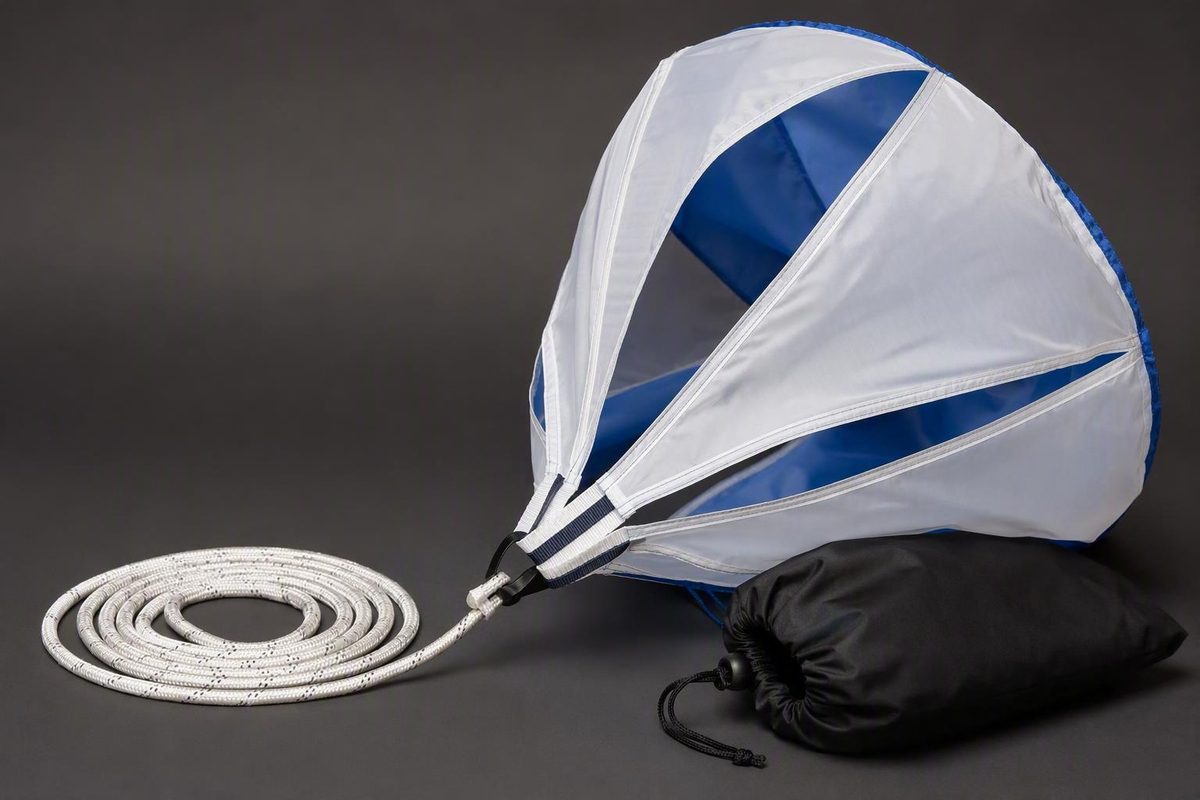
A para anchor is not a conventional anchor and does not fasten a boat to one place. It is a parachute-like device opened underwater to create drag. Usually streamed from the bow, it can reduce movement through the surrounding water and encourage the bow to face wind and waves.
That simple description hides a demanding system. The canopy must suit the vessel and intended use; the rode, connectors, deck fittings and hull structure must carry changing loads; the crew must manage long lines without becoming entangled; and recovery must be planned before deployment. Equipment intended for routine fishing drift is not automatically suitable for an offshore storm.
This is a research-based overview, not a report of hands-on testing or a vessel-specific engineering review. No generalized article can validate a boat’s fittings, determine safe operating limits or prescribe equipment for particular conditions. Current instructions for the exact product and qualified marine advice take priority.
What a para anchor is—and what it actually holds
“Para anchor” is an abbreviation of parachute sea anchor. You may also see para-anchor, parachute anchor or simply sea anchor. Those terms commonly overlap, although manufacturers, retailers and boaters do not use them with perfect consistency.
The device has a fabric canopy resembling a parachute. Once the mouth opens below the surface, the canopy presents a large area to the water. That resistance creates hydrodynamic drag, which loads the rode connecting the canopy to the boat. Unlike a conventional anchor, it does not dig into, hook or otherwise attach to the seabed—a distinction reflected in the general definition of a sea anchor as a water-drag device rather than ground tackle.
A para anchor therefore “holds” the boat relative to the surrounding water, not necessarily relative to the Earth. If wind is pushing the vessel through the water, the additional drag can reduce that movement. But if the entire water mass is moving in a tidal stream or ocean current, the boat and deployed canopy can travel with it. Drift may be reduced without the vessel remaining at a fixed latitude and longitude.
The usual arrangement places the load at the bow. As wind pushes the vessel away from the submerged canopy, the tensioned rode tends to pull the bow toward the device—and therefore toward the weather in a typical deployment. That is an intended tendency, not a promise of a perfect heading. Hull form, windage, superstructure, keel and rudder configuration, sail plan, bridle geometry and waves can all produce yawing or an offset angle.
The mechanics can be reduced to three linked ideas:
- Area creates drag. Water meeting the open canopy resists passing around or through it.
- The rode transmits that resistance. Force travels from the canopy through the lines and hardware to the vessel.
- Attachment geometry influences orientation. A bow attachment, single lead or bridle determines where and how that force acts on the hull.
Terminology guide
- Para anchor / para-anchor: Usually shorthand for a parachute sea anchor.
- Parachute anchor: A descriptive name for the same general canopy-style device.
- Sea anchor: Often an umbrella term for a bow-deployed water-drag device; it may also describe other shapes in older or product-specific terminology.
- Storm anchor: An informal label emphasizing heavy-weather use. It does not define a standardized design or rating.
- Drift anchor: A loose term that may mean a para anchor, drogue or fishing drift-control device.
- Drift sock: Commonly a smaller fabric device used to moderate drift while fishing, especially from small boats and kayaks.
- Drogue: Generally a stern-deployed drag device intended to slow the boat and support directional control rather than hold the bow toward the weather.
Because the vocabulary overlaps, identify a product by its deployment point, construction, intended use and system requirements—not its name alone.
Para anchor vs. seabed anchor, drogue and drift sock
The correct device depends on the job. “I need to slow down,” “I need to remain over a fishing area,” “I need to keep my bow toward the weather” and “I need ground tackle for an overnight anchorage” are different requirements.
| Device | Deployment point | Source of resistance | Primary objective | Typical orientation | Common context |
|---|---|---|---|---|---|
| Conventional seabed anchor | Usually bow | Mechanical engagement and holding in the seabed | Limit geographic movement within the anchor system’s scope | Bow generally faces the dominant load | Anchoring in suitable depth and bottom |
| Para anchor | Usually bow | Hydrodynamic drag from an open canopy | Substantially reduce movement through the water and influence bow-to-weather orientation | Bow toward the deployed device, with possible yaw | Open-water drift reduction, waiting, repairs or heavy-weather planning |
| Conventional drogue | Stern | Hydrodynamic drag | Slow the vessel and assist directional control | Stern toward the deployed device | Following seas, steering assistance or controlled drift |
| Jordan Series Drogue | Stern | Drag distributed across a series of small cones | Stern-first heavy-weather strategy using distributed drag | Stern toward the deployed series | Offshore storm planning |
| Fishing drift sock | Position varies by craft and objective | Hydrodynamic drag from a relatively small fabric sock | Moderate deliberate drift | Depends on tether point, wind and current | Angling from kayaks and small boats |
A seabed anchor needs appropriate depth, scope and bottom conditions. A para anchor operates in the water column and can be used where the bottom is too deep for practical ground tackle. The trade-off is that it cannot prevent the current from carrying the entire system toward a hazard.
A drogue is not simply a smaller para anchor. It is generally streamed astern so the vessel continues moving, but more slowly and with added directional resistance. A para anchor is generally deployed forward with the more ambitious objective of substantially arresting progress relative to the water and presenting the bow to the weather. A marine retailer’s overview similarly distinguishes a bow-deployed sea anchor from a stern-deployed drogue, although its instructions are commercial guidance rather than a vessel-specific engineering assessment.
Names can obscure these differences. Some sellers use sea anchor, drift anchor and drift sock broadly. Before buying, determine whether the item is designed for bow or stern deployment, its intended vessel range, whether it is for fishing or severe weather, and what lines and attachment structure it requires.
A kayak-fishing drift sock illustrates why context matters. It may be used with an adjustable tether or anchor trolley to slow a deliberate fishing drift and alter the kayak’s orientation. Retail guidance describes that general kayak drift-sock and trolley arrangement, but does not establish offshore suitability or provide validated procedures for capsize, entanglement or recovery. It should be treated as a small-craft fishing system, not a scaled-down offshore storm solution.
The Jordan Series Drogue is another distinct strategy. It is deployed from the stern and uses many cones distributed along a long line. It should not be ranked universally above or below a bow para anchor. The systems impose different orientations, handling requirements, load paths and recovery problems, and the available evidence does not include controlled, like-for-like trials that settle the question for every vessel.
When boaters use a para anchor
A para anchor may be considered when a crew wants to reduce unwanted drift through the water and influence the boat’s orientation. Commonly described situations include:
- Waiting for adverse weather to pass
- Reducing wind-driven drift
- Limiting movement toward shoals, a lee shore or another hazard
- Buying time after propulsion, steering or rigging trouble
- Holding a more workable orientation while repairs are attempted
- Resting or pausing an ocean-rowing passage when progress is impossible
- Moderating drift for some fishing operations
“Buying time” is the useful unifying idea. A para anchor may make drift slower or vessel motion more manageable, but it does not solve the underlying failure. The crew must continue monitoring position, direction of drift, traffic, weather, hazards, fittings and lines. Communications, navigation, propulsion alternatives, flotation equipment and assistance plans remain essential.
Ocean-rowing accounts provide bounded examples rather than proof of universal performance. One rower described using a para anchor when adverse wind made continued rowing impossible; that boat’s system used a 70-metre main line and a 100-metre crown-attached retrieval line. Those dimensions belong to that specific rowing boat and should not be copied without a separate assessment. The project’s description of the rowing boat’s para-anchor setup explains its intended drift reduction and crown-line recovery arrangement.
A separate account reports deployments after a rudder failure while two Pacific rowers awaited a tow and later when southerly winds threatened to carry them rapidly in the wrong direction. The account is reported in a professional-services article about the expedition and para-anchor development. These events demonstrate plausible uses, not general effectiveness or suitability for another vessel.
Similar terminology does not make the systems interchangeable.
Different craft, different behavior
Monohulls: A monohull may use a single bow attachment, a bridle or a specialized arrangement. Forward windage, keel profile, rudder position and remaining sails can influence yaw. A bridle may change the angle, but its dimensions and attachment points are design-specific.
Multihulls: Widely separated hulls provide two bow locations for a bridle. Manufacturer guidance commonly calls for a multihull bridle, but its strength, geometry and connection to the structure must suit the particular boat.
Powerboats: High cabins and superstructures can create substantial windage. The strength of bow fittings, backing structures and surrounding hull cannot be inferred from appearance. Their suitability for the proposed drag system must be verified.
Rowing craft: Ocean rowing boats may use para anchors to limit loss of progress or wait through adverse conditions. Their low mass, exposed deck arrangements and specialized fittings make direct comparison with yachts or trawlers unreliable.
Kayaks: Small drift devices can support routine fishing position control, but the supplied evidence does not establish safe kayak-specific rigging, capsize procedures or operating limits. Offshore para-anchor guidance should not be transplanted to a kayak.
A para anchor may be the wrong tool when the crew cannot deploy or recover it without unacceptable exposure; the attachment structure is unknown; lines could foul the keel, rudder, propeller or other appendages; available sea room is inadequate; or the product instructions do not support the proposed use. It is also unsuitable as a substitute for navigation, communications, propulsion, flotation, sound seamanship or a complete heavy-weather strategy.
Anatomy of a complete para-anchor system
The visible parachute is only the drag-producing part of the system. The complete arrangement extends from the canopy through every loaded component to the hull structure.
                         WIND / WAVES
                              ↓

                    BOW OF VESSEL
                 ┌─────────────────┐
                 │ backed strong   │
                 │ points or cleats│
                 └───┬─────────┬───┘
BRIDLE / optional; design-specific
/
                 [CHAFE PROTECTION]
                         │
                      SWIVEL            where specified
                         │
===================== MAIN RODE ===================== water
                         │
               weight/chain where specified
                         │
| /
CANOPY /
MOUTH / drag-producing opening
/
\____/
                         ▲
                    crown / apex
                         │
                     TRIP LINE
                         │
          ┌──────────────┴────────────────┐
          │                               │
     FULL TRIP LINE                  PARTIAL TRIP LINE
     returns to boat                 ends at recovery float
                                             ○

       A separate support float may be specified by some systems.
       Follow the exact product diagram for component placement.
Canopy
The canopy creates drag. Its mouth must open and remain in a useful orientation, while panels, seams, shroud lines and attachment hardware carry the load. Canopy diameter alone does not describe construction, strength or behavior.
Main rode
The rode transmits changing loads from the canopy to the vessel. Its material, diameter, construction, terminations, age and condition matter. Elasticity can moderate some load variation, but stretch does not cure weak fittings, poor leads or chafe.
Bow attachment and bridle
The rode may terminate at one strong point or connect through a bridle. A bridle can distribute force between attachment points and alter the angle at which the boat lies. Multihulls commonly use two-bow arrangements; monohull arrangements remain dependent on design and operating strategy.
Trip line
The trip line attaches to the rear, crown or apex of the canopy. Pulling from that point spills water and collapses the parachute, reducing resistance during recovery.
A full trip line returns to the vessel. A partial trip line terminates at a recovery float near the canopy. The first can permit direct control from aboard but adds another long line between boat and device. The second reduces the amount of trip line returning to the boat but requires retrieval of the float. The available evidence does not establish that either arrangement has a universally lower failure or entanglement rate.
Floats, swivel, weighting and chafe gear
A recovery float marks the end of a partial trip line; a support float may serve a separate function in systems that specify one. A swivel may reduce the transfer of rotation into the rode. Some designs specify weight or chain to help submerge and orient the canopy. Chafe protection shields loaded line where it passes through fairleads or over deck edges. The presence, position and dimensions of these components are product-specific.
The complete load path
Trace the force in order:
Canopy → shrouds and canopy hardware → rode → swivel or connectors → bridle or pendant → strong point → backing structure → hull
Every link matters. A correctly sized canopy cannot compensate for an unsuitable connector, damaged rode, sharp lead or inadequate structural attachment. Nor does a component’s breaking strength, on its own, establish a safe system working load under changing conditions.
Buying checklist
Before comparing prices, ask exactly what is included:
- Canopy and shroud lines
- Main rode
- Trip line
- Recovery and support floats, where specified
- Swivel and connectors
- Bridle or attachment pendants
- Deployment and stowage bags
- Weight or chain, if specified
- Chafe sleeves or guards
- Current instructions and sizing support
- Load information, inspection criteria and replacement guidance
Do not assume “para anchor package” means a complete, deployable system. In one specific example, the Fiorentino Offshore Para-Ring listing says the package includes a stowage bag, ring, swivel, weight arrangement and manual, while the anchor rode and trip line are sold separately. That is a product-specific example, not an industry-wide rule; the details appear in the Landfall Navigation retail listing.
How to approach canopy sizing, rode and attachment geometry
There is no universal canopy-size or rode-length formula supported by the available evidence. Boat length matters, but it is not enough.
Sizing inputs to collect
Before requesting a recommendation, document:
- Length overall
- Displacement in the intended operating condition
- Monohull, multihull, powerboat, rowing craft or paddle craft
- Hull and keel configuration
- Beam and draft
- Cabin, rig and other sources of windage
- Intended attachment points and bridle geometry
- Intended use: routine drift control, emergency waiting or severe weather
- Expected wind, wave and current context
- Available storage and handling capacity
- Crew strength, mobility and experience
- Recovery arrangement
- Propellers, rudders, foils and other potential fouling points
Larger canopies generally offer more drag-producing area, but “more” is not automatically “better.” A canopy the crew cannot control, attach or retrieve is not a sound choice merely because its diameter looks conservative.
A brand-specific sizing example
The following figures come from a Fiorentino-specific retail chart and apply only as an example of that seller’s published guidance. They are not a transferable engineering formula; the listing itself says selection should consider vessel design, weight, length, windage, beam, draft and use. See the retailer’s Fiorentino sizing chart and qualifications.
| Listed vessel weight and length | Listed Fiorentino canopy |
|---|---|
| 2,000 lb / 20 ft | 3 ft |
| 10,000 lb / 30 ft | 6 ft |
| 20,000 lb / 40 ft | 9 ft |
| 30,000 lb / 45 ft | 12 ft |
| 40,000 lb / 50 ft | 16 ft |
| 46,000 lb / 60 ft | 18 ft |
| 50,000 lb / 65 ft | 21 ft |
| Over 50,000 lb or over 65 ft | 24–40 ft |
Products with different canopy geometry, venting, materials, seams, shrouds or rigging may require different sizing. The figures above should not be used to select another manufacturer’s product.
Rode material and length
Nylon appears repeatedly in storm-use guidance because its stretch can moderate changing loads. That does not mean any nylon line is suitable. Diameter, construction, strength, age, wet behavior, terminations, connectors and compatibility with the device and vessel all require consideration.
A frequently repeated commercial rule of thumb is approximately 10 feet of rode per foot of vessel length, or about ten times boat length. It is not an engineering standard or a mandatory answer for every craft. Coppins’ manufacturer FAQ gives approximately ten times vessel length for storm conditions while also treating configuration as product- and vessel-specific; its para sea-anchor rigging guidance emphasizes strong attachment points, chafe control and prior recovery practice.
Published figures vary because the objectives vary. Fiorentino’s commercial material says some average trawlers and sailboats may deploy 300–600 feet, while sport-fishing deployments may use 20–100 feet; those are vendor examples rather than universal requirements, as shown in the company’s general para-anchor rigging material. The ocean rower described earlier used a 70-metre main line, again for one particular craft and setup.
Shorter deployments used for routine fishing involve a different objective and may produce different opening and loading behavior. Recommendations about chain percentages, intermediate weights, trip-line dimensions or tuning the system to waves must not be transferred between products without support from the exact manufacturer.
Before offshore reliance, obtain current sizing and rigging instructions for the chosen product. Ask the manufacturer to consider the vessel, attachment arrangement and intended use. Deck fittings, backing structures and the complete structural load path may also require assessment by an appropriately qualified marine professional.
Preparation and deployment principles
Deployment guidance should be treated as a sequence of safety principles, not as universal step-by-step operating instructions. The exact order, line leads, scope, snubbing method and crew positions must come from the current manual for the selected system and a vessel-specific plan.
Prepare before departure
Inventory and inspect the packed system before relying on it. Confirm that the canopy, rode, trip line, floats, connectors, bridle components, deployment bag and specified chafe gear are aboard. Understand how the bag opens, which component is intended to enter the water first and how the lines are packed.
Map the intended load path. Identify the prescribed lead, chafe locations and structural attachment points. The supplied evidence does not establish the working-load limit of a particular fitting, its backing structure or the surrounding hull, so suitability must not be inferred from appearance.
Rehearse deployment and recovery in moderate, controlled conditions before depending on the system in an emergency. Fiorentino’s manufacturer FAQ describes preparation, controlled payout, repeated snubbing and trip-line recovery, while also showing why the procedure must be matched to the system rather than copied blindly; see its commercial technical guidance.
Act before conditions become extreme
Late deployment can combine heavy wet gear, long moving lines, a pitching boat, poor visibility and tired crew. Manufacturer guidance commonly recommends preparing early and practising the full cycle in manageable conditions. “Early” cannot be reduced to a universal wind speed or wave height: the decision depends on the vessel, crew, sea room and product limits.
Control the crew and deck
A deployment plan should address:
- Personal flotation and other equipment appropriate to the conditions
- Securing loose equipment
- Clearly assigned roles
- Communication over wind, wave and engine noise
- Lines packed or arranged for controlled payout
- Crew positions outside loops, bights and the path of loaded line
- A method for stopping the operation if a bag, lead or line behaves unexpectedly
Fiorentino’s guidance specifically calls for flotation, secured equipment, keeping people and gear clear, and allowing the device to sink away from the vessel. Its detailed sequence is product guidance, not a universal procedure. Any line paying out rapidly or carrying load should be treated as a serious hazard; crew should not stand in a coil or wrap line around the body.
General deployment logic
Across the available commercial guidance, the broad logic is to place the canopy in the water clear of the vessel, allow it to submerge, pay out the rode under control, maintain useful order and tension while the canopy opens, and prevent loose line from accumulating around people or appendages. Repeated controlled snubbing appears in some vendor and retailer procedures, but the evidence does not establish a universal timing, force, speed or payout length.
The system is intended ultimately to load from the bow, but that does not mean crew must always work on an exposed foredeck. Some products describe pre-rigged leads or cockpit handling; others use different arrangements. Work location and line routing must follow the exact system instructions and the boat’s verified layout.
The supplied evidence does not establish attachment-point strength, safe working-load limits, deployment thresholds or emergency operating limits for an individual boat. Those questions require product-specific information and, where appropriate, professional structural assessment.
Monitoring, recovery and the main failure risks
Deployment is the beginning of the operating period, not the end. While the para anchor is in the water, monitor:
- Geographic position and distance from hazards
- Drift rate and direction
- Heading, yaw and changes in vessel motion
- Weather and sea-state development
- Traffic and visibility
- Rode tension and visible condition
- Chafe points and line leads
- Strong points, connectors and surrounding structure
- Trip-line and float positions
- Signs that the canopy has failed to open, collapsed or is behaving irregularly
A reduced drift rate can still carry the boat into danger. Allow for the water mass itself to move, and do not let apparent stability replace a navigation watch.
Recovery principle
The usual recovery principle is to reduce or remove the main load as directed by the product instructions, obtain the trip line, pull from the canopy’s rear or apex, spill the trapped water and collapse the canopy. The deflated fabric and lines can then be recovered with less resistance.
Do not base a recovery plan on hauling a fully open, heavily loaded canopy solely by its main rode. Coppins’ manufacturer FAQ describes slackening the main rode and using a recovery float and trip line rather than trying to retrieve the deployed canopy by the loaded rode; the exact sequence remains system-specific.
Risk table
Commercial manufacturer guidance identifies line organization, chafe control, strong attachment points, opening behavior and trip-line recovery as recurring concerns. Separately, cruising author John Harries identifies bow exposure, yawing, difficult retrieval, shock loading and rode failure as reasons he rejected a large bow sea anchor for his own boat. His critique of large bow-deployed sea anchors is experience and judgment rather than a controlled comparison.
| Risk | What may happen | Planning response |
|---|---|---|
| Entanglement | A person, clothing or equipment enters a loop or bight | Organize lines, assign handlers and keep crew outside the payout and load paths |
| Rode or trip-line fouling | Line catches the keel, rudder, propeller, foil or another line | Plan leads, control unnecessary slack and monitor line position |
| Chafe | Loaded line wears at a fairlead, edge or fitting | Identify contact points and use the protection specified for the system |
| Inadequate attachment | A fitting, deck area or backing structure deforms or fails | Verify the complete structural load path before reliance |
| Shock loading | Sudden tension changes load lines, connectors and the hull | Use the specified rode and geometry; do not improvise snubbing methods |
| Excessive yaw | The boat sails from side to side, changing load direction | Evaluate windage, bridle geometry and vessel configuration |
| Canopy fails to open | Drag is much lower than expected | Follow the product’s troubleshooting instructions without entering loose-line zones |
| Canopy collapses | Drag changes abruptly and the rode cycles between slack and load | Monitor behavior and use the product-specific response |
| Difficult recovery | Crew cannot collapse or haul the system safely | Plan the trip line, recovery lead and crew roles before deployment |
Keeping lines organized and maintaining the tension specified by the manufacturer may reduce fouling, but the correct tension is not universal. Excessive load can be as problematic as uncontrolled slack.
The available evidence does not establish a validated procedure for a canopy or line fouled around a keel, rudder or propeller. Do not improvise close to loaded lines or enter hazardous water to clear the system. The appropriate response depends on conditions, vessel control, available assistance and the manufacturer’s emergency guidance.
After-use checklist
Once the system has been safely recovered:
- Inspect the canopy, seams, shrouds, rode, trip line, connectors and chafe gear for visible damage.
- Check areas that contacted fairleads, deck edges or hardware.
- Dry, organize and repack the equipment according to the current manufacturer’s instructions.
- Replace or obtain professional assessment of components that appear damaged, heavily chafed, contaminated or otherwise questionable.
- Record deployment, monitoring and recovery problems so packing, leads and crew roles can be reviewed.
The available evidence does not establish a universal inspection interval or service life. Ask the manufacturer for current inspection, repair and retirement criteria for the exact product rather than inventing a schedule.
What the evidence can—and cannot—tell you
The fundamental concept is consistent across the sources: a para anchor creates drag in the water, is usually deployed from the bow and commonly uses a trip line to collapse the canopy for recovery. Sources also repeatedly identify the rode, suitable attachment points, chafe protection, floats and optional bridles or swivels as parts of the wider system.
Confidence should decrease as claims become more specific. Much of the detailed material on sizing, deployment and performance comes from manufacturers or retailers selling the equipment. Manufacturers may know their own designs best, but their recommendations remain product-specific commercial guidance rather than independent proof of general performance. Some available material is also old enough that current instructions should be obtained directly before use.
Claim audit
Operating concepts supported across multiple sources
- An underwater canopy creates hydrodynamic drag.
- A para anchor does not grip the seabed.
- Bow attachment is generally intended to influence bow-to-weather orientation.
- A stern drogue has a different objective and operating geometry.
- A trip line can spill water and collapse the canopy for retrieval.
- Sizing depends on more than boat length.
- Load-path strength, chafe control, organized lines and prior practice matter.
Claims not independently established by the available evidence
- A para anchor eliminates broaching, capsize or rolling.
- A proprietary component guarantees that the canopy cannot collapse.
- A product supplies adequate holding power in every storm.
- One canopy chart or rode formula works across all brands and vessels.
- One system is categorically safer or more effective than every drogue.
- A successful expedition deployment predicts the outcome on another boat.
- General instructions establish safe thresholds or working-load limits.
Product pages may make strong statements about storm performance. For example, one Ocean Safety listing describes reinforced construction, a sinking chain and a separate retrieval line, but its anti-broaching and anti-capsize language is marketing rather than independent test evidence. That distinction is visible on the Ocean Safety para-anchor product page.
Expedition accounts and survival stories matter as illustrations. They show that crews have used para anchors while waiting, resting or responding to failures. They do not establish average drift reduction, opening reliability, peak loads, failure rates or suitability for another hull.
The para-anchor-versus-Jordan-Series-Drogue debate is similarly unresolved by the supplied evidence. A bow system and a stern series drogue expose the vessel and crew to different orientations, handling tasks, yaw behavior and retrieval demands. Individual authors and manufacturers express strong preferences, but there are no controlled, like-for-like comparisons here across defined boats and storm conditions.
Before purchase or offshore reliance, take these questions to the manufacturer and, where appropriate, a qualified marine professional:
- What canopy is specified for the vessel, attachment arrangement and intended use?
- What are the working-load limits of the canopy, rode, bridle, connectors and swivels?
- What loads should the deck fittings and backing structure be designed to carry?
- What conditions or vessel behaviors define the product’s operating limits?
- What is the approved response to failure to open, collapse or fouling?
- How should the system be inspected after use?
- What damage requires retirement rather than repair?
- Are there age, storage or replacement criteria?
- Which components are included, and which must be sourced separately?
- Has any claimed performance been independently measured or load-tested?
A sound decision process is straightforward:
- Define the objective. Routine fishing drift control, emergency waiting and offshore heavy-weather use are not interchangeable.
- Describe the vessel and anticipated conditions. Include displacement, windage, appendages and crew capability.
- Map the complete load path. Start at the canopy and end in the hull structure.
- Verify the package contents. Account for lines, floats, connectors, bridles, bags and chafe gear.
- Read the current instructions. Do not rely on an old article or another boat’s setup.
- Plan recovery before deployment. Include trip-line handling, work location and possible fouling.
- Practise the full cycle. Deploy, monitor, recover, inspect, dry and repack in manageable conditions.
- Reject unsupported guarantees. No canopy, ring, rode or anecdote removes all risk.
Frequently asked questions
Is a para anchor the same as a sea anchor?
Usually, yes. Para anchor, para-anchor, parachute anchor and parachute sea anchor commonly describe the same general bow-deployed, parachute-like drag device. However, sea anchor is sometimes used more broadly for other water-drag devices, while small-craft sellers may apply it to drift socks. Check the product’s design and intended deployment rather than relying on the label.
Does a para anchor stop a boat from moving?
Not necessarily. It is intended to reduce movement through the surrounding water, sometimes substantially. It does not attach to the seabed, and the water containing both boat and canopy may itself be moving. Wind, waves and current can therefore continue to move the system geographically.
How much rode should a para anchor have?
There is no universal length. Approximately ten times vessel length is a recurring commercial rule of thumb for some storm applications, not an engineering standard. The correct rode depends on the product, vessel, intended use, conditions, attachment geometry and line properties. Obtain current guidance for the exact canopy and assess the complete load path.
Can a para anchor be used on a kayak?
Small drift socks or devices called sea anchors are used on kayaks, particularly to moderate fishing drift. That does not establish that an offshore para anchor or offshore rigging guidance is appropriate for a kayak. The supplied evidence does not provide validated kayak procedures for attachment, capsize, entanglement or recovery, so paddlers need guidance specific to the kayak and device.
Is a para anchor better than a drogue for heavy weather?
Not universally. A para anchor is generally deployed from the bow to reduce drift and encourage a bow-to-weather orientation. A conventional or series drogue is generally deployed from the stern to slow the vessel and support stern-to-sea directional control. The better strategy depends on vessel design, expected conditions, load paths, crew exposure, handling and recovery. The available evidence does not justify declaring either approach superior for every boat.
Conclusion
A para anchor is a water-drag system—not a portable substitute for a seabed anchor and not simply another name for every drogue or drift sock. It may reduce drift and influence vessel orientation, but the canopy is only one part of a safety-critical arrangement.
Define the intended use, obtain product- and vessel-specific sizing guidance, verify every component and attachment in the load path, and plan recovery before deployment. Practise the complete cycle in manageable conditions before relying on the equipment. No general guide can validate a particular boat’s fittings, prescribe storm scope or guarantee protection from broaching, capsize, equipment failure or injury.