
Choose a Kayak Paddle Holder That Fits Your Boat—and Your Reach
Compare track-mounted holders, fixed clips and cockpit-rim options, then check paddle fit, mounting clearance and safe access before buying.
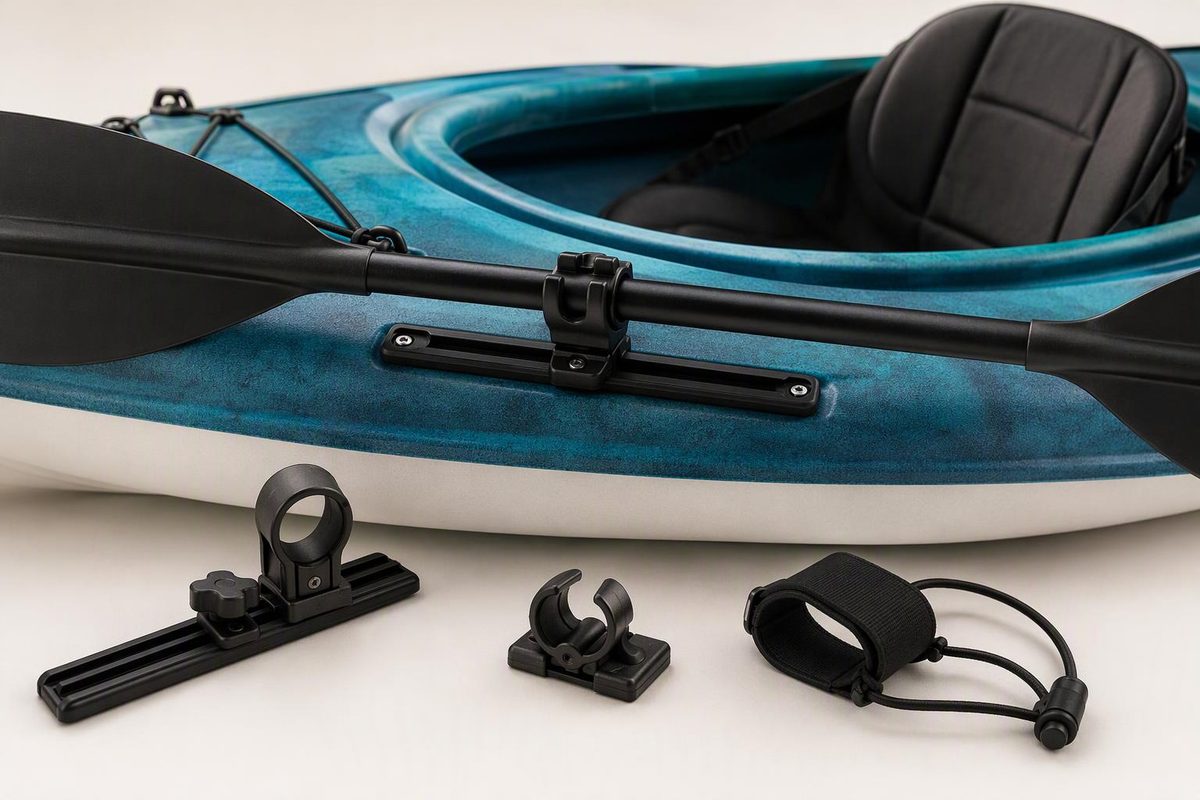
A kayak paddle holder gives you somewhere to park the paddle while fishing, taking a drink or sorting gear. Choose the mounting method first, then check shaft fit and seated reach. A firm grip is useful only if you can release the paddle promptly without leaning awkwardly over the side.
For a kayak with an existing accessory track, start with a repositionable track-mounted holder. Without a track, consider a fixed clip on a manufacturer-approved mounting surface or a removable cockpit-rim clip. Check any holder already fitted to the boat before adding another.
Which type fits your kayak?
These are examples of different mounting approaches, not a tested ranking.
| Holder type | When to consider it | Main check before buying |
|---|---|---|
| Track-mounted roller holder | You already have a suitably placed accessory track and want adjustable positioning | Exact track compatibility, adapters and clearance |
| Fixed rubber clip | You want a dedicated parking position on a rigid kayak | Approved mounting location, fasteners and shaft fit |
| Removable cockpit-rim clip | You paddle a sit-inside kayak without a spray skirt and want a no-drill option | Rim fit and whether it obstructs entry or exit |
Track-mounted example: YakAttack RotoGrip. It holds the shaft between two soft rollers and attaches using YakAttack’s Mighty Bolt. The manufacturer lists a height of 2.25 inches, compatibility with its MightyMount and GearTrac systems and most tracks from Scotty, RAM and YakGear. It specifies an adapter for FeelFree, 3 Water Kayaks and Jonny Boats. Holders are sold individually; the track is not included. Check your exact setup rather than assuming every track accepts the same hardware. YakAttack specifications
Fixed-clip example: YakGear Molded Paddle Clip Kit. This kit contains two rubber clips intended to work together in line on one paddle or mud anchor. Stainless installation hardware is included; YakGear recommends waterproof silicone, which is not included. The clips come in two sizes. The listing labels the larger version’s shaft-fit range as “circumference”; confirm the intended measurement and correct version with YakGear before ordering. YakGear kit details
Cockpit-rim example: Yakclips. NRS describes a plastic clip that attaches directly to the cockpit coaming—the raised rim—with no tools. Its important limitation is explicit: it will not attach while a spray skirt is fitted. That makes it an option for recreational use without a skirt, not a universal sit-inside solution. NRS product details
For an inflatable or folding kayak, use the boat maker’s approved accessory system or seek approval for a suitable mount. Do not drill an inflatable chamber or assume a rigid-kayak fastener kit is suitable for a flexible hull.
Check fit before installing
Measure the shaft where the holder will actually grip—not at a wider joint, drip ring or padded grip. For an oval or bent shaft, check both the cross-section and whether there is a suitable straight section.
Then dry-fit the complete paddle with the kayak supported securely ashore:
- Reach: Can you park and retrieve it from your normal seated position, wearing your usual PFD and paddling gloves?
- Stroke clearance: With the paddle released, do your hands or shaft hit the holder during a normal stroke?
- Blade position: When parked, are both blades clear of the water and unlikely to catch the dock or shoreline?
- Access: Does the paddle block a hatch, pedal drive, rod holder or your route into and out of the cockpit?
- Retention: Does the shaft stay seated when gently bumped, without requiring an awkward pull to release it?
For fixed mounts, follow both the holder instructions and the kayak manufacturer’s guidance on location, fasteners and sealing. Check what lies behind the mounting surface before making holes. For track mounts, check that tightening the holder actually locks it in place.
A holder is not a leash
Do not treat a friction clip as guaranteed paddle retention during a capsize, or as a road-transport tie-down. Remove or separately secure the paddle before transporting the kayak.
A paddle leash serves a different purpose: it tethers the paddle rather than parking it. It also introduces a line that can entangle. NRS specifically warns that its Coil Paddle Leash is not intended for whitewater because of possible entanglement in swift water. Do not use that leash for whitewater or assume another leash is suitable without checking its intended use. NRS safety warning
After installation, test parking and retrieval on sheltered, calm water while wearing a PFD. Keep the paddle in hand when conditions demand immediate control; the holder is for pauses, not active maneuvering.