
Three Reliable Ways to Check Your Lenses for Polarization
A full blackout isn't needed. Substantial darkening that repeats at the same angle is persuasive; a slight color shift alone is inconclusive.
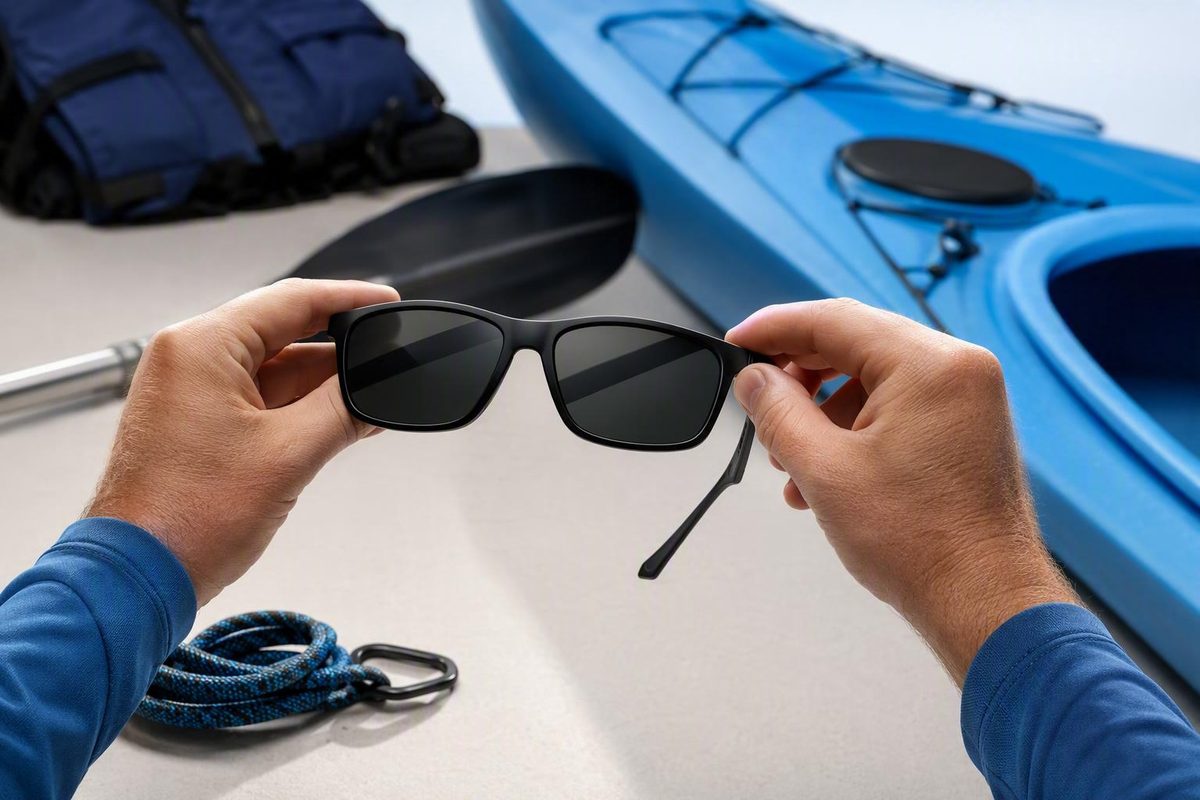
The quick answer: rotate the lenses and look for a major change
This screen-rotation procedure is a widely used practical check for polarization (BLUPOND).
A large, repeatable change in brightness—especially substantial darkening or a nearly black screen at one orientation—strongly suggests that the lens is polarized. Complete blackout is not required. The result can vary with the display, device orientation, viewing angle, and alignment of the sunglasses.
Use this quick procedure:
- Open a bright white page and raise the screen brightness.
- Hold the sunglasses horizontally, as they would normally sit on your face.
- Look through one lens.
- Slowly rotate the glasses toward a quarter-turn.
- Watch for pronounced darkening at a particular angle.
- Return to the starting position and repeat the movement.
A slight color shift, faint dimming, or change that you cannot reproduce is inconclusive. It is not enough by itself to establish polarization.
Likewise, no change on one device does not prove that the lenses are non-polarized. Change the device orientation, test each lens separately, and try another display. If the result remains unclear, check reflected glare or compare the lenses with a pair already known to be polarized.
All three methods in this guide are practical indicators. They can show that sunglasses are likely polarized, but they do not formally certify the lenses.
Test 1: Use a phone, tablet, or computer screen
The screen test is usually the most convenient because it requires no special equipment. It works when the display and the sunglasses both filter light according to orientation. As one filter rotates relative to the other, substantially less light may pass through.
Step-by-step screen test
-
Prepare a bright screen. Open a blank document, white webpage, settings menu, or another mostly white image. Raise the brightness enough that changes are easy to see.
-
Hold the sunglasses normally. Position them horizontally, as they would sit on your face. Keep the lenses a comfortable distance from the screen.
-
Test one lens at a time. Close one eye or position the frame so that you are looking through only the left lens. This prevents the other lens and the frame from complicating the result.
-
Rotate slowly. Turn the sunglasses from their normal horizontal position toward approximately 90 degrees. You can instead hold the glasses still and rotate a phone or tablet (BLUPOND).
-
Watch throughout the movement. Do not judge the lenses from a single glance. Look for a brightness change that appears at a particular orientation and reverses when you rotate the glasses back.
-
Repeat and switch lenses. Rotate the glasses back and forth, then perform the same check through the other lens.
A strong positive result is a dramatic, angle-dependent change: the display becomes much darker, nearly black, or difficult to read at one orientation, then becomes visible again as the lens rotates back.
Complete blackout is not necessary. Substantial darkening that occurs consistently at the same part of the rotation is persuasive evidence that the lens is polarized.
What counts as an inconclusive result?
Treat the result as unclear if you see only:
- A slight change in brightness
- A mild color cast
- Dimming that occurs once but cannot be reproduced
- A change that appears similar regardless of lens orientation
- A change caused by moving closer to or farther from the display rather than rotating the lens
Some displays produce a clearer effect than others, and viewing angle matters. If the first attempt does not work, rotate the device itself before repeating the test. With a phone or tablet, try both portrait and landscape orientations. Then try another phone, laptop, or desktop display.
Do not assume that every LCD, LED, OLED, television, monitor, or mobile device will produce an equally clear result. No obvious change means that particular attempt was unsuccessful; it does not settle whether the sunglasses are polarized.
Why the screen changes
A compatible digital display emits or filters light in a particular orientation. Polarized sunglasses also filter light according to orientation. When the two filtering directions become crossed, much more of the display’s light is blocked. When they are aligned differently, more light reaches your eyes. OU Health describes this interaction and notes that rotating a display can change its visibility through polarized lenses (OU Health).
The same interaction explains why polarized sunglasses can make some phones, digital watches, GPS units, dashboards, ATMs, instrument panels, and other displays appear unusually dark, distorted, or difficult to read. That effect can help identify polarization, but it may also be inconvenient when equipment must remain clearly visible.
Test 2: Check reflected glare while safely stationary
You can also check for likely polarization by observing a strong reflection. Suitable examples include glare from:
- Water
- A glass table or window
- Bright pavement
- A shiny tabletop
- The hood of a parked car
- Another smooth, reflective surface
Choose a clearly visible reflection in bright conditions. Weak, scattered, or diffuse light makes this test harder to interpret.
Remain stationary throughout the test. Do not rotate glasses or tilt your head to test them while driving, piloting a boat, paddling in active conditions, or operating machinery. Move to a safe, stable location and give the test your full attention.
Step-by-step glare test
- Stand or sit where you can see a distinct patch of reflected glare.
- Put on the sunglasses or hold them in front of your eyes.
- Look at the reflection without looking directly at the sun.
- Slowly tilt your head or rotate the glasses through approximately 60 to 90 degrees.
- Observe whether the glare changes substantially at a particular orientation.
- Return to the original position and repeat the movement.
A substantial, repeatable change in the reflection suggests polarization. The glare may fade, become much less intense, or stop obscuring details at one lens orientation.
Polarized lenses are intended to reduce reflected glare rather than merely darken the entire scene uniformly. The American Academy of Ophthalmology explains that smooth surfaces can direct reflected light toward the eyes and that polarized lenses filter this glare (American Academy of Ophthalmology).
For a water-based test, stand safely on shore or use another stable location. Look at a bright surface reflection. If changing the lens orientation greatly reduces the glare or allows you to see more beneath the reflection, that supports a finding of polarization.
Why this test is less conclusive
The glare test depends heavily on conditions. Reflection strength and direction change with the surface, weather, sun position, and viewing angle. You are also making a subjective visual judgment rather than observing the more obvious crossed-filter effect that a compatible screen or confirmed polarized pair can produce.
Ordinary tinted sunglasses can make the entire view darker, which may initially resemble glare reduction. The better clue is not simply that everything looks dimmer. It is that the reflected glare changes disproportionately and repeatedly as the lenses rotate.
If the glare remains unchanged in overcast weather, shade, low light, rippled water, or other diffuse conditions, do not rule out polarization. Repeat the test with a stronger reflection or use the screen or known-pair method.
Test 3: Compare the lenses with a known polarized pair
A second pair of sunglasses can serve as a reference filter—but only if you already know that the reference pair is polarized. Comparing two uncertain pairs merely transfers the original uncertainty to the test.
Step-by-step comparison test
- Find a reference pair whose polarized status has been confirmed through credible product documentation or professional verification.
- Hold one lens from the unknown pair in front of one lens from the reference pair so that the lenses overlap.
- Look through the overlapping area toward a bright but safe background, such as a white wall, bright window area, or illuminated screen.
- Keep the reference pair still.
- Slowly rotate the unknown pair toward approximately 90 degrees.
- Watch the overlapping area as the lenses move from a similar orientation to a crossed orientation.
- Rotate the unknown pair back and repeat.
- Test the other unknown lens in the same way.
If the overlapping area becomes very dark at the crossed orientation and brightens again when you rotate back, both lenses are likely polarized. The overlap does not need to become completely black. The important signal is a strong, repeatable change tied to the angle between the lenses. Total Vision describes this known-pair comparison and its pronounced darkening effect (Total Vision).
The principle is straightforward: one polarizing filter restricts light in one direction, and the second restricts it again. When their filtering directions are crossed, the combination blocks far more light.
This can be a strong home cross-check, but it is only as reliable as the reference pair. A memory that a pair “should be polarized” is weaker than credible documentation or professional verification.
Test both lenses of the unknown pair. If one behaves differently or you see irregular or patchy darkening, repeat the test carefully. Do not use the result to diagnose damage, uneven construction, or another specific problem; the home test does not establish the cause.
How to interpret blackouts, dimming, color shifts, and conflicting results
The strength, repeatability, and angle dependence of the change matter more than whether the display becomes perfectly black.
| Result | Practical interpretation | Next step |
|---|---|---|
| Near-blackout | Persuasive evidence that the lens is likely polarized | Repeat the test and check the other lens |
| Strong dimming | Also persuasive when tied to orientation and reversed by rotating back | Cross-check if certainty matters |
| Slight brightness or color change | Inconclusive because displays and viewing conditions can create weak effects | Change orientation or use another method |
| No change on one display | That test produced no useful evidence | Try another orientation, display, or method |
| Tests disagree | Conditions, the display, the reference pair, or subjective glare judgment may be limiting the result | Repeat carefully or seek professional verification |
Near-blackout
A display or overlapping lens area that becomes nearly black at one orientation and brightens again when rotated back provides strong evidence of polarization. Reversibility matters: a view that remains equally dark throughout the movement may simply reflect a heavy tint.
Strong dimming
Strong dimming can be as useful as near-blackout. Different displays and viewing angles produce different degrees of change, so there is no need to demand complete darkness. Look for a large effect that repeatedly appears at approximately the same orientation.
Slight change
Minor dimming or a subtle shift to blue, green, or another color is not enough to establish polarization. Reposition yourself, clean the lenses and screen if necessary, and repeat the movement. If the change remains weak, classify the result as inconclusive.
No change on one display
First, change the phone or tablet from portrait to landscape orientation. Return the glasses to their normal position and repeat the slow rotation. Then try another device.
A phone may produce an unclear result while a laptop or desktop monitor shows an obvious change, or vice versa. If several displays remain unhelpful, move to the reflected-glare test or compare the sunglasses with a confirmed polarized pair.
Disagreement among tests
Give more weight to a large, repeatable, orientation-dependent change than to a subjective impression that glare looks slightly weaker. A strong crossed-lens result is generally easier to interpret than a glare test performed under weak or diffuse lighting.
If several careful methods remain weak or contradictory, ask an optician or optometrist to verify the lenses. Eye-care guidance recommends professional testing when home checks remain uncertain (Prairie Vision).
Even a clear positive home result has limits. These methods do not certify:
- Overall optical quality
- Uniformity across the lens
- Durability
- Ultraviolet transmission or protection
Do not infer a specific defect from patchy darkening or different behavior between the left and right lenses. The home tests cannot establish the cause.
What does not prove that sunglasses are polarized
Several visible characteristics are commonly mistaken for evidence of polarization. None is sufficient by itself.
Dark lenses
Lens darkness primarily tells you how dim the overall view appears. Very dark sunglasses can be non-polarized, while lighter-looking lenses can be polarized. A uniformly darker scene is not the same as an orientation-dependent reduction in reflected glare.
Lens color
Color may affect the appearance of the view, but it does not establish whether the lens filters reflected light according to orientation.
A mirrored finish
A reflective exterior coating is visually obvious, but it does not prove that a polarizing filter is present. A mirrored pair may be polarized or non-polarized.
Apparent clarity or vivid color
A scene that looks sharper, cleaner, or more colorful may influence your preference for a pair, but it is not a dependable polarization test.
Price and brand reputation are not substitutes for a screen, glare, or known-pair test either.
A polarized label
Check the frame, sticker, packaging, receipt, and product documentation for the word “polarized.” A label is a useful preliminary check, but reading it is not an independent test of lens performance.
If polarization matters for a particular activity, follow the label check with the screen test or another cross-check.
A prescription
Prescription correction and polarization perform different jobs. A prescription changes how light is focused to correct vision, while polarization filters reflected glare according to orientation.
The same caution applies to mirrored, gradient, and photochromic appearances: do not decide whether a lens is polarized merely by looking at another treatment or finish.
Polarized does not mean UV-protective
Polarization and ultraviolet protection are separate lens features:
- Polarization is intended to reduce reflected glare.
- UV protection concerns how much ultraviolet radiation the lenses block.
A pair can be polarized without providing the UV protection you expect. Conversely, non-polarized sunglasses can provide UV protection when that protection is built into the product. The American Academy of Ophthalmology distinguishes glare control from UV blocking and advises checking sunglass features separately (American Academy of Ophthalmology).
After checking for polarization, inspect credible labeling or original product documentation separately for UV400 or 100% UVA and UVB protection. None of the three home polarization tests—the screen test, glare test, or crossed-lens test—measures UV transmission. Eye-care guidance likewise recommends confirming ultraviolet protection independently of polarization (ReFocus Eye Doctors).
Do not guess from lens darkness. If the original packaging and documentation are unavailable, ask an optician or optometrist whether the lenses can be checked rather than assuming that a positive polarization test also confirms UV protection.
Polarized lenses can be useful around water because reducing surface glare may reveal details otherwise hidden by reflections. That does not prove UV protection or make polarized sunglasses universally suitable for every activity.
Practical limitations include:
- Some phones, watches, navigation units, dashboards, ATMs, and instrument displays may become dark or difficult to read.
- Polarized lenses may make certain icy patches harder to distinguish.
- Polarized sunglasses are not recommended for night driving.
These icy-surface and night-driving limitations are noted in professional eye-care guidance and should be considered separately from daytime glare reduction.
Polarized sunglasses are also not safe for looking directly at the sun. Polarization is a glare-control feature, not protection for direct solar viewing (Sunski).
Frequently asked questions
Does the screen need to turn completely black for the sunglasses to be polarized?
No. Complete blackout is not required. A substantial, repeatable reduction in brightness at a particular orientation is persuasive evidence that the lenses are likely polarized.
Treat near-blackout and strong dimming as positive indications. Treat a slight color or brightness shift as inconclusive.
What should I do if my phone screen does not change at any angle?
Change the phone from portrait to landscape orientation, return the glasses to their normal horizontal position, and repeat the slow rotation. Test each lens separately.
If there is still no clear change, try a tablet, laptop, or desktop display. Then use strong reflected glare while safely stationary or compare the lenses with a confirmed polarized pair. No change on one phone does not prove that the sunglasses are non-polarized.
Can dark or mirrored sunglasses still be non-polarized?
Yes. Darkness, color, and mirrored appearance do not independently establish polarization. Ordinary tinted lenses can reduce overall brightness without selectively reducing reflected glare.
Look for a major orientation-dependent change during a screen, glare, or known-pair test instead.
Do polarized sunglasses automatically provide UV400 protection?
No. Polarization and UV protection are independent properties. A positive polarization test does not verify UV400 performance or confirm complete UVA and UVB protection.
Check credible packaging, labeling, or documentation separately. If those materials are unavailable and UV protection is important, ask an optician or optometrist rather than inferring it from tint or polarization.
Who can confirm whether my sunglasses are polarized if the home tests disagree?
An optician or optometrist can examine or test the lenses when the results remain unclear. Bring the sunglasses and any original packaging, receipt, or product documentation you still have.
Ask separately about polarization and UV protection because they are different lens features.
The final decision path
Start by checking the label, then perform the screen-rotation test. If the result is weak or unclear, cross-check it with reflected glare while safely stationary or compare the lenses with a confirmed polarized pair. If the methods conflict, consult an optician or optometrist.
A strong, repeatable, orientation-dependent change means the lenses are likely polarized. It does not certify their quality, durability, uniformity, or UV performance. Verify UV400 or 100% UVA and UVB protection separately.